Overview
The policy goals of the Made in China 2025 (MIC25) plan have increased development in Shenzhen High-Tech Industrial Park's dominant industries. From 2015 to 2022, imagery analysis showed increased activity and construction, much of which promoted MIC25's core industries.
The majority of this development occurred in the communications, computer hardware, and wireless technology sectors, with some development in biomedical technology. Our findings suggest that Shenzhen High-Tech Industrial park is successfully promoting pre-existing advanced industries, but not new industries.
Activity
This Tearline article from William & Mary's geoLab is one in a series of three reports analyzing China's Made in China 2025 (MIC25) policy's impacts on Chinese industrial parks. This report examines the Shenzhen High-Tech Industrial Park using radar imagery, electro-optical imagery, and text-based data. In addition to the MIC25-connection thesis, this report serves as a baseline on the history, composition, and expansion of the zone.
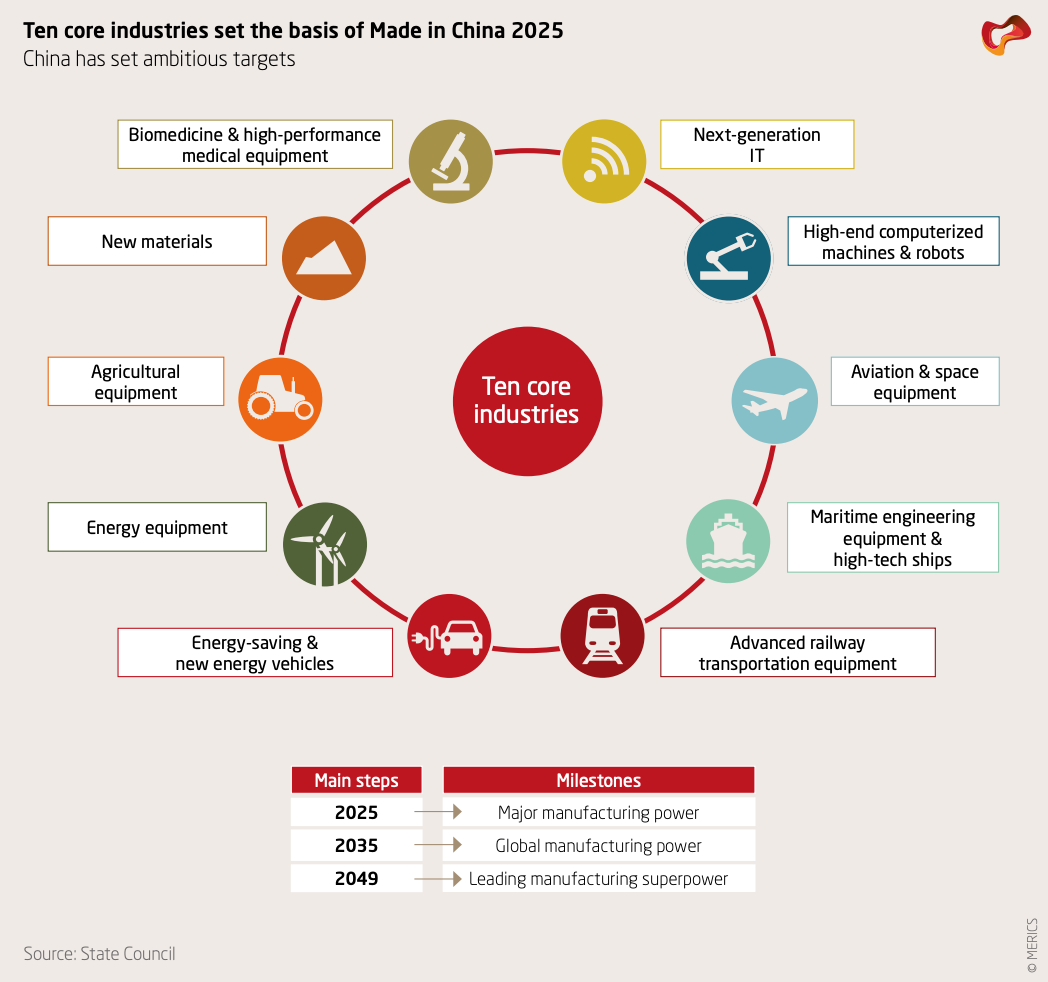
In 2015, the Chinese government implemented the Made in China 2025 (MIC25) policy, which aims to make China self-sufficient by promoting technical innovation and developing the key industries outlined in Figure 1. It uses incentives like favorable taxes or research subsidies alongside mandates like forced joint ventures to promote these industries. For more information about MIC25, see part one of our study.
The Chinese government created Shenzhen High-Tech Industrial Park in 1997 and has continued to develop it under the MIC25 policy. Special policies have been implemented in the industrial park with the intention of promoting investment and development in the key industries outlined by the MIC25 policy.
This report aims to determine the extent to which MIC25 successfully promoted high-tech industries in Shenzhen High-Tech Industrial Park. Our previous report examined an industrial park in Beijing, and a simultaneous report examines one in Shanghai. These case studies can be used as bellwethers for the overall success of the MIC25 policy.
Using satellite imagery from 2015 to the present alongside mapping data and press reporting, we determined what physical construction has occurred and what types of companies have appeared in Shenzhen High-Tech Industrial Park. We find that, since 2015, significant expansion has taken place in the park's communications, computer hardware, and wireless technology sectors, with some expansion occurring in the biomedical sector.
Methodology
Our team, based out of the geoLab at William & Mary, used satellite imagery and publicly available web pages to determine how MIC25 has affected Shenzhen High-Tech Industrial Park. Public web sources such as Chinese government material for policy information, online company profiles of businesses in the park, mapping services, and press reporting were used to determine the park's intended function and details on government policies. Information from these sources supplemented our analysis of trends and physical developments by providing details that were not visible from overhead imagery analysis. This information also helped inform the analysis we conducted using geographic information systems (GIS).
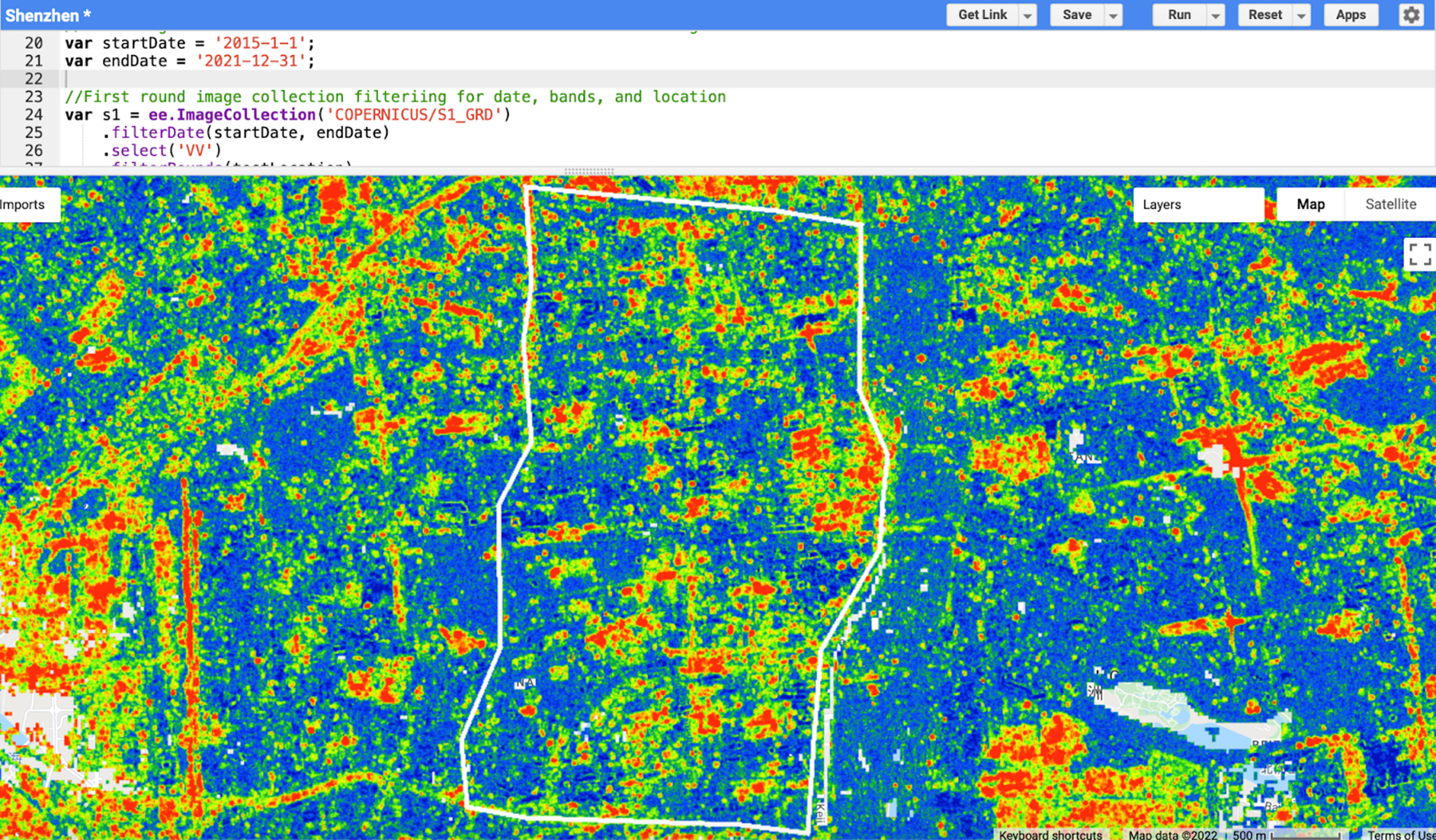
To detect construction and other activity in the industrial park, we created an activity and change alerting and detection service within Google Earth Engine, using open synthetic aperture radar (SAR) data collected by Sentinel-1. This SAR activity/change service detects changes in radar backscatter over time caused by moving vehicles, construction, or natural phenomena. The change in backscatter was analyzed over the seven-year timeframe from January 2015 to December 2021 to identify areas of increased activity (for more details, read our earlier article that leveraged similar SAR techniques). A sample of the Google Earth Engine script can be seen in Figure 2. Detected activity hotspots were further investigated using electro-optical satellite imagery and previously mentioned open-source data sources to determine what type of development was occurring.
Overview: The Shenzhen High-Tech Industrial Park
In the city of Shenzhen, a total of 147.96 km2 are dedicated to promoting innovation and advanced industries. Shenzhen High-Tech Industrial Park, a 11.52km2 park founded in 1997, is one of many industrial parks in Shenzhen envisioned as primary sub-areas for the promotion of new industries. It is bounded by the Guangzhou-Shenzhen Expressway in the north, Binhai Avenue in the south, Qilin Road and Nanyou Avenue in the west, and Shahe West Road in the east. The industrial park is divided into three districts by Beihuan and Shennan Avenue north, central, and south.
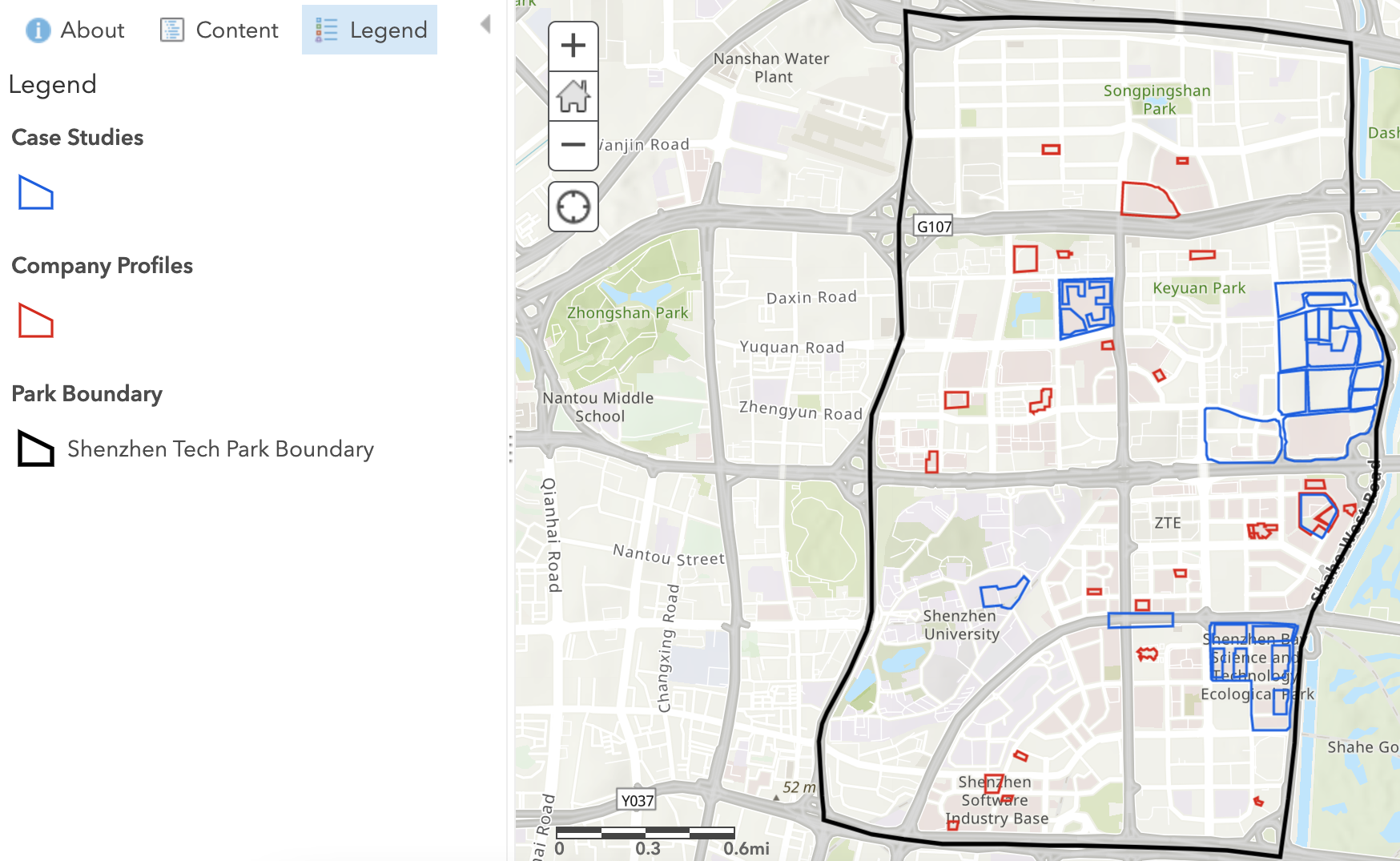
Shenzhen High-Tech Industrial Park is a special economic area where the key industries specified in the MIC25 policy are promoted using economic policies like tax incentives and research subsidies. It was originally established to foster development and growth in four main industries: electronic information (explicitly comprising computers, communications, and microchips), bioengineering, new materials (industry that researches and produces new compounds, like graphene, which has high tensile strength and conductivity), and optical device production. A particular emphasis is placed on the electronic information sector which consists of computing, microelectronics, and communications. Figure 3 shows the locations within Shenzhen High-Tech Industrial Park where we analyzed satellite imagery and located specific companies. An interactive version of this map provides additional details on these selected companies including their industries and how they fit into the broader goals of Shenzhen High-Tech Industrial Park.
Development of Targeted Industries
Open radar imagery from the European Space Agency's Sentinel-1 satellite analyzed in Google Earth Engine allows us to track change over time, and when combined with on-the-ground reporting, determine what type of activity is occurring. Development will be measured by looking at the types of industries experiencing growth. Based on information from Baidu Maps, the majority of the park's companies seem to be operating in high-tech industries. We focus on these high-tech companies and disregard service industry (e.g. restaurants and hotels) and non-high-tech companies since most of them seem to be complementary to the high-tech companies, providing services for workers and residents.
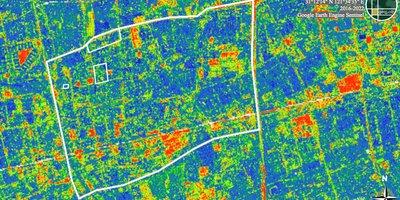
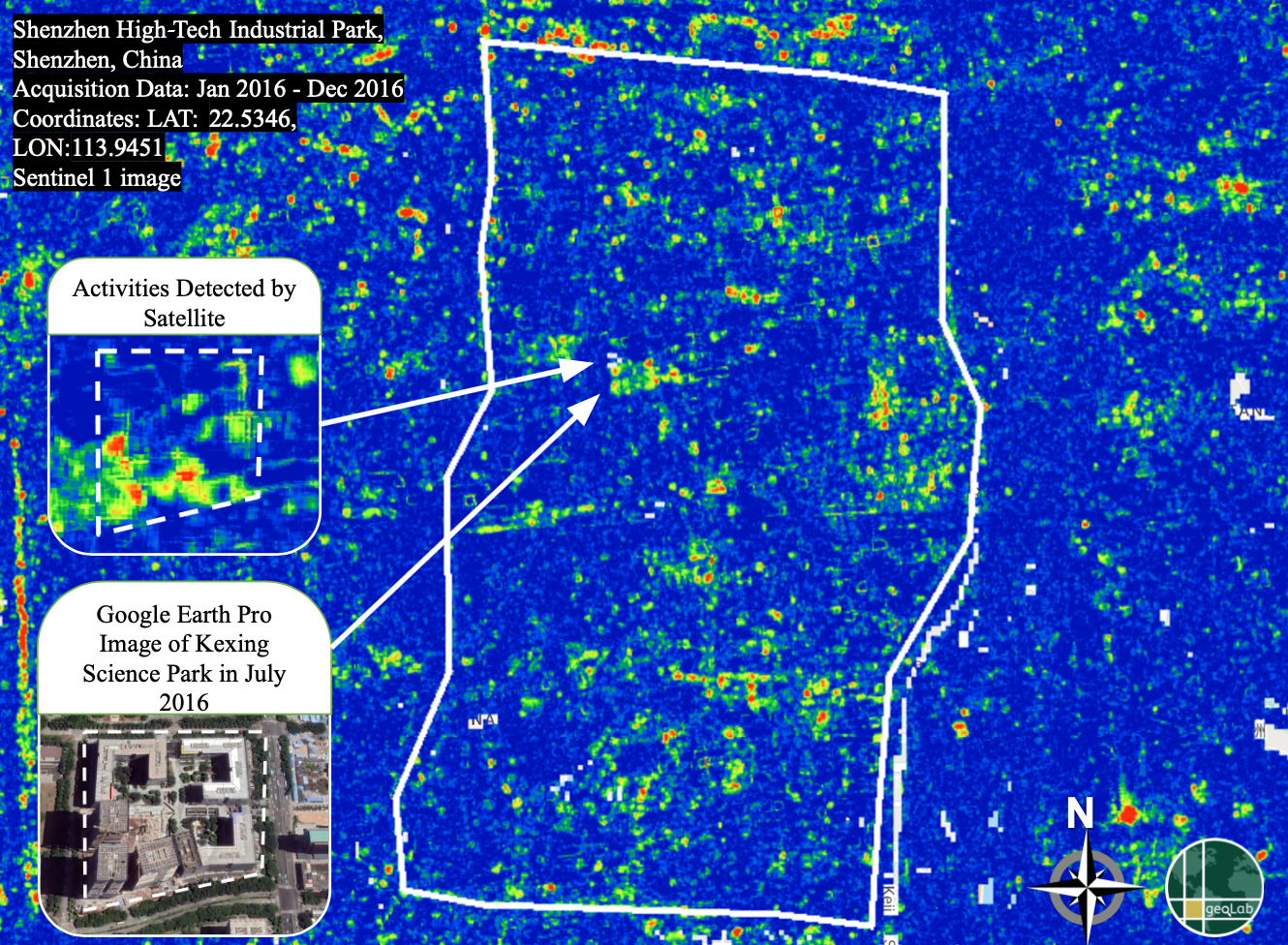
Figure 4 depicts our SAR data from Shenzhen High-Tech Industrial Park between January 2015 and December 2021. Warmer hues (yellowish) indicate areas where activity (detected as a positive change in total backscatter) has occurred over the selected time period, with darker hues (red) indicating more intense activity. Cooler hues indicate areas where less activity was detected, with dark blue indicating no new activity (no change in total backscatter).
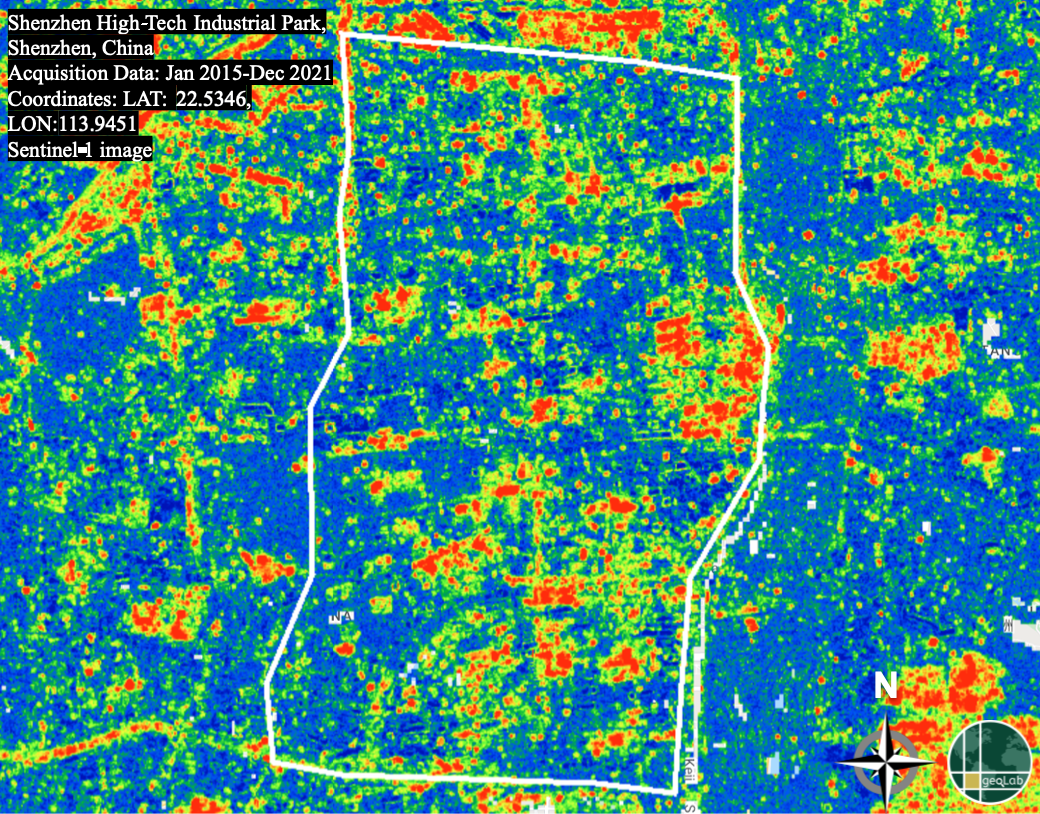
As shown in Figure 4, substantial activity occurred throughout the park over this time period. While the intensity of this activity seems to indicate construction and development, some of the detected backscatter may result from moving vehicles or other routine activities. By supplementing SAR data with other open source information, we can determine which activities are causing these patterns.
The stages of activity in Shenzhen High-Tech Industrial Park are depicted in Figures 5, 6, and 7. In 2015, there was minimal activity detected which then increased dramatically into a pattern of high activity in 2017. The bulk of the activity occurs in 2017, as seen in the larger areas of warmer hues. The activity persists into 2021, albeit to a lesser degree.
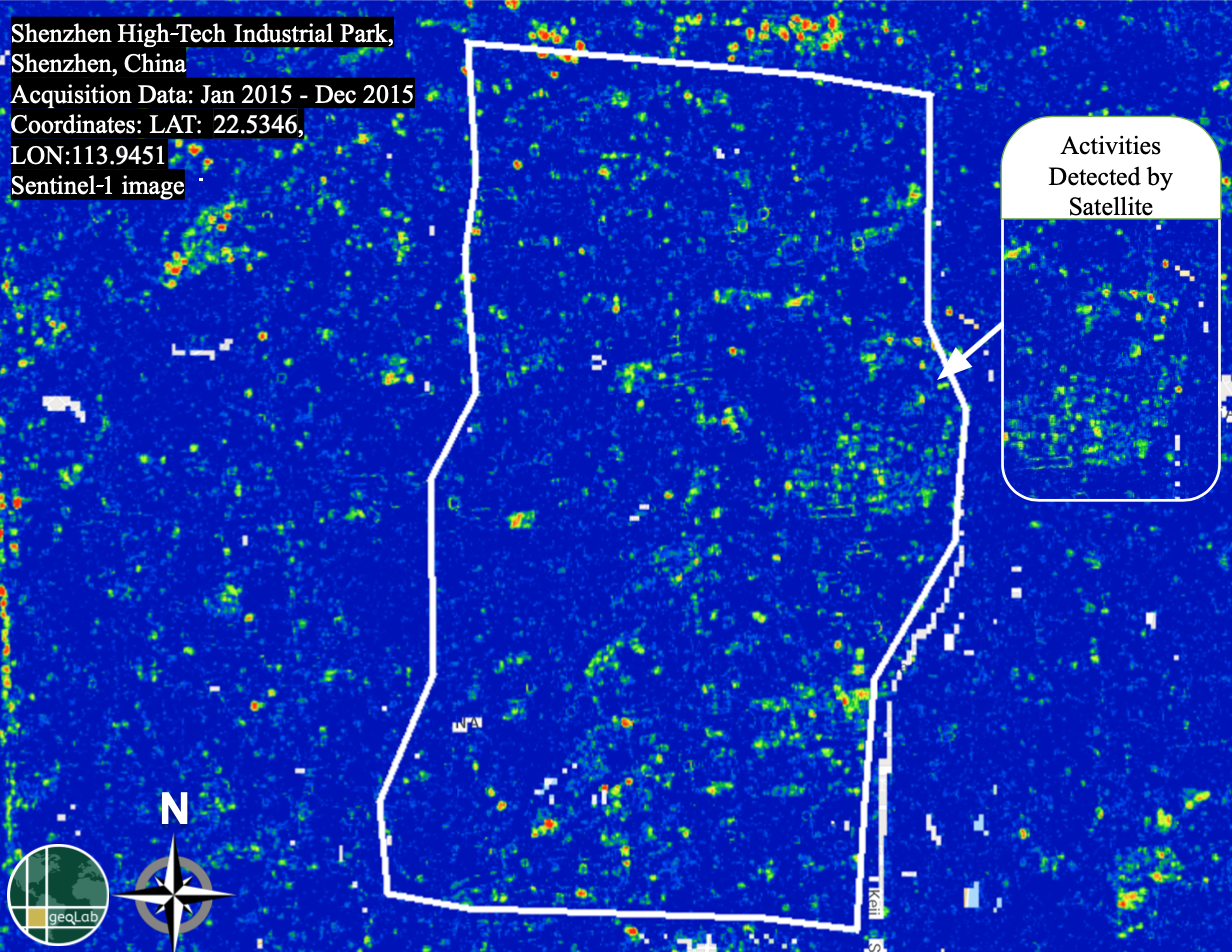
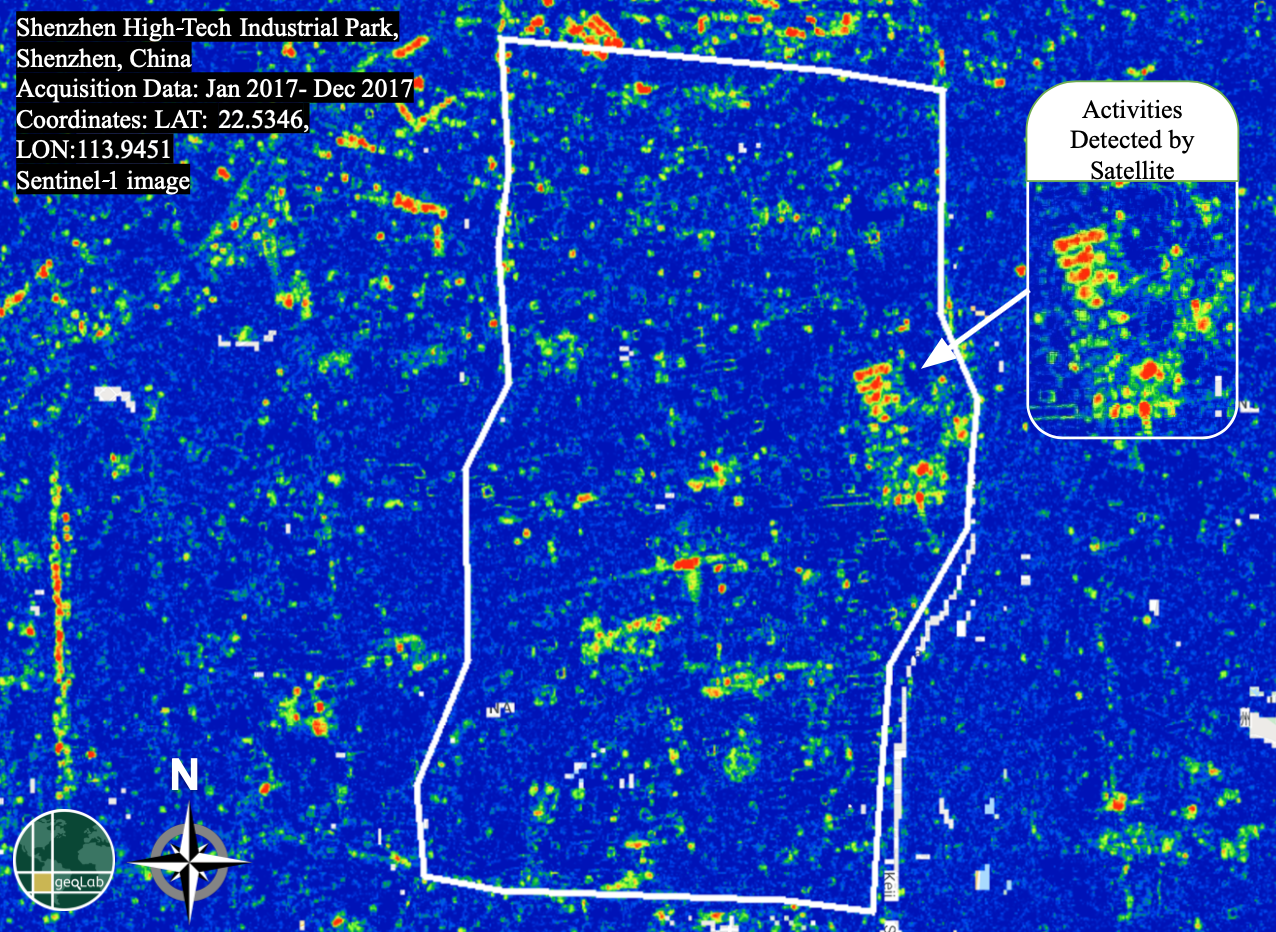
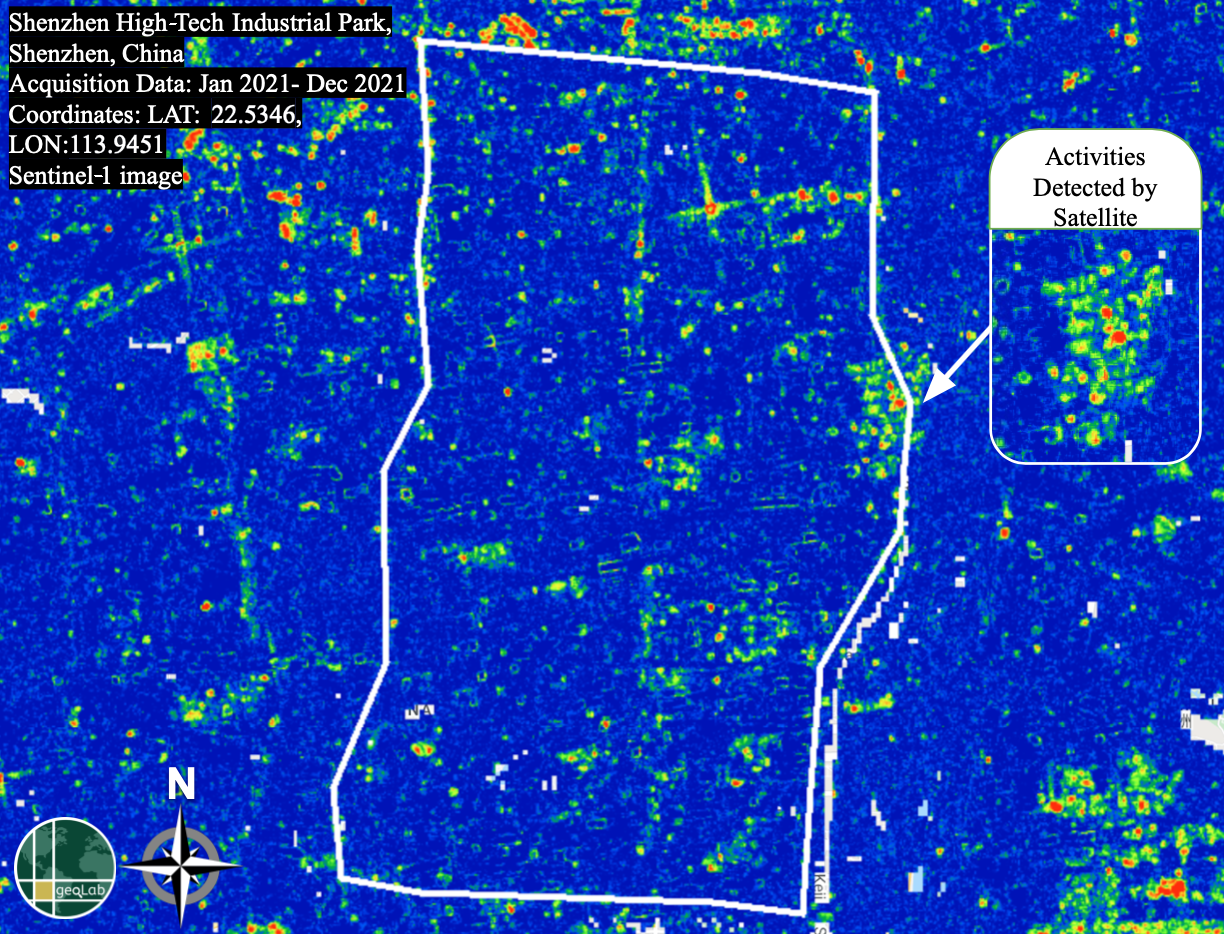
Through this time series, we can see that MIC25 has stimulated activity within the park, with only minimal activity in 2015 when MIC25's was first introduced and most activity occurring a few years later after MIC25's launch. This pattern is consistent with what we would expect to see given that MIC25 is a ten-year industrial development policy; the initial stage of development is marked by rapid activity in the form of construction which is followed by a second stage of development focused on attracting and fostering new companies.
Kexing Science Park
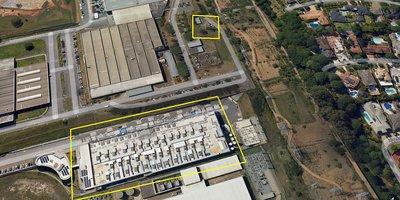
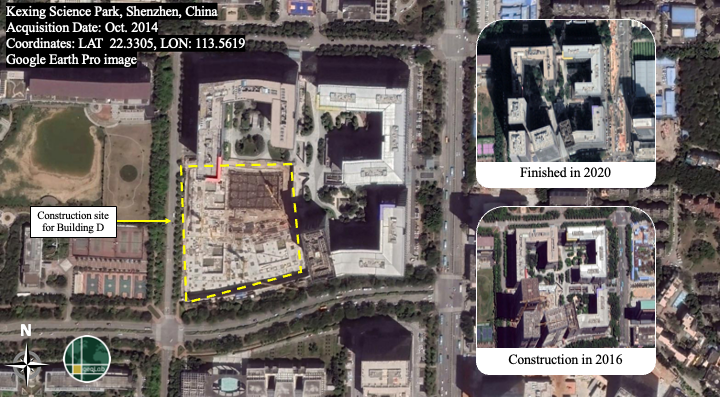
Much of Shenzhen High-Tech Industrial Park's development since 2015 has been in the advanced industrial sectors targeted by MIC25. One example of this development is Kexing Science and Technology Park, located in the central district of Shenzhen High-Tech Industrial Park (Figure 8), which is a recently constructed business park consisting of four buildings. Figure 9 depicts its construction from 2014 to 2020. Kexing Science and Technology Park is designed to attract companies by offering rentable offices and amenities including its proximity to public transportation and commercial areas.
We have identified 28 companies in Kexing Science and Technology Park which relate to at least one MIC25 industry. Figure 10 shows where these companies are located.
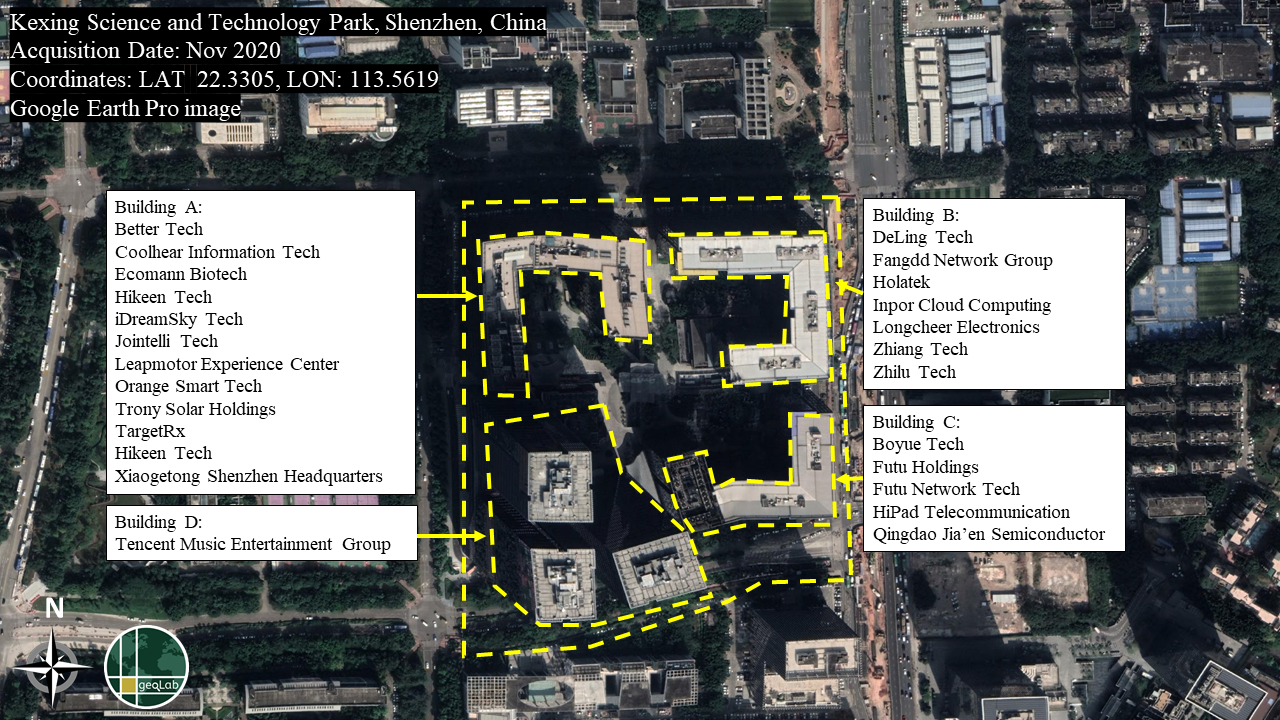
All but four of these 26 companies fall into computer-related industries, including next-generation IT, electronic hardware and software, and communications. The four non-computer companies are Ecomann Biotech (biomedical/biotech sector), TargetRx (biomedical/biotech sector), Shenzhen Leapmotor (new energy vehicles sector), and TRONY (energy equipment sector). Additionally, Qingdao Jia'en Semiconductor operates partially in the MIC25-defined Energy-Saving Vehicles sector, as semiconductors it produces are specifically for electric cars. See Figure 11 for a graphical breakdown of the companies in Kexing Science and Technology Park.
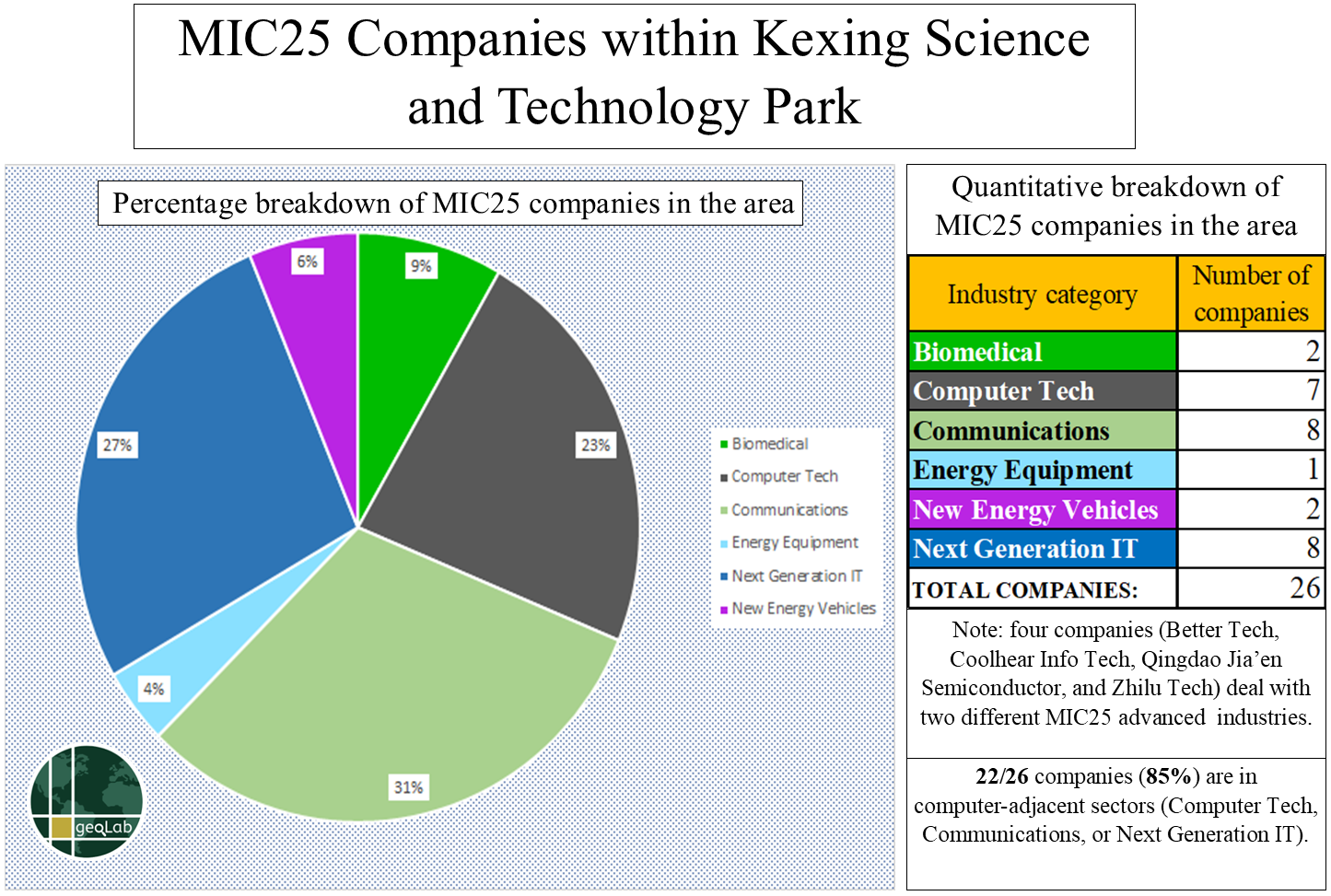
Based on this distribution of industries, Kexing Science and Technology Park demonstrates that MIC25 has increased the development of the core industries in Shenzhen High-Tech Industrial Park, but that this development is largely concentrated in computer-related industries.
Shenzhenwan Science and Technology Ecological Garden
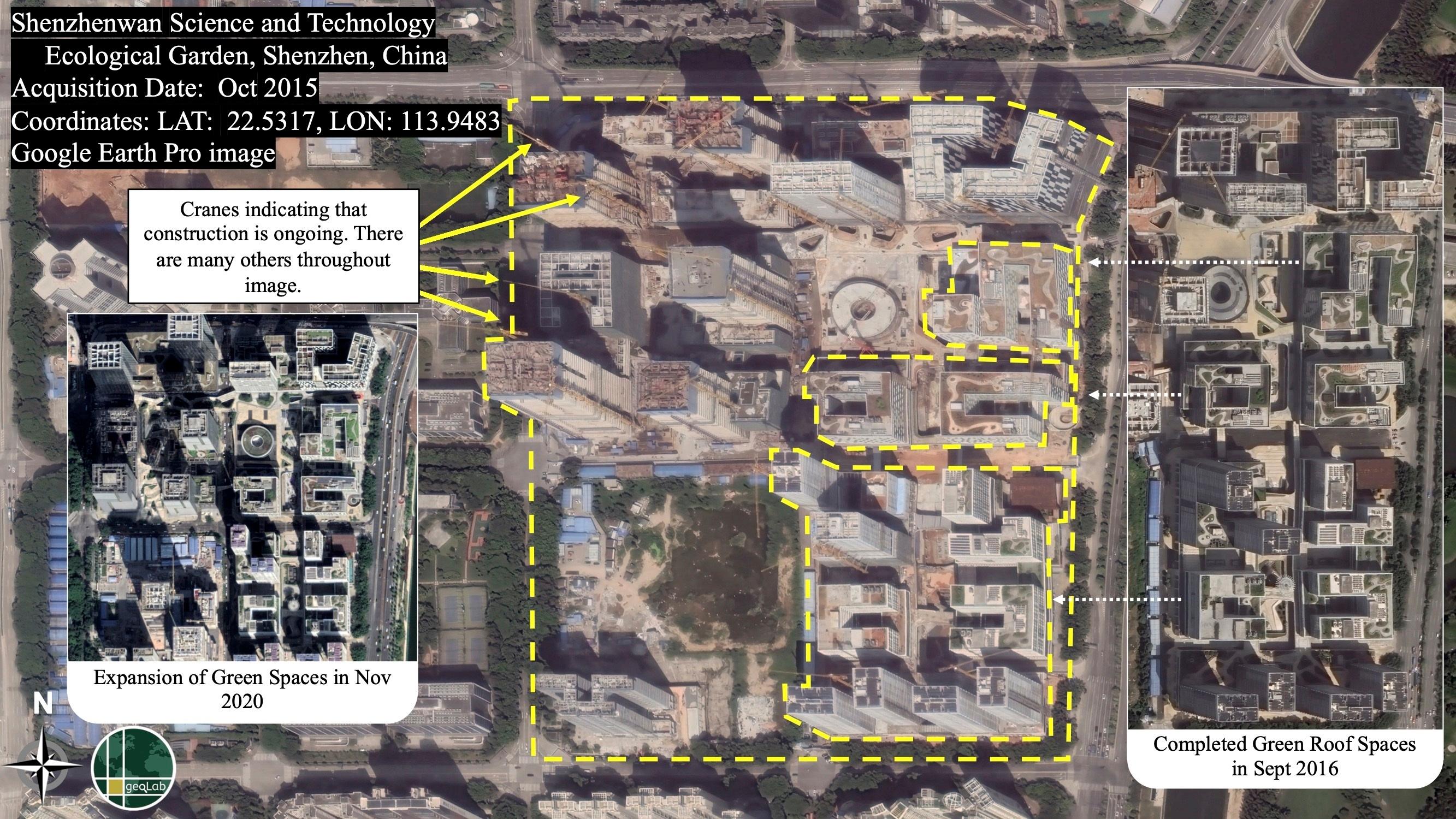
Shenzhenwan Science and Technology Ecological Garden business park is located in the south district of Shenzhen High-Tech Industrial Park, and has been the site of significant development since 2015 (see Figure 12).
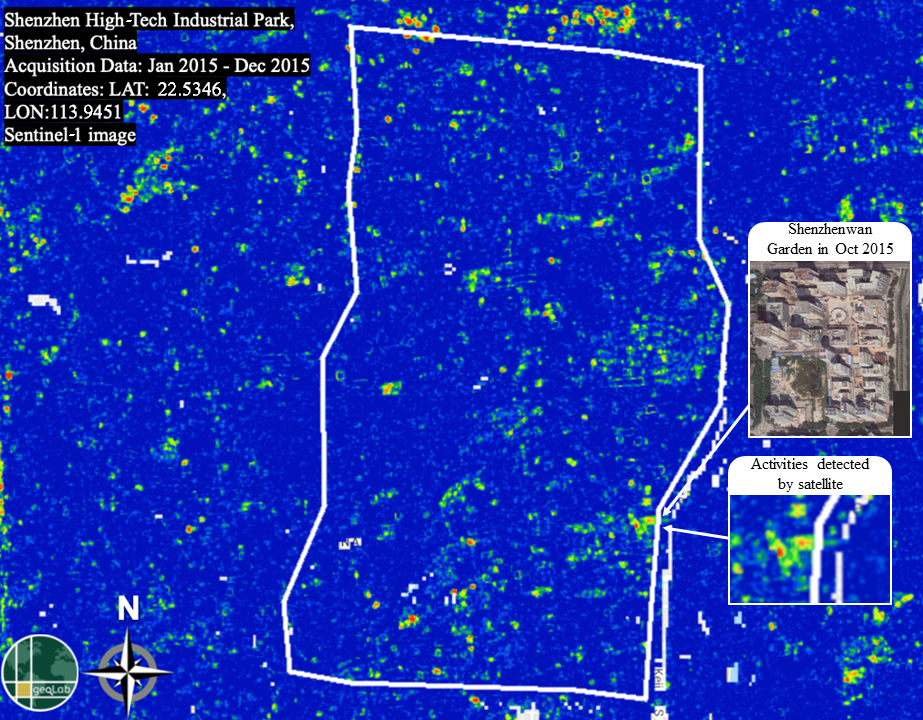
The garden was under construction until late 2016 (Figure 13 details this construction).
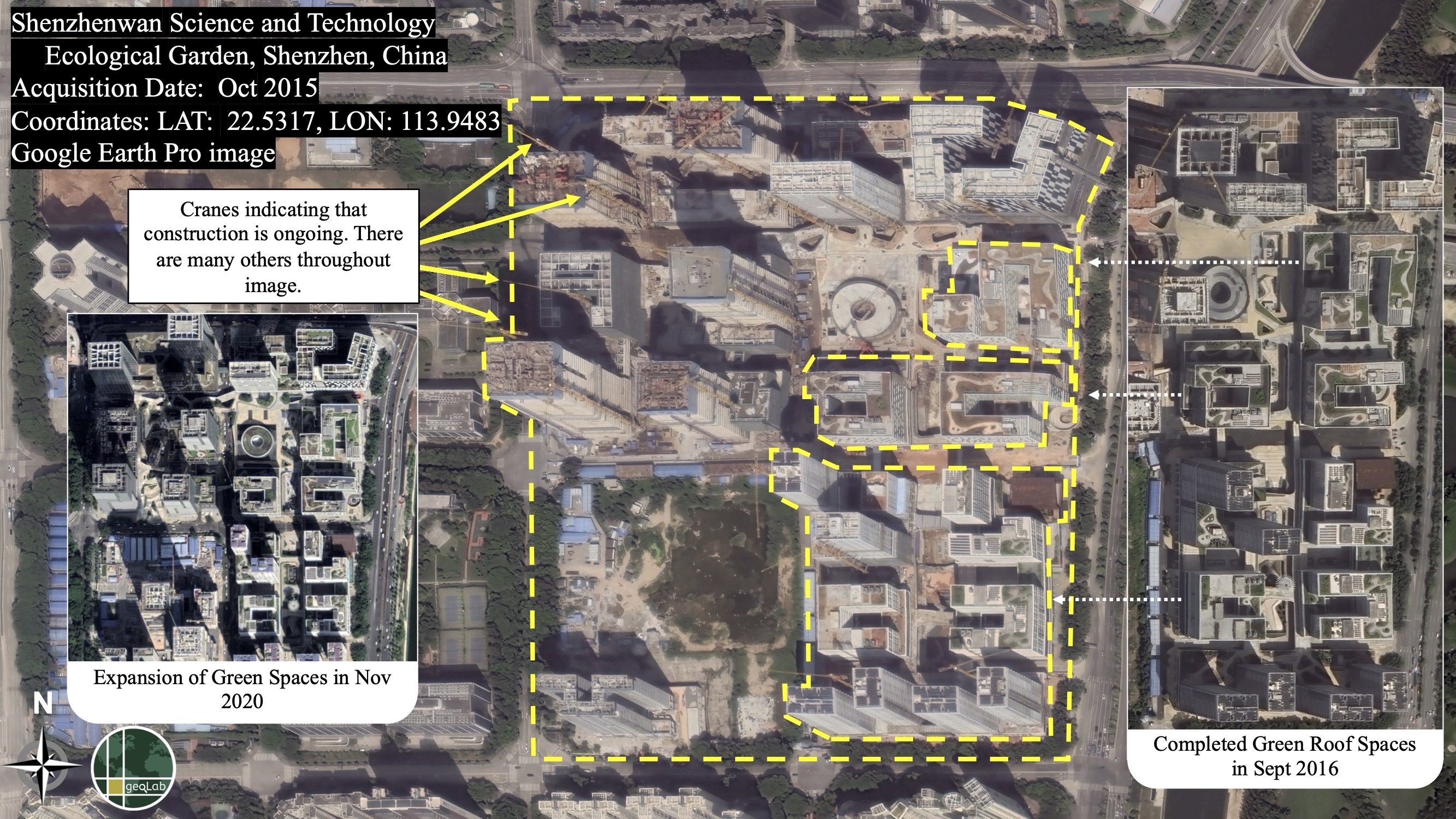
Since its completion, 30 companies operating in MIC25 advanced industries have moved into Shenzhenwan Science and Technology Ecological Garden. Figure 14 shows the location of high-tech companies within the garden.
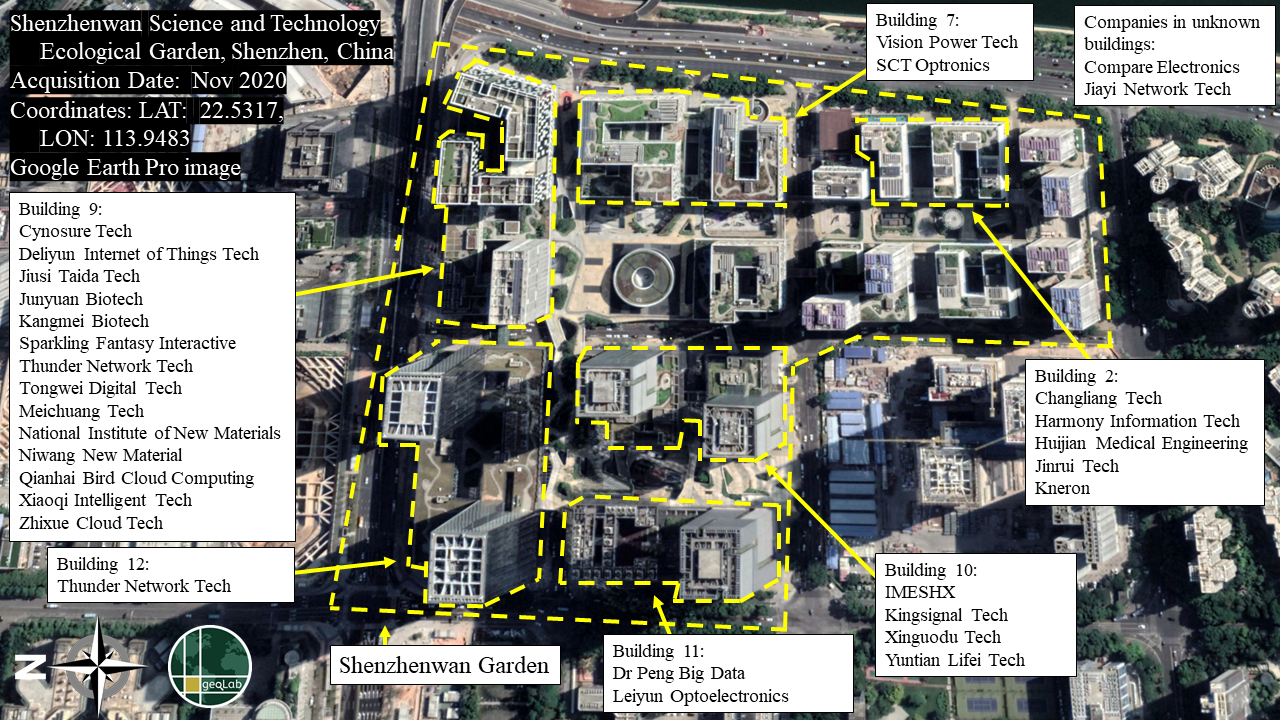
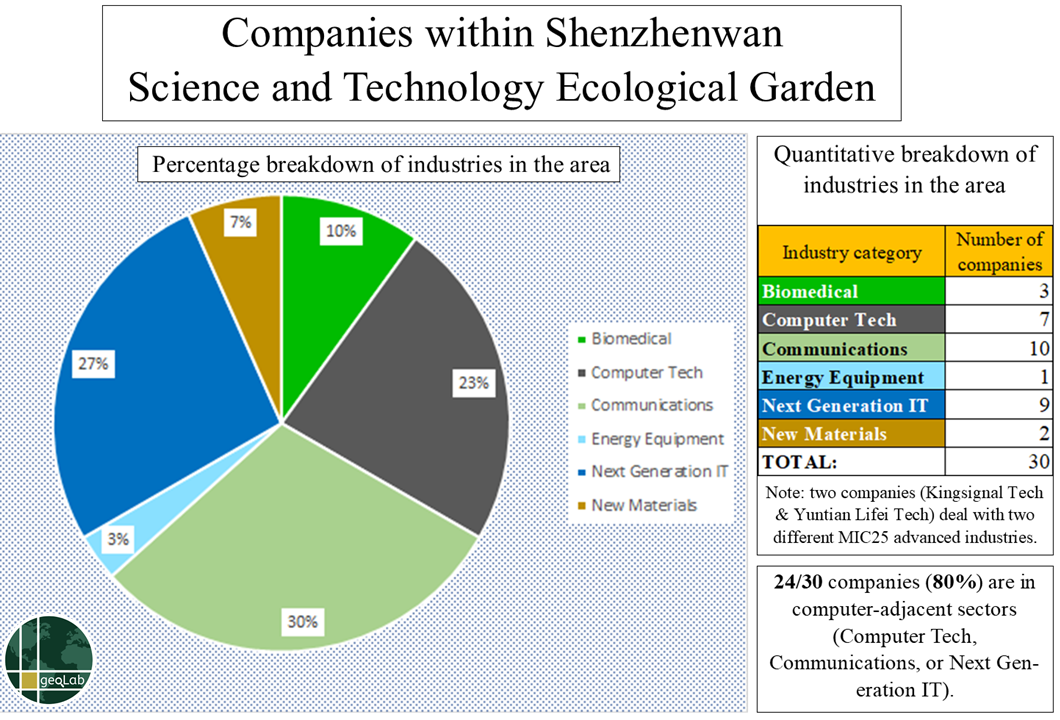
Advanced industrial development in Shenzhenwan Science and Technology Ecological Garden have been highly concentrated in just three MIC25 core industries. These industries are, in descending order, communications, next-generation IT, and computer technology. Like in the case of Kexing Science and Technology Park, there was also some development in the biomedical field. Huijian Medical Engineering Co., Junyuan Biotechnology Co., and Kangmei Biotechnology Co. are the three companies involved in this sector. However, Shenzhenwan also contains two companies in the new materials industry, those being the National Institute of New Materials and Niwang New Material Co., Ltd. Additionally, Vision Power Technology Co. operates in the energy equipment sector. Since the Shenzhenwan Garden was constructed entirely under MIC25, this high concentration of companies in industries targeted by this policy demonstrates its positive impact on industrial development.
Visible Trends
In both Kexing Science and Technology Park and Shenzhenwan Science and Technology Ecological Garden, the vast majority of development is occurring in computer-related industries. In these areas, 85% and 80%, respectively, of identified companies operate in computer-related sectors. We hypothesize that this concentration of MIC25-driven development in computer-related industries results from Shenzhen's pre-existing specialization in these fields.
Shenzhen High-Tech Industrial Park has been the target of efforts to develop the computer and communications industries since well before MIC25's implementation. Since the mid-2000s, the park's targeted areas of development have been electronic information, bioengineering, new materials, and opto-mechatronics. In 2015 (the year MIC25 was introduced, before it could have a large impact) communications equipment, computer manufacturing, electrical machinery, and equipment manufacturing were already Shenzhen's three largest industries.
The park has long been recognized as having a strong foundation for communications development. The city of Shenzhen dominates China's computer industry and Shenzhen High-Tech Industrial Park makes up a large part of that manufacturing. For example, in 2010, the park produced 40% of Shenzhen's computers. The presence of large firms like Huawei, Tencent, and ZTE make Shenzhen High-Tech Industrial Park especially poised to develop its communications, next-generation IT, and computer industries. Huawei and ZTE are both major players in the 5G field and produce consumer devices like smartphones. Tencent offers cloud computing services and maintains QQ and WeChat, two of the most prevalent Chinese social media and messaging services. Given this long-established focus on computer-related industries, it is easier to continue development in these already-dominant industries, rather than introducing new areas of specialization.
This trend of development occurring only in pre-existing industries holds true outside of computer-related industries as well. While most development has been computer-related, those non-computer companies which have popped up since 2017 have been concentrated in the biomedical and new materials industries, which were original priorities for the park alongside electronic information ( computers, communications, and microchips). Out of the ten non-computer-related companies found in these two parks, seven have been in the biomedical or new materials sectors. Of the remaining three companies, two have been in the energy equipment sector and one has been in the energy-saving vehicles industry - perhaps suggesting that the environmental aspect of MIC25 is having a positive, though small impact.
We conclude that MIC25 has spurred growth in Shenzhen High-Tech Industrial Park, but primarily in the advanced industries in which the park already had a comparative advantage. The greatest development occurred in the communications, computer, and next-generation IT (primarily 5G) sectors, which already dominated Shenzhen. Some growth has also occurred in the bioengineering and biomedical sectors, which the park has been fostering for over a decade. Energy-saving vehicles or new energy development has been minimal suggesting that the environmentally-focused aspect of MIC25 has had a small yet positive impact on development..
Shenzhen University
Shenzhen High-Tech Industrial Park was intentionally established adjacent to the Shenzhen University campus to integrate the university within the park. This proximity was intended to maximize the university's potential as a source for talent training and cutting-edge research. See Figure 16 for a land-use map of the university.
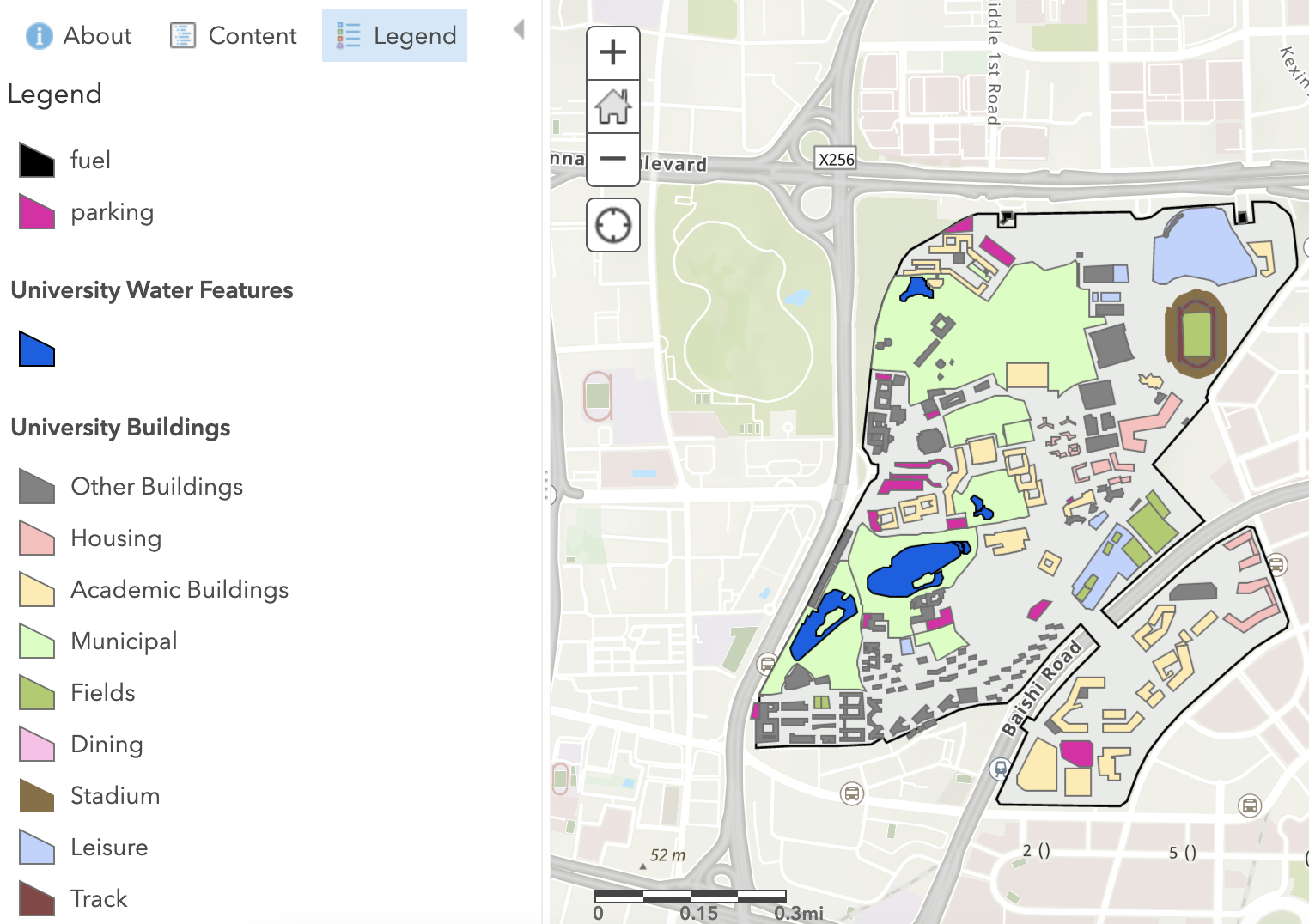
Historically, Shenzhen University has provided tangible benefits in business and innovation in advanced industries. One such example is Tencent Holdings Ltd., a major Chinese conglomerate, which was founded by a university alumnus. Its subsidiary, Tencent Music, is present in Shenzhen High-Tech Industrial Park. It continues to provide for the park, as the 40,000 students who attend the university comprise a vast pool of human capital available for the park. The university is actively building and expanding programs that will assist in the development of MIC25 core industries, as in 2020 it added Financial Technology and Robotic Engineering majors.
Shenzhen University also conducts relevant policy research on MIC25 and the Shenzhen High-Tech Industrial Park. The university is home to the China Center for Special Economic Zone Research, the only one of China's key research bases which focuses on special economic zones. Thus, Shenzhen University may impact Shenzhen High-Tech Industrial Park and MIC25 itself by influencing policies through its research, though the extent of this impact is unknown.
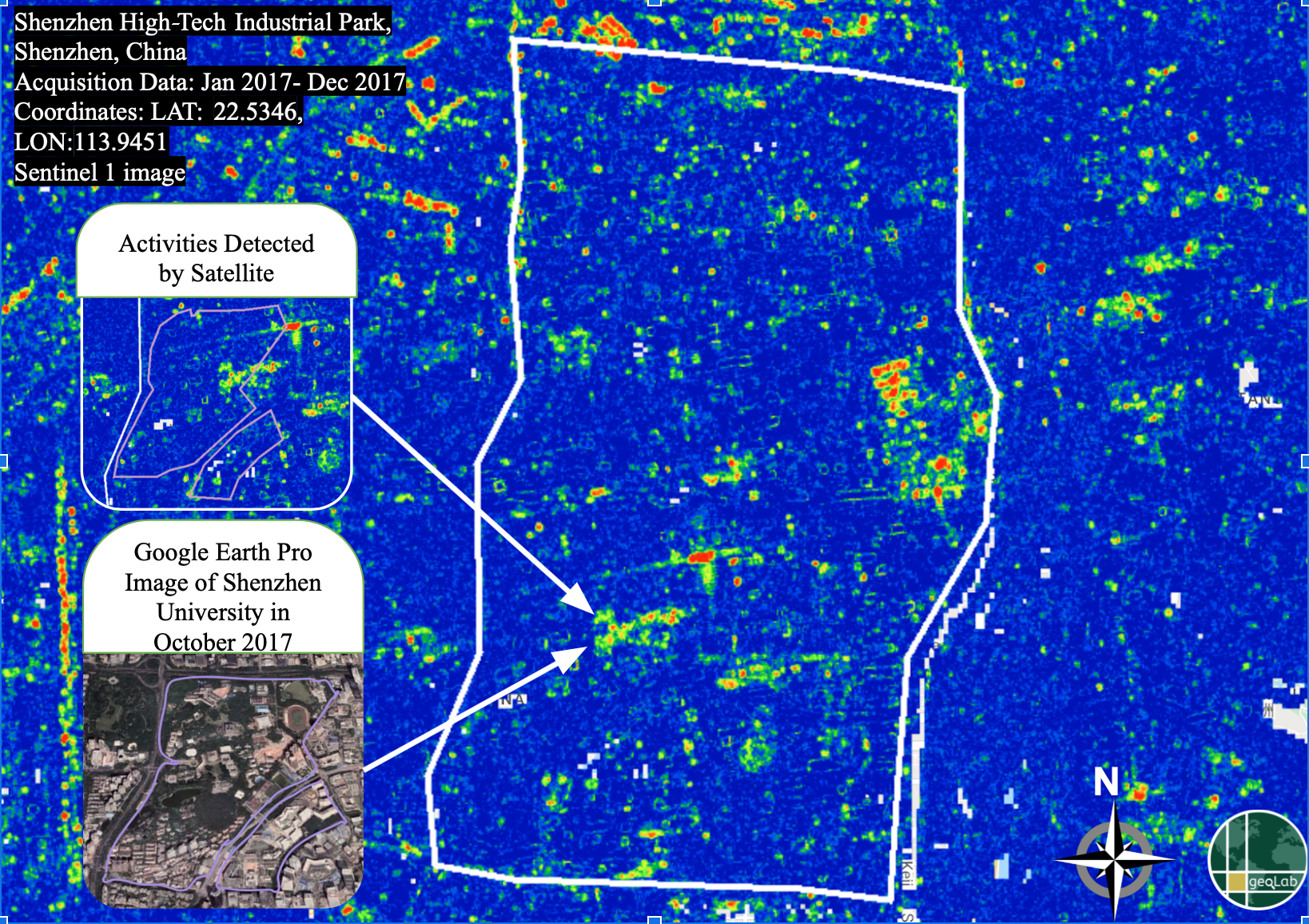
Activity within the university can be seen at differing levels throughout the radar data; this is shown in Figure 17, which displays activity in and around the campus during 2017.
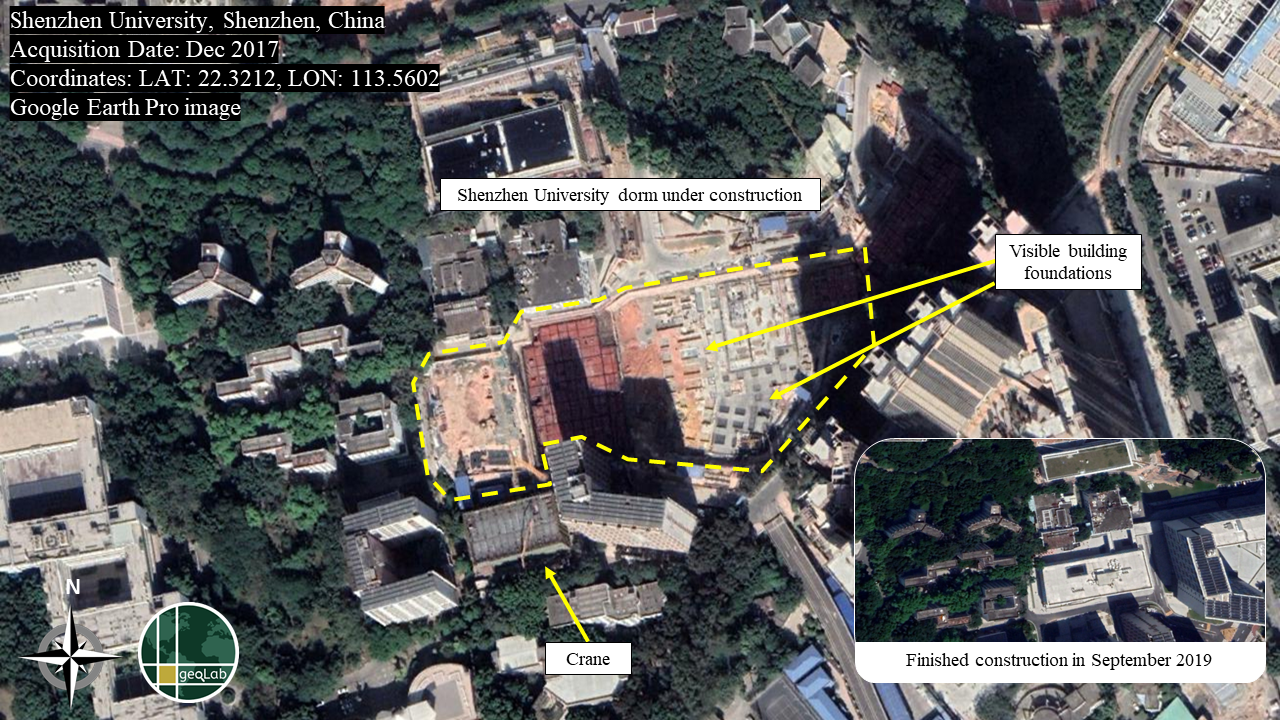
Since 2015, Shenzhen University itself has seen development since MIC25's implementation. Construction of a new dorm began in 2017 and was quickly finished by late 2019 (see Figure 18 below). This expansion may be connected to MIC25, given its timing.
Green Infrastructure and Spaces
Many of MIC25's ten core industries focus on clean energy and energy-efficient technologies. Additionally, MIC25 includes goals of decreasing energy and water consumption by 35% in companies' research and development processes, developing green factories and industrial parks, and increasing thermopower, hydropower, and nuclear power facilities.
As part of the core industry of energy saving and new energy vehicles, China produced 53% of the global market share of electric vehicle (EV) batteries in 2017. Within Shenzhen High-Tech Industrial Park, Shenzhen VMAX New Energy contributes to this industry by providing electric vehicle batteries, wireless electric vehicle charging equipment, and other energy-efficient products for car companies while Qingdao Jia'en Semiconductor company designs and produces semiconductors for electric vehicles. Additionally, Shenzhen Fast Technologies, which operates out of the industrial park, produces 20 million solar products per year, contributing to MIC25's goal of energy efficiency. As evidenced by the emergence of these companies, the industries within the industrial park seem to be contributing to MIC25's broader goal of increasing energy efficiency and decreasing China's environmental footprint.
In addition to MIC25's goals, Shenzhen's 13th Five-Year Plan laid out three related goals: to reduce carbon emissions, to maintain air quality, and to continue economic prosperity. Shenzhen has since implemented many green policies including closure of resource-intensive factories, revitalization of unused spaces, and addition of low-emissions electric buses and taxis. Other approaches taken in Shenzhen include carbon trading, “greening” construction regulations and increased environmental transparency and accountability.
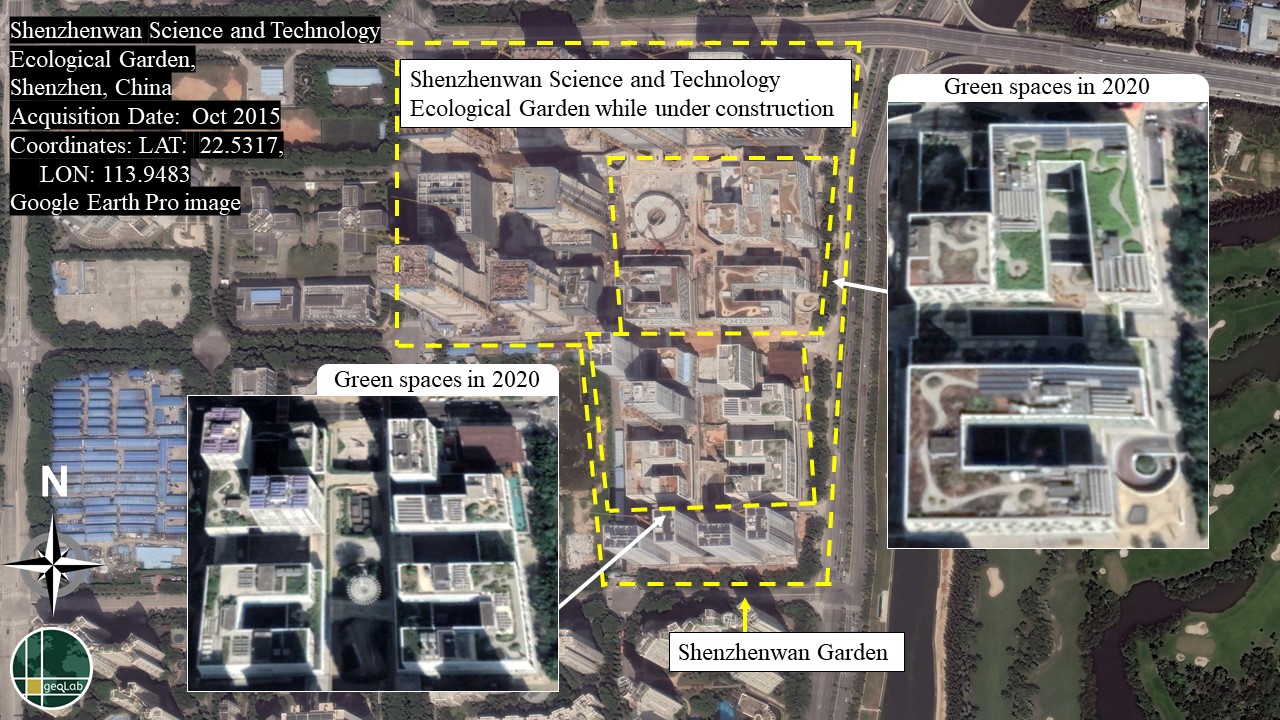
In our analysis, we have seen continued maintenance of green spaces and green roofs in the park as shown in Figure 19. Additionally, there have been efforts to increase public transportation infrastructure within both Shenzhen and Shenzhen High-Tech Industrial Park.
Quality of Life in Shenzhen High-Tech Industrial Park and the Surrounding Area
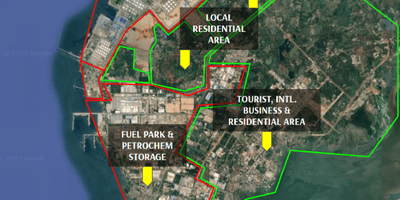
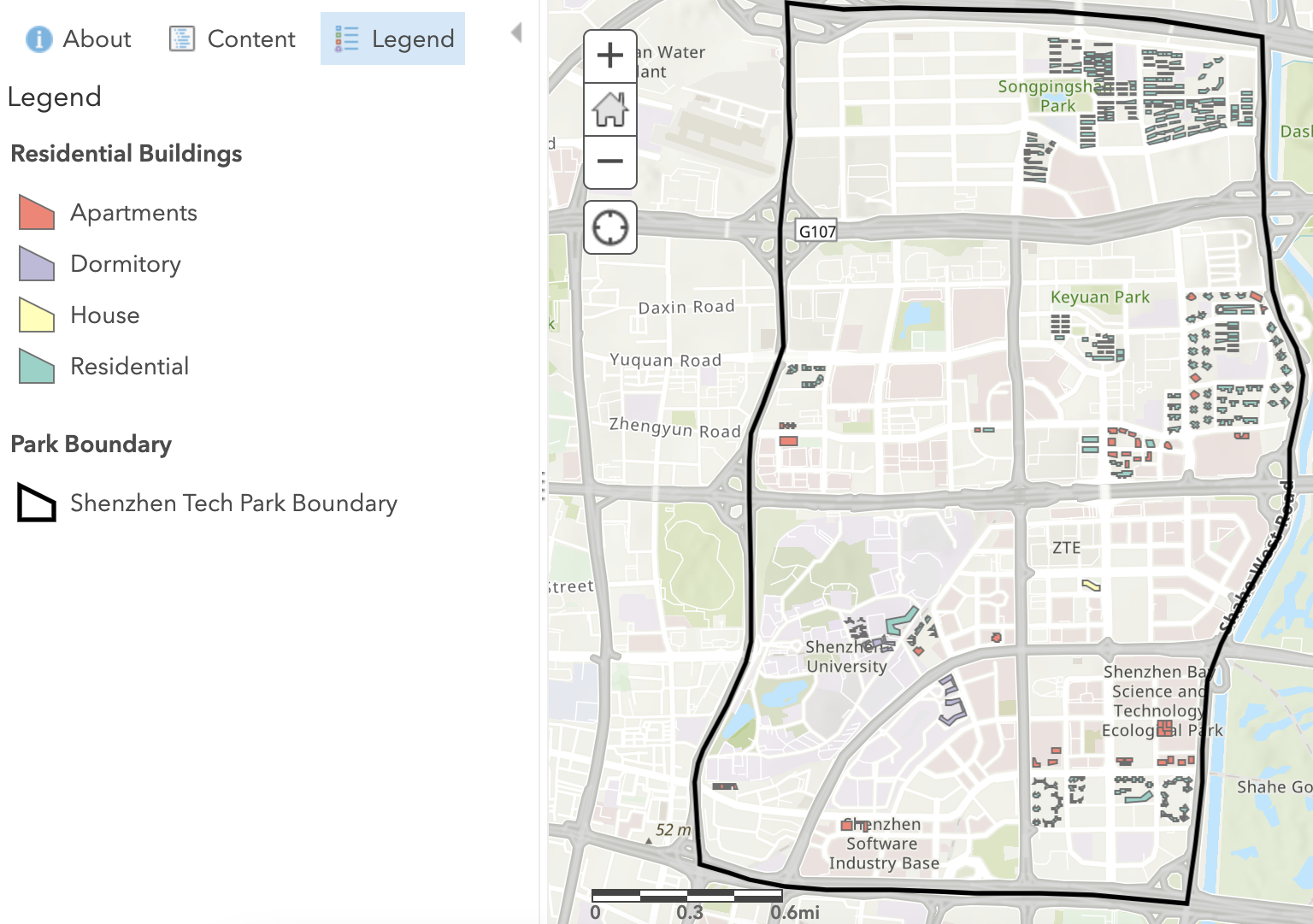
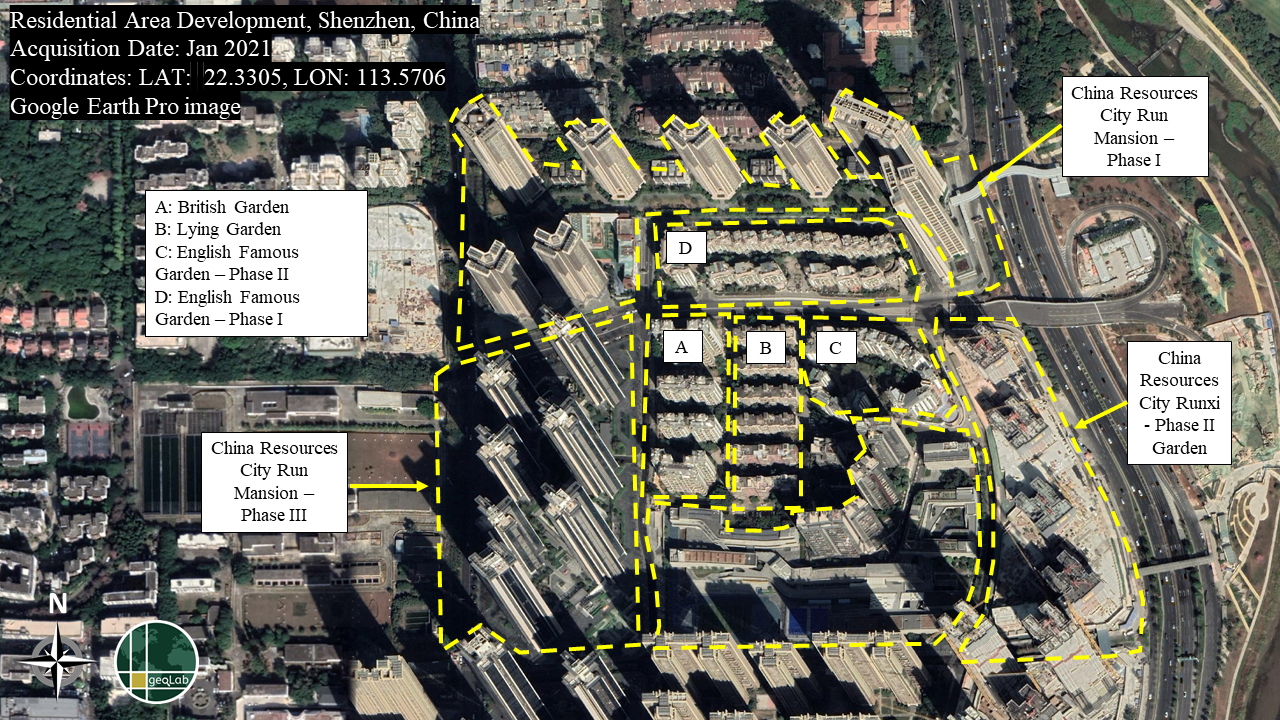
In order to attract more educated employees to work in these newly established high-tech industries, the Shenzhen government has been upgrading old housing units and replacing them with “sleek, modern units" (see Figure 20 for a map of purely residential areas inside the industrial park, and Figure 21 for satellite imagery of residential area development).
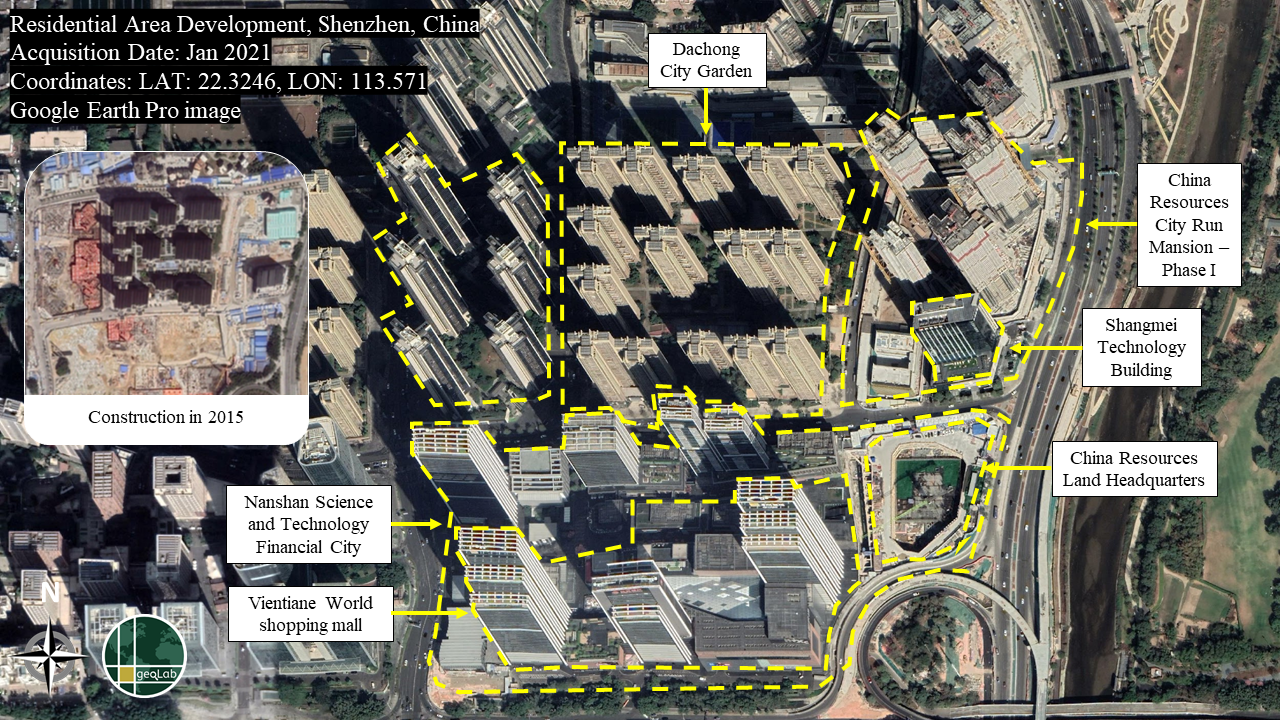
Chinese developers have made efforts to raise standards of living by constructing mixed-use buildings which provide park residents with accessible and convenient amenities. One example, the Nanshan Technology Finance City (Figure 22), is a planned city block with seven skyscrapers, ranging from residential flats to corporate offices. Vientiane World, a shopping mall with several luxury brands such as Tesla, Huawei, and Fred Perry, is at the heart of this planned community. This mall is one example of a shift toward infrastructure that is designed to appeal to higher-skilled and higher-income workers.
In addition to attracting young, middle-class, highly educated workers, these residential changes force current residents and factory workers out of their homes. Developers are looking to Shenzhen's “urban villages” as targets of redevelopment and modernization, forcing current residents to move out with as little as one month's notice.
Additionally, as of 2018, the average rent increased from $100 to $250 per month, a particularly difficult price to pay for factory workers who made an average of $600 per month. China's effort to construct subsidized housing is moving slowly, leading to a housing affordability crisis. Many workers are being pushed outside of Shenzhen, and some are leaving Shenzhen completely and returning home.
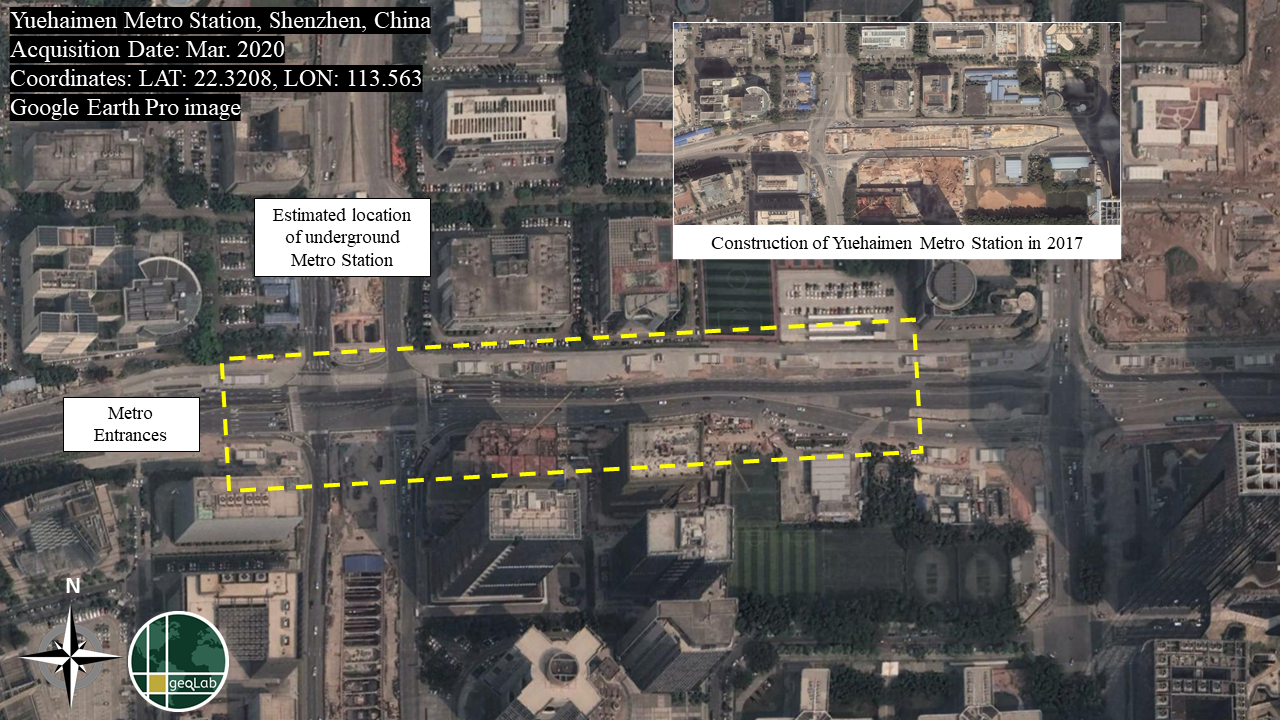
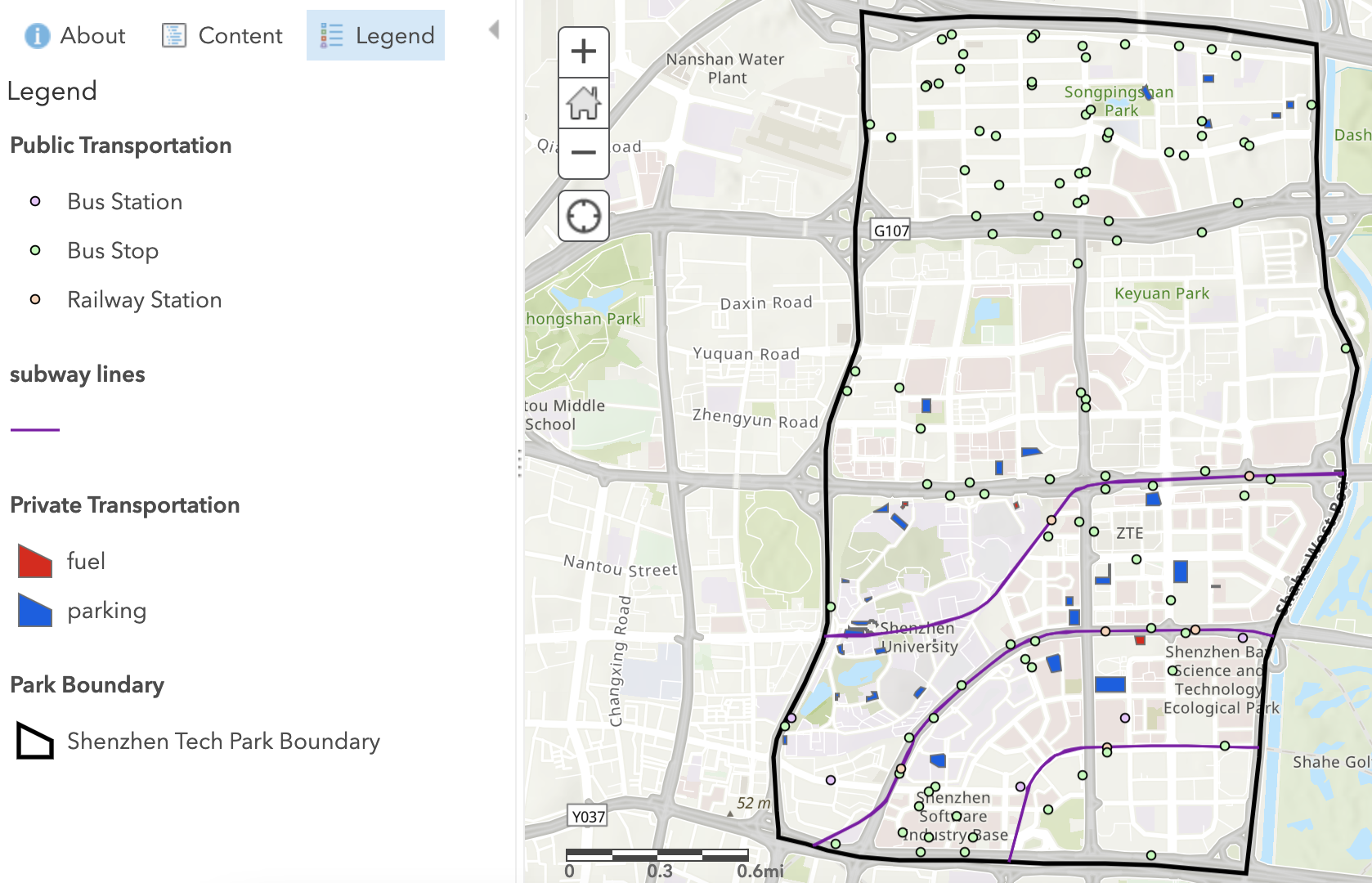
Workers living farther from their site of employment increase transportation time and costs. Commute options are not well supplemented by the park's lack of sufficient transportation infrastructure. In 2011, the residential population of Shenzhen High-Tech Industrial Park was 139,000 people and there were 300,000 people who worked in the park. Plans for the development of Shenzhen High-Tech Industrial Park were made according to a projected doubling in both populations (310,000 residents and 600,000 workers). Based on the high number of workers who live outside the park, there is a clear demand for transportation into the park. As of 2014, the government planned to construct five additional metro lines: Luobao (Line 1), Shekou (Line 2), Meilin (Line 9), Shiyan (Line 15), and Qiannan (Line 17). As of 2017, the transportation infrastructure was still insufficient, with extensive traffic issues and limited public transportation options. Figure 23 shows the construction of the Yuehaimen Metro Station, which now provides an additional stop near Shenzhen University and Shenzhen Digital Technology Park on the Meilin metro line. Figure 24 shows a map of current public transportation inside the industrial park.
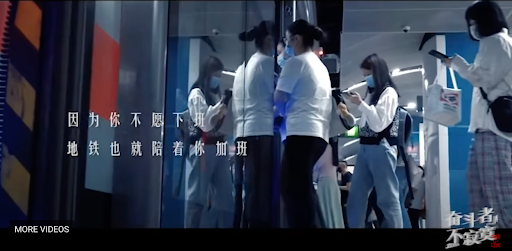
In addition to housing and transportation issues, many employees in Shenzhen are faced with poor working conditions. Although employees in high-tech industries may be more likely to work under better conditions, Shenzhen is renowned for its extreme work culture. Last year, Shenzhen's Communist Party Committee published a video celebrating the city's culture of overwork. In particular, they applauded the habit of working overtime and spending late nights in the office and romanticized the “996” culture in which employees work from 9AM to 9PM, six days per week (Figure 25).
In 2010, Foxconn's Shenzhen facility reported 18 suicide attempts, 14 of which were successful. As the suicides gained international media attention, Foxconn employees revealed details of their working conditions including extreme levels of stress, long days, unfair fines, unmet promises of benefits, and harsh managers who used public humiliation as punishment. Foxconn's only response was to add nets to catch future jumpers and to make workers sign pledges that they would not commit suicide; no changes were made to their working conditions. In the following years, the suicides continued though at decreasing rates. Additionally, in 2012, 2016, and 2017, groups of workers gathered on rooftops and threatened to jump if conditions were not improved.
While the Foxconn suicides were an extreme example, similar working conditions can still be found in Shenzhen in more recent years. In 2021, a high school student committed suicide after being forced to work in a Shenzhen factory as part of an “internship.” A group of students at his school was forced, under threat of expulsion, to do manual labor at a Welco Wong's Technology factory instead of the computer training course they were promised. They only received a fraction of the promised pay, 14 yuan per hour, and faced poor working conditions with long hours, night shifts, and bullying from their bosses.
In 2021, two workers in high-tech industry jobs at Tencent in Shenzhen High-Tech Industrial Park committed suicide. Tencent referred to the first suicide as an accident, a claim which was later refuted by current and former workers who revealed that the employee, Máo Xīngyún, had jumped off the building's roof while working overtime on a Saturday. Many of the workers were convinced that the company was at fault due to their unrealistic expectations and long hours. One employee, fired from Tencent three years ago for refusing to work overtime, described working conditions as “dismal” and “toxic”, prompting his own suicidal thoughts. Just seven months prior, an intern at one of Tencent's subsidiaries committed suicide in the same location.
The combination of such working conditions and employee protests once earned Shenzhen the title of labor protest capital of China but, recently, protests have decreased. In 2015, there were 75 worker protests; in 2019, there were 11. Within Shenzhen High-Tech Industrial Park, there was a strike in September 2017 organized by workers at Tungtex and another one in June 2018 over a construction project.
In 2021, the government proposed harsh changes to Shenzhen's employee payment and work regulations. This is the first time in 17 years that Shenzhen amended its rules on worker pay. These amendments will disempower workers by reducing overtime pay, tightening bonus rules, extending deadlines for paying employees, and slowing the scheduled increases of Shenzhen's minimum wage. As of June 2021, Shenzhen's minimum wage was 2,480 yuan per month, an income level at which it is almost impossible to live in Shenzhen.
The Shenzhen government explained that their intentions were to lower wages in order to prompt more hiring in post-pandemic times. While the government acknowledged that these policies disadvantage workers, they claimed that the changes would benefit workers in the long term. It is also of note that economic policies are often tested in Shenzhen before being implemented elsewhere in China and some have speculated that these policy changes could indicate a coming overhaul of China's national labor laws.
Conclusion
Shenzhen is often used as a testing ground for policies that will later be implemented throughout China. The city itself was designated China's first Special Economic Zone in 1980, making it a test site for Deng Xiaoping's economic reforms. From 1979 to 1990, the Shenzhen SEZ passed over 400 pieces of economic legislation that were highly influential on national economic legislation. These measures included groundbreaking reforms to the tax and finance system, the wage system, the price system, the commodities circulation system, and the labor contract system, all of which were later copied throughout China. Shenzhen also led China in reforming land tenure, state-owned enterprises, and labor markets. Under these policies, Shenzhen grew at an unprecedented rate, rapidly transitioning from a rural fishing village to a large manufacturing hub. Since then, hundreds of cities have been built using the “Shenzhen Model”.
The trend of Shenzhen as a testing ground has continued in multiple policy areas including environmental policy, working conditions policy, and other economic policies. For example, Shenzhen was chosen as one of the eight cities in which the Chinese government piloted its low carbon policies; it is now endorsed as both a “low carbon pilot city” and a “low carbon ecological demonstration city”. More recently, Shenzhen is taking the lead as a testing ground for a series of environmental policies including the development of electric vehicles, promotion of low-emission public transportation, and stricter pollution regulation. Additionally, China's national social security system was based on Shenzhen's and, in 2001, Shenzhen became the first city to give workers pensions, a practice which was later duplicated throughout China. Based on Shenzhen's history as a policy testing ground, some scholars expect that the policy and industry development approaches taken in Shenzhen since 2015 will soon be implemented across the country.
If the Chinese government continues to look at Shenzhen as a testbed for wider policies, then the impacts of MIC25 in Shenzhen will shape Chinese industrialization policies moving forward. Our findings indicate that in Shenzhen, MIC25 has promoted industrial development, but almost entirely within the city's preexisting industries. How the Chinese government crafts future policies based on these results remains to be seen.
Dec 11, 2021
Tencent employee suicide
An employee at Tencent’s building in the Shenzhen High-Tech Industrial Park committed suicide while working overtimeJun 25, 2021
Student suicide at Shenzhen factory
After being forced to do manual labor for low wages and long hours at Welco Wong’s Technology’s factory in ShenzhenMay 27, 2021
Shenzhen Municipal People’s Congress proposes policy changes
The Shenzhen Municipal People’s Congress met to discuss proposed changes to Shenzhen’s employee payment and work regulationsMay 08, 2021
Shenzhen’s CCP Committee celebrates culture of overwork
The Shenzhen government published a video that celebrates Shenzhen’s culture of overwork and the tradition of “996”,May 01, 2021
Intern at Tencent subsidiary commits suicide
An intern for a Tencent owned game developer studio committed suicide at Tencent’s Shenzhen High-Tech Industrial ParkJun 08, 2018
Construction worker protest
Workers protest wage arrears at a construction project in Shenzhen High-Tech Industrial Park.Nov 15, 2017
Tungtex worker protest
Tungtex workers protest sudden closure and wage arrears at a facility within Shenzhen High-Tech Industrial Park.May 01, 2017
Foxconn protest
Seven or eight Foxconn workers successfully used the same method of protest -- threatening to commit suicide -- toJan 01, 2016
Foxconn protest
A smaller group of Foxconn workers used the same strategy of threatening to commit suicide to leverage better workingJan 01, 2015
MIC25 policy introduced
The Chinese government introduced MIC25, a national policy intended to make China self-sufficient by promoting innovationJan 01, 2012
Foxconn worker protest
150 Foxconn workers gathered on a rooftop and threatened to jump if working conditions were not improved. In response,Jan 01, 2010
Series of Foxconn suicides
Within one year, the Foxconn facility in Shenzhen had 18 worker suicide attempts, 14 of which were successful. 20Jan 01, 2001
China Center for Special Economic Zone Research established
China’s Ministry of Education approved Shenzhen University’s China Center for Special Economic Zone Research as theJan 01, 1997
Shenzhen High-Tech Industrial Park established
The Chinese government established the 11.5 square kilometer Shenzhen High-Tech Industrial Park within the city of
Look Ahead
MIC25 did spur Shenzhen expansion but most of the expansion came from existing industrial bases. Researchers should investigate cases where MIC25 alignment created wholly new industries rather than evolutions of existing bases.
Things to Watch
- Are the observed impacts of the MIC25 policy on the city of Shenzhen present in other major Chinese cities?
- How will the Chinese government craft economic policies after 2025, given that MIC25 largely did not promote new advanced industries within Shenzhen?
- How will deteriorating worker conditions alongside MIC25's implementation affect public opinion regarding the policy? If so, how will this affect Chinese policymaking going forward?
- How will the promotion of environmental sustainability impact how manufacturing occurs in China?
About The Authors
Undergraduate student in William & Mary's geoLab, Research Assistant
Undergraduate student in William and Mary's geoLab, Team Lead
Undergraduate Student in William & Mary's geoLab, Research Assistant

Undergraduate Student in William & Mary's geoLab, Assistant Program Manager

Undergraduate student in William & Mary's geoLab, GIS Assistant

Methodologies Reviewed by NGA
Publication of this article does not constitute an endorsement of the contents, conclusions, or opinions of the author(s). The published article’s contents, conclusions, and opinions are solely that of the author(s) and are in no way attributable or an endorsement by the National Geospatial-Intelligence Agency, the Department of Defense, the United States Intelligence Community, or the United States Government. For additional information, please see the Tearline Comprehensive Disclaimer at https://www.tearline.mil/disclaimers.