Overview
The Kaesong Industrial Complex (KIC), a joint venture between North Korea and South Korea that hosted South Korean manufacturers inside North Korea and employed North Korea labor, shut down in 2016 amid deteriorating relations. Recent commercial imagery analysis shows a moderate uptick in activity—especially since 2023.
This renewed activity could signal that North Korea is preparing to re-start some industrial activity at the KIC with internal resources or is refurbishing the complex to attract allies more aligned with North Korea.
Activity
The Kaesong Industrial Complex (KIC) was opened in December 2004 as a symbol of efforts to create peace and stability on the Peninsula. The complex—situated just north of the demilitarized zone (DMZ)—was designed to host South Korean factories and manufacturers, who would employ North Korean workers. The KIC operated for more than a decade despite ebbs and flows in the inter-Korean relationship. While similar initiatives were susceptible to the broader political climate, Kaesong appeared to withstand administration changes in South Korea and provocations from either side of the border until 2016. Even once it closed, there was still hope in Seoul and Pyongyang to restart operations, as most recently evidenced by its inclusion in the Panmunjom Declaration in 2018. But like broader North-South relations, those dreams faded quickly after the failure of the US and North Korea to sign an agreement in Hanoi in 2019, which would have paved the way for greater cooperative activity to move forward but instead resulted in the DPRK returning to more of an isolated approach to its foreign relations. Inter-Korean relations today have reached a new low point, with Pyongyang rejecting the notion of peaceful reunification and dismantling its related institutions. As tensions escalate between North and South, the dream of resuming operations at the KIC and other cooperative projects seems from an era long gone. South Korea has disbanded the Kaesong Industrial Foundation, which managed operations at the KIC, and unconfirmed reports suggest North Korea has eyes on using KIC to build its own industrial base. Commercial satellite imagery suggests that there has, indeed, been a resurgence of activity at the KIC in recent months that would indicate plans to use the facility are moving forward, without South Korean partnership.
Background
The pilot phase of KIC development included around 15 South Korean companies with manufacturing facilities. The initial phase—including the pilot—was intended to house 300 ROK companies, 100,000 DPRK workers, and occupy 800 acres. Though the complex was never fully built-out, the final vision for the project, intended to be complete by 2012, was designed to be able to accommodate 1,500 South Korean companies, 350,000 North Korean workers, and span 4,800 acres plus 1,600 acres of supporting area—an exponentially large number of employees, factories, and auxiliary/support facilities. This vision, of course, was never fully realized. At the time of its closure, KIC contained over 120 South Korean manufacturers and employed over 50,000 North korean workers.
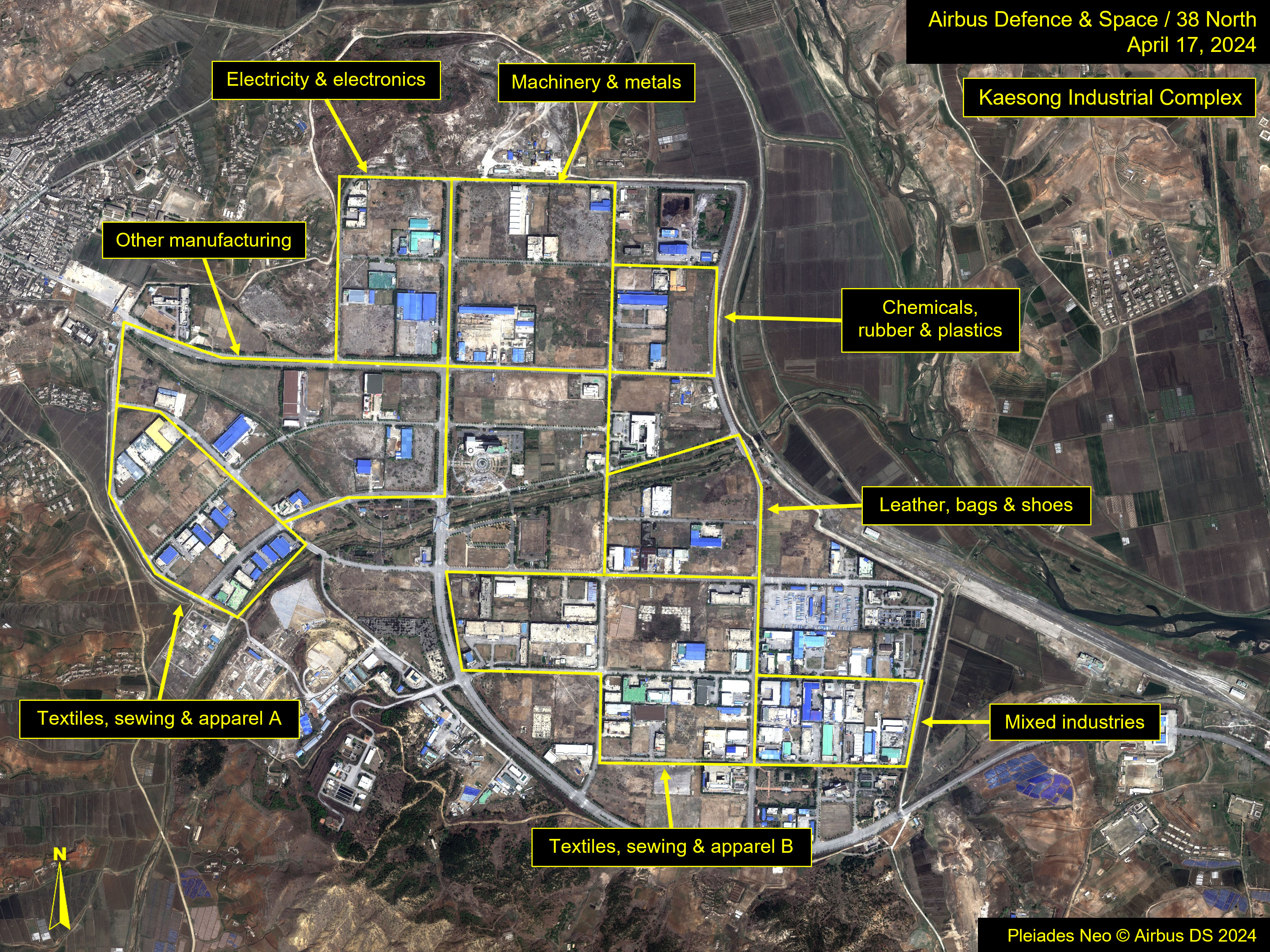
Initial plans grouped factories into sectors based on the types of goods produced, including electricity and electronics; machinery and metals; chemicals, rubbers and plastics; textiles, sewing and apparel; leather, bags and shoes; and mixed industries and/or undefined manufacturing sectors.
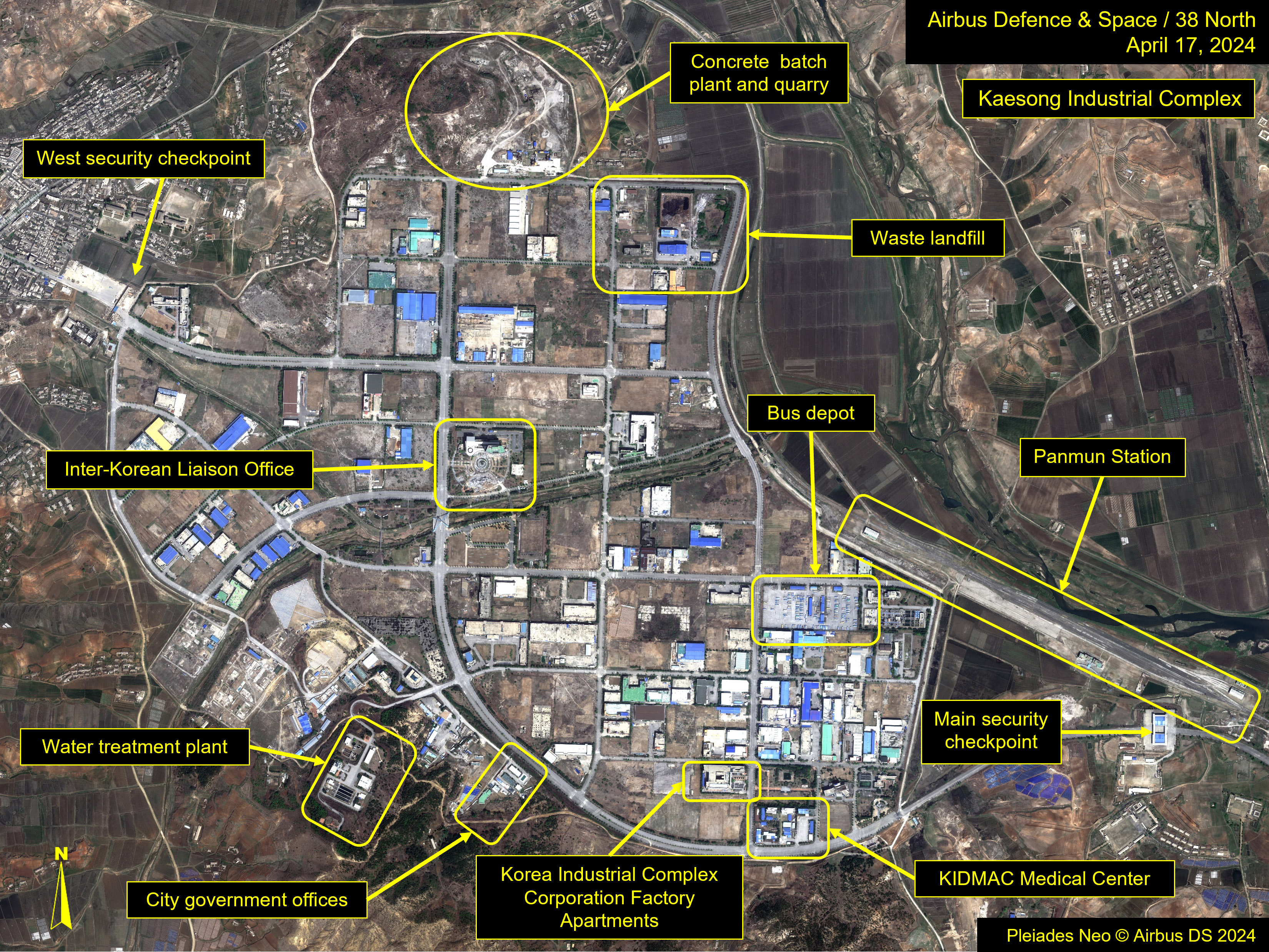
The complex also held several support elements, including a hospital and medical center, a landfill/open garbage dump, a water/waste treatment plant, city government offices complex, the Kaesong Industrial District Management Committee office, a quarry and concrete batch plant, and importantly, a bus depot where vehicles transporting workers to and from the complex were kept, potentially alluding to the level of activity occurring within the confines of the KIC. In 2018, as inter-Korean relations improved, an Inter-Korean Joint Liaison Office was also established within the compound.
The complex briefly shuttered in spring 2013 when North Korea unilaterally recalled its workers and closed borders to the South in response to broader inter-Korean tensions. This period was marked by a series of North Korean nuclear tests, North Korea unilaterally ending inter-Korean peace pacts, and general hostility coming from both sides of DMZ. Despite these tensions, negotiations to reopen the complex began a few months later and by September, operations restarted.
After North Korea’s satellite launch in February 2016, South Korea’s President Park Geun-hye unilaterally announced the ROK would close the KIC, asserting that North Korea was utilizing funds from the complex to fuel its WMD program. The South then moved to shut off electricity supply to the area.
Upon closure in February 2016, some equipment and materials were left behind in hopes of a near-term reopening, much like the brief closure and reopening in 2013. Yet, despite multiple attempts to reach consensus to reopen the KIC, it has since remained shuttered.
The Rise and Fall of the Inter-Korean Liaison Office
In 2018, the two Koreas pushed for the revival of large-scale inter-Korean economic projects, including the KIC, as committed under the Panmunjom Declaration. An Inter-Korean Liaison Office was established in the center of the KIC, with hopes that further implementation of the agreement would follow swiftly. However, neither side was able to secure the sanctions exemptions needed to move forward, and eventually both US-DRPK and inter-Korean negotiations collapsed in 2019.
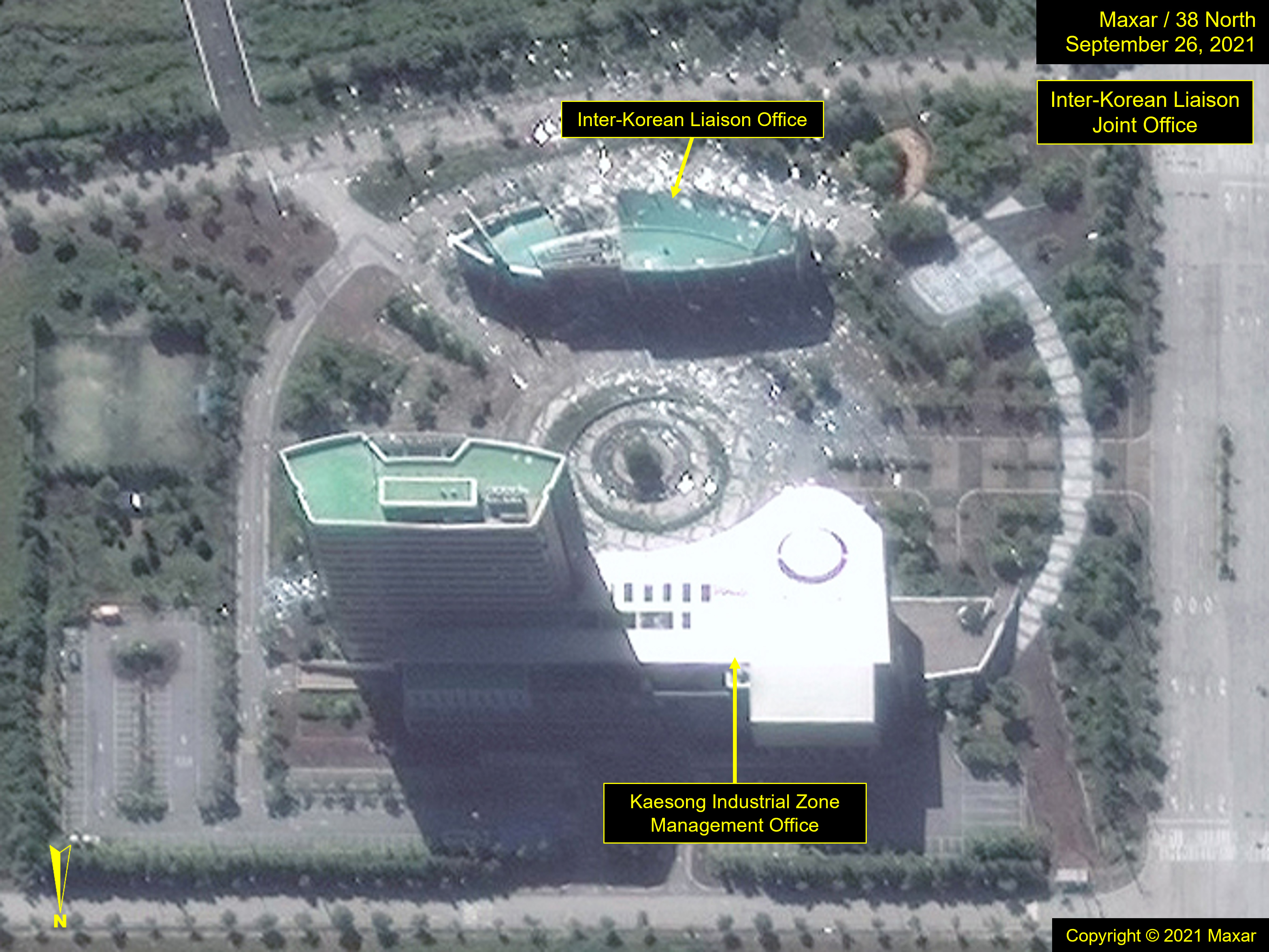
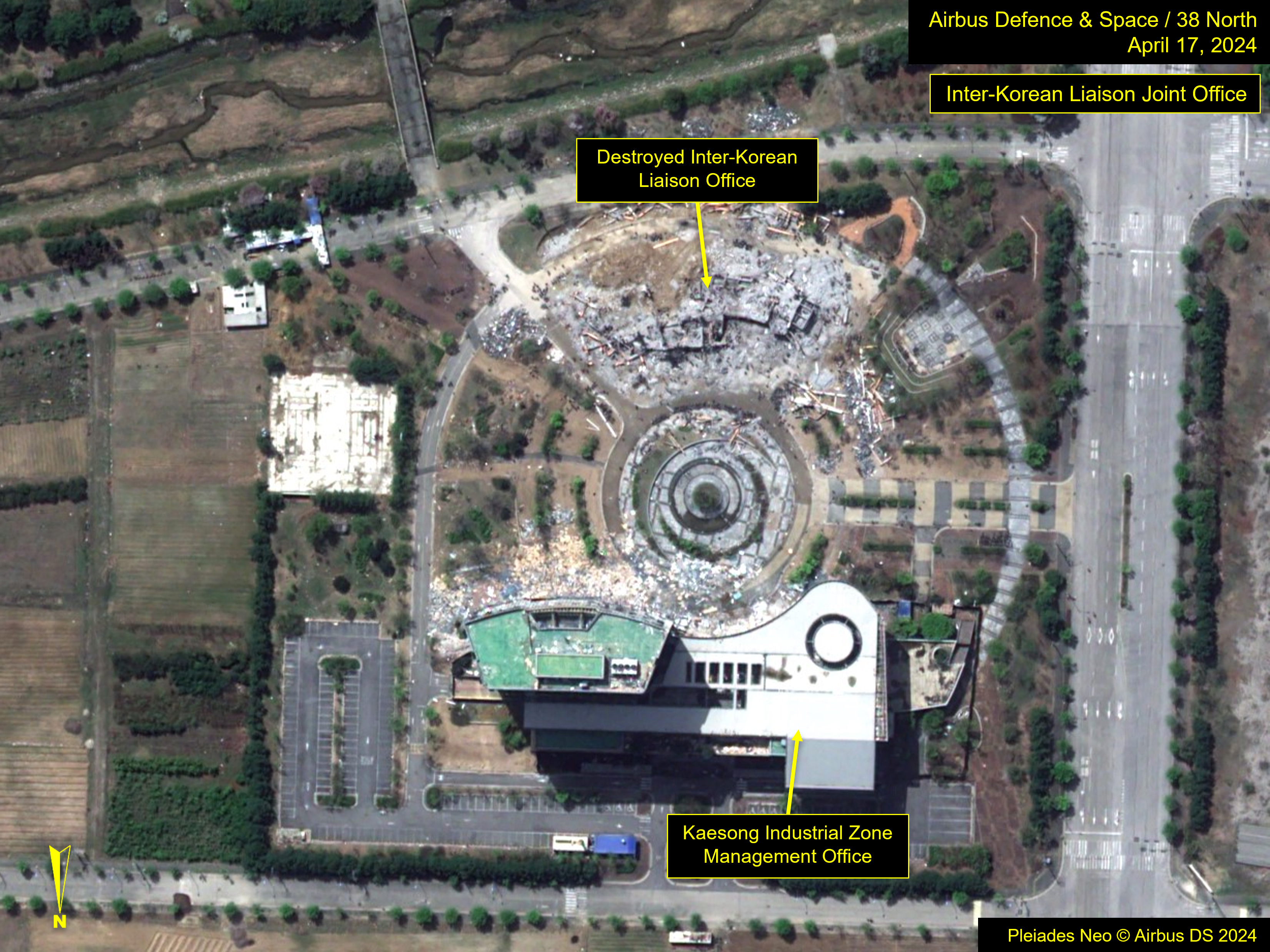
In June 2020, North Korea destroyed the inter-Korean liaison office as a dramatic display of how much inter-Korean relations had deteriorated. North Korean state media reported the building as being “tragically ruined with a terrific explosion, calling it an “eyesore” that was “unnecessary and useless. Of the two buildings in the complex, the explosion was targeted at the joint liaison office but also caused significant damage to the Kaesong Industrial District Management Committee office nearby. (See Figures 3a-3c)

Activity Around the Complex
There have been rumors that North Korea has coopted various parts of the KIC since its shut down in 2016. It is difficult to corroborate these assertions using only satellite imagery due to a shortage of outwardly visible signatures for factory operations and the infrequency of imagery captured. However, some observable activity around the complex provides clues as to its operating status in recent years, especially around the support facilities.
Bus Depot
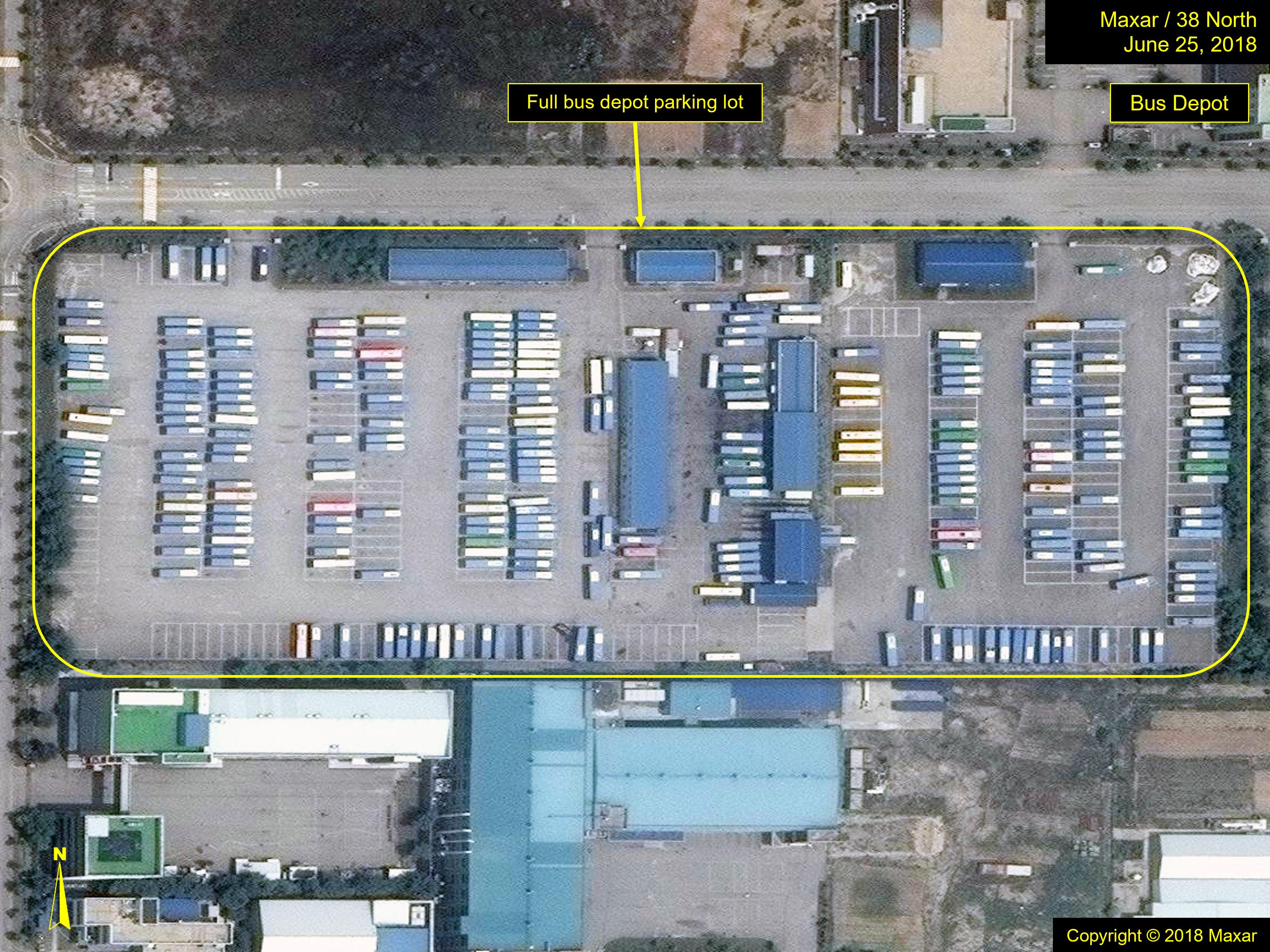
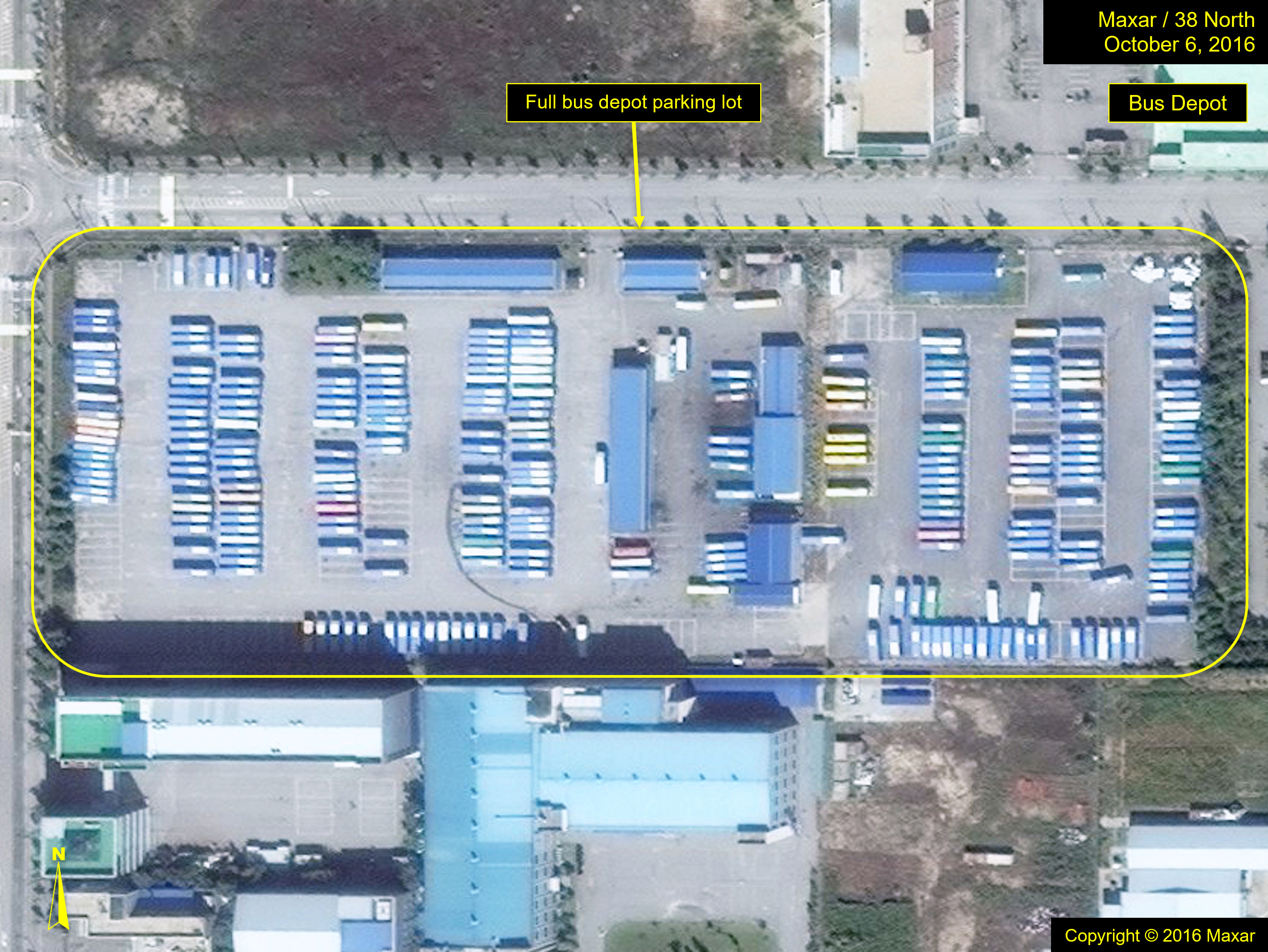
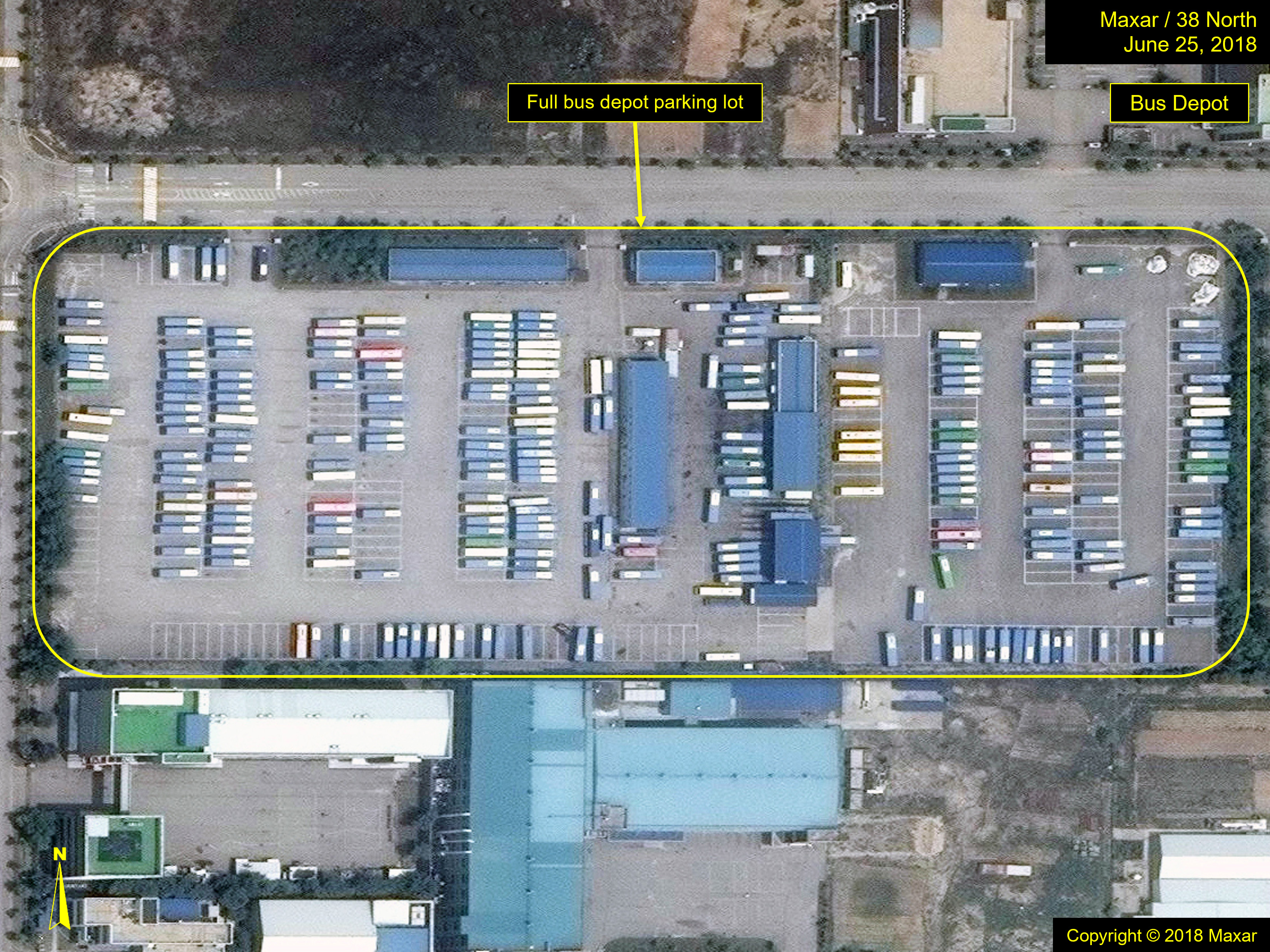
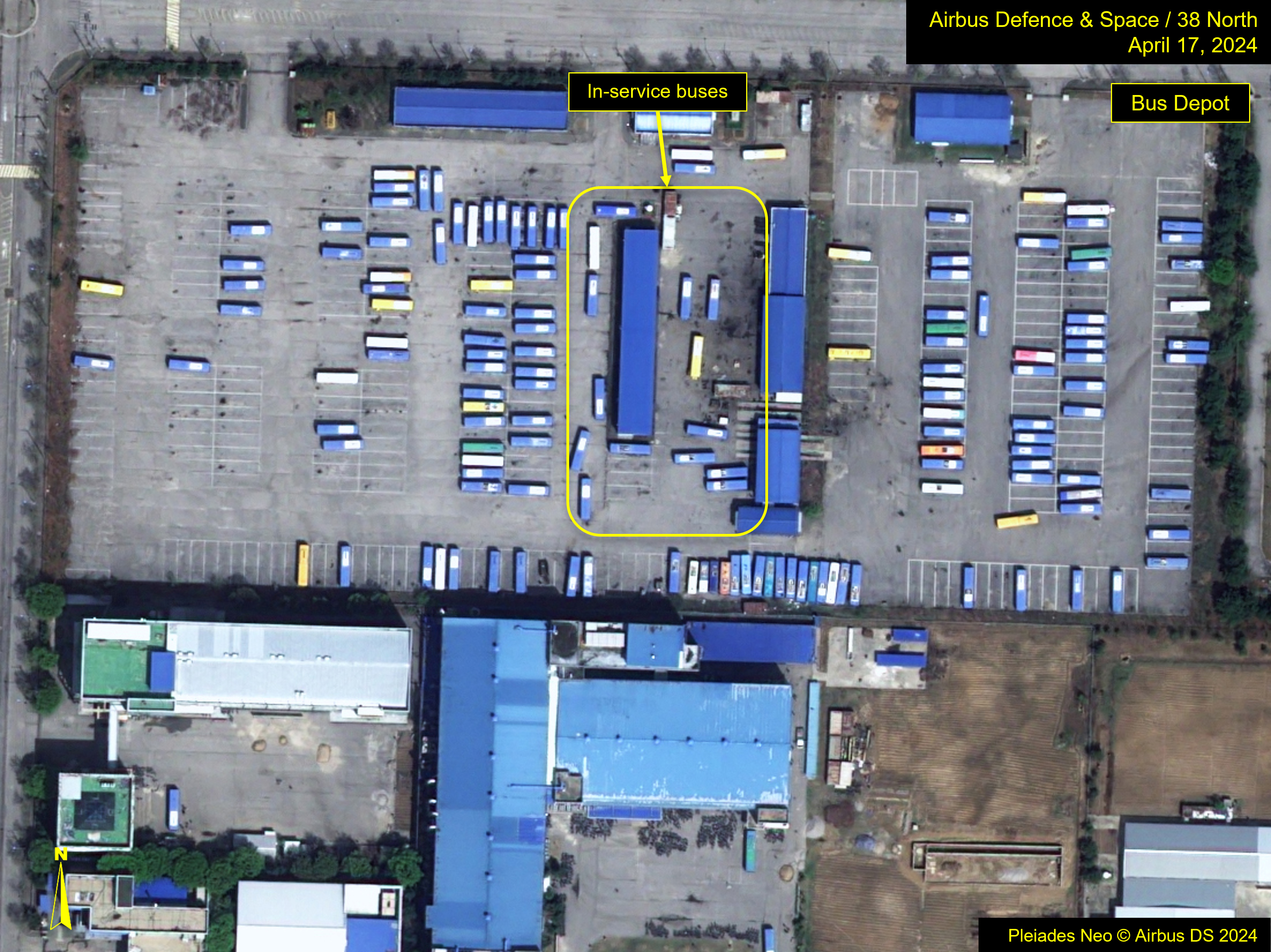
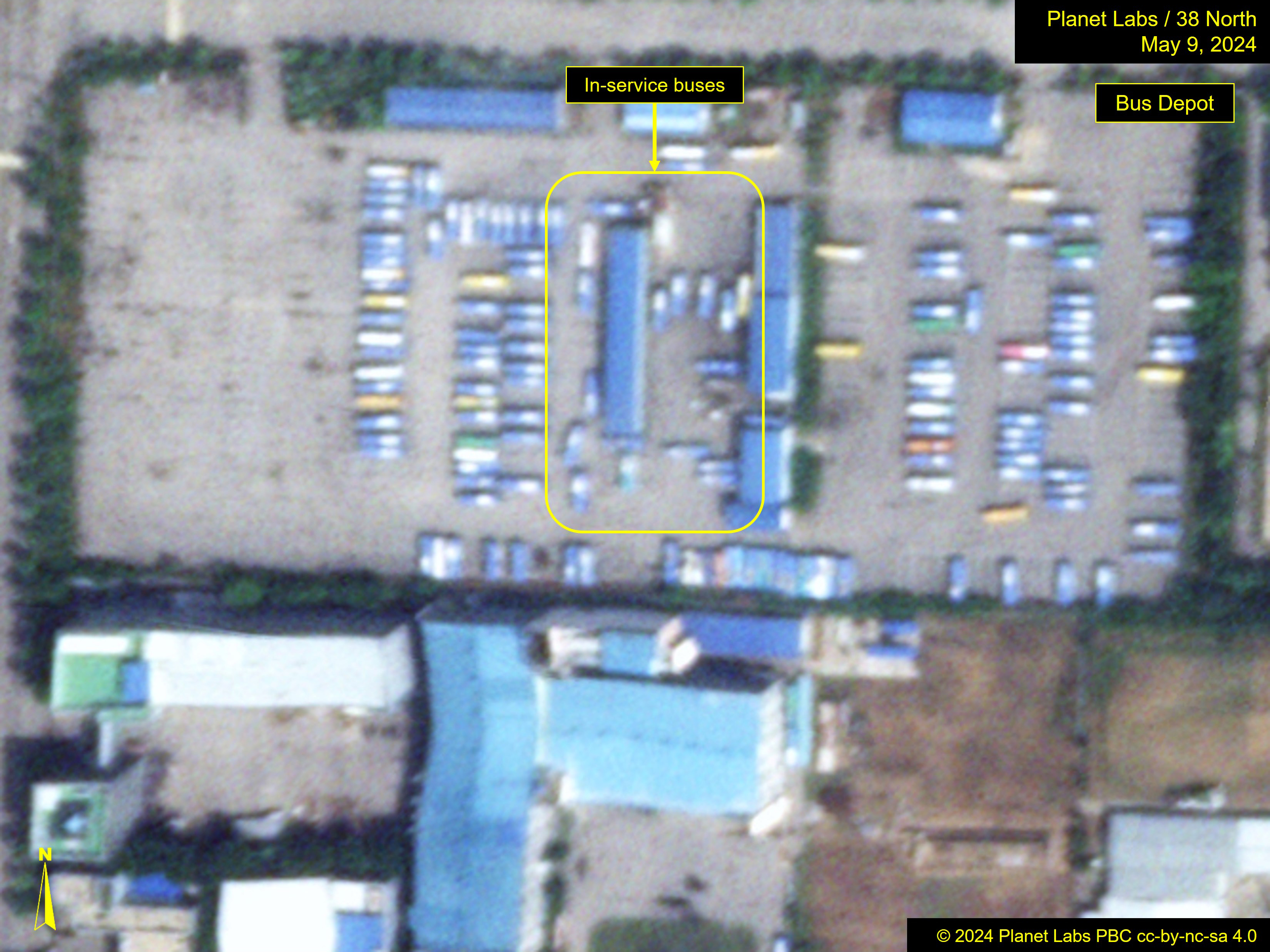
Though there are few consistent indicators to the full extent of the KIC’s operation, vehicle parking patterns at the bus depot provide some insights. At full operation, South Korean-owned buses were utilized to transport North Korean workers to KIC each day and remained parked at a depot located toward the east of the complex’s boundary overnight. The number of vehicles became a relative measure for the size of the workforce employed at Kaesong—as the complex grew, so did the number of buses parked at the depot.
In 2015—around the peak of activity at KIC—approximately 300 buses were routinely observed in the parking lot, arranged in an orderly fashion, alongside additional support vehicles like trucks, mobile cranes, and large trailers. During operations, these types of vehicles could be observed at factories around the complex, whereas buses typically remained in the lot. With this as a baseline, subsequent imagery reveals a gradual fluctuation in the number of buses and other vehicles over time.
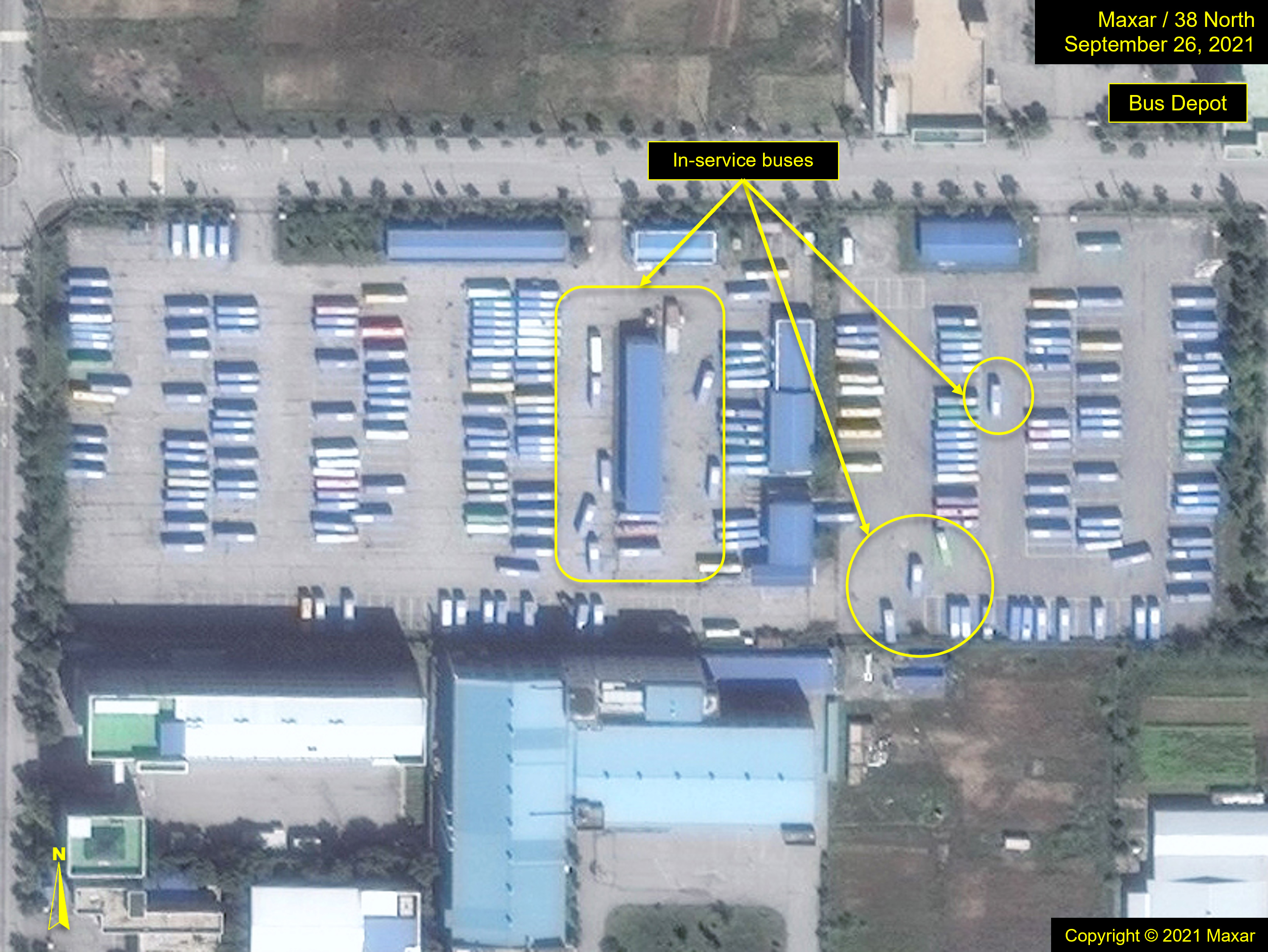
On imagery from June 2020, the total number of buses parked at the depot was around 280 at the time of capture. Most vehicles remained in the same positions they occupied four years prior, although some were observed in different positions within the depot, indicating at least some activity had taken place. While day-to-day movements at the KIC are impossible to determine from satellite imagery alone, especially given infrequent coverage of the site, the relative positions suggest very little activity during that four-year period. However, on imagery from May 2024, half the buses parked at the depot since 2016 were dispersed throughout the complex.
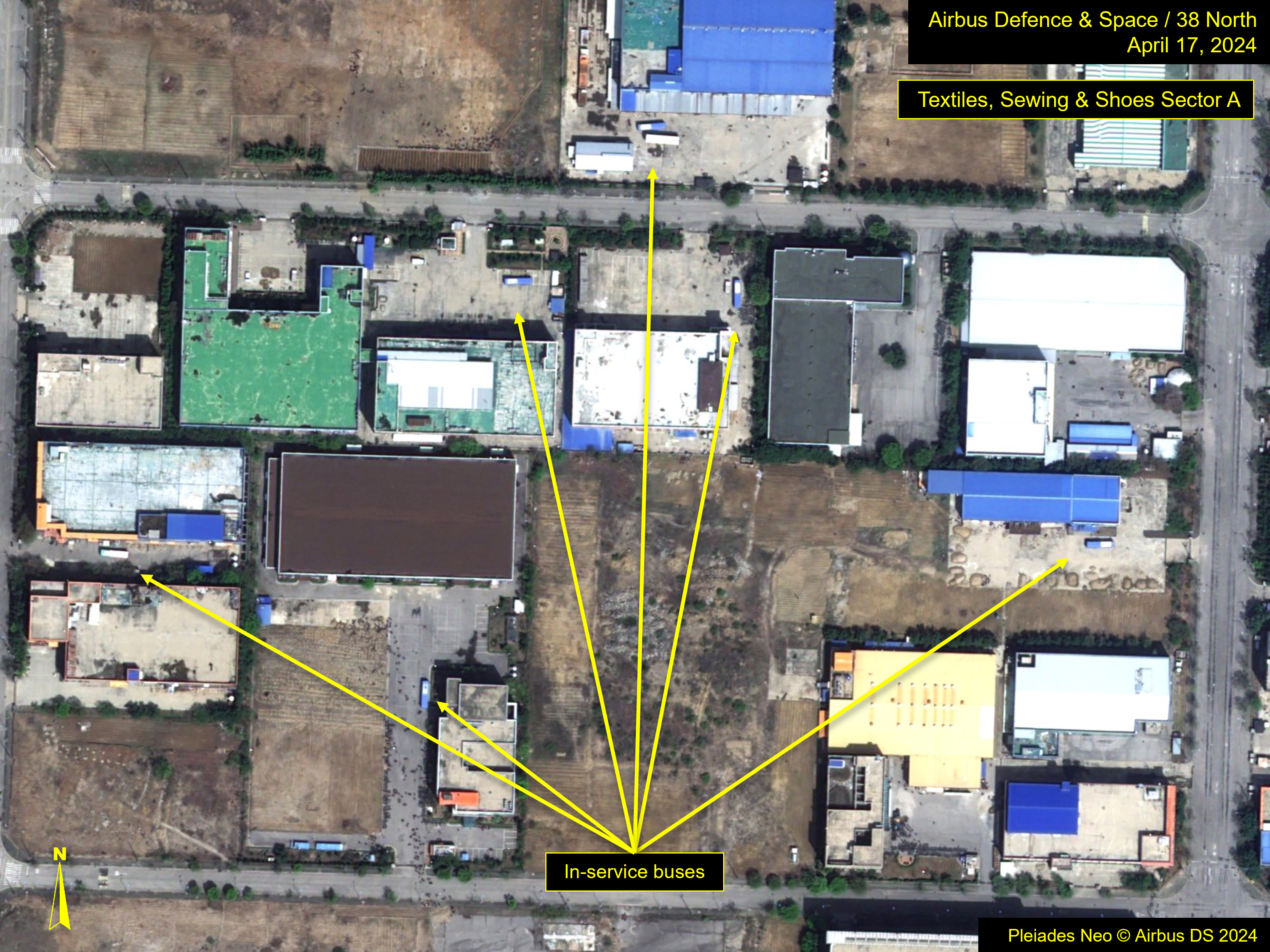
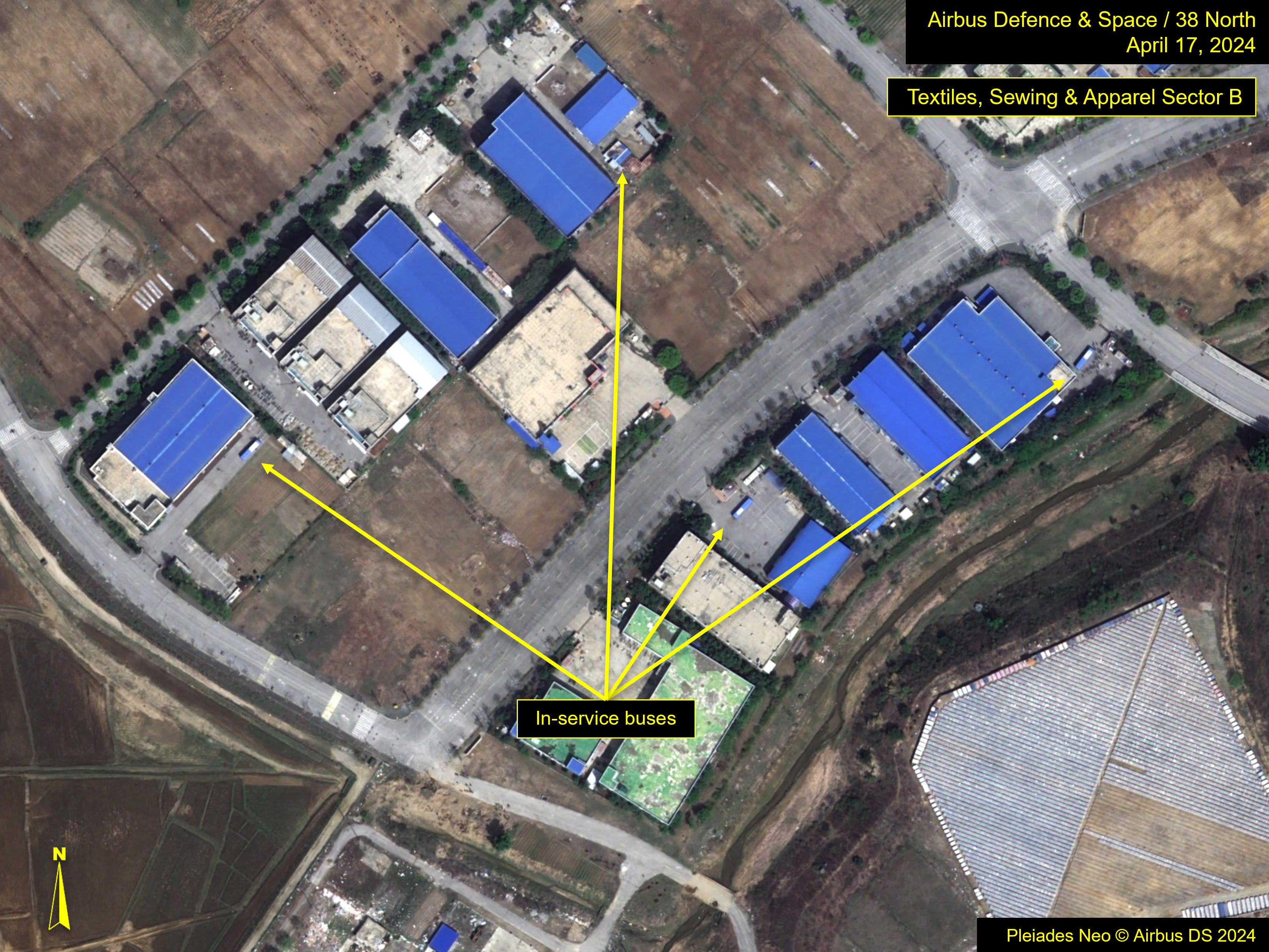
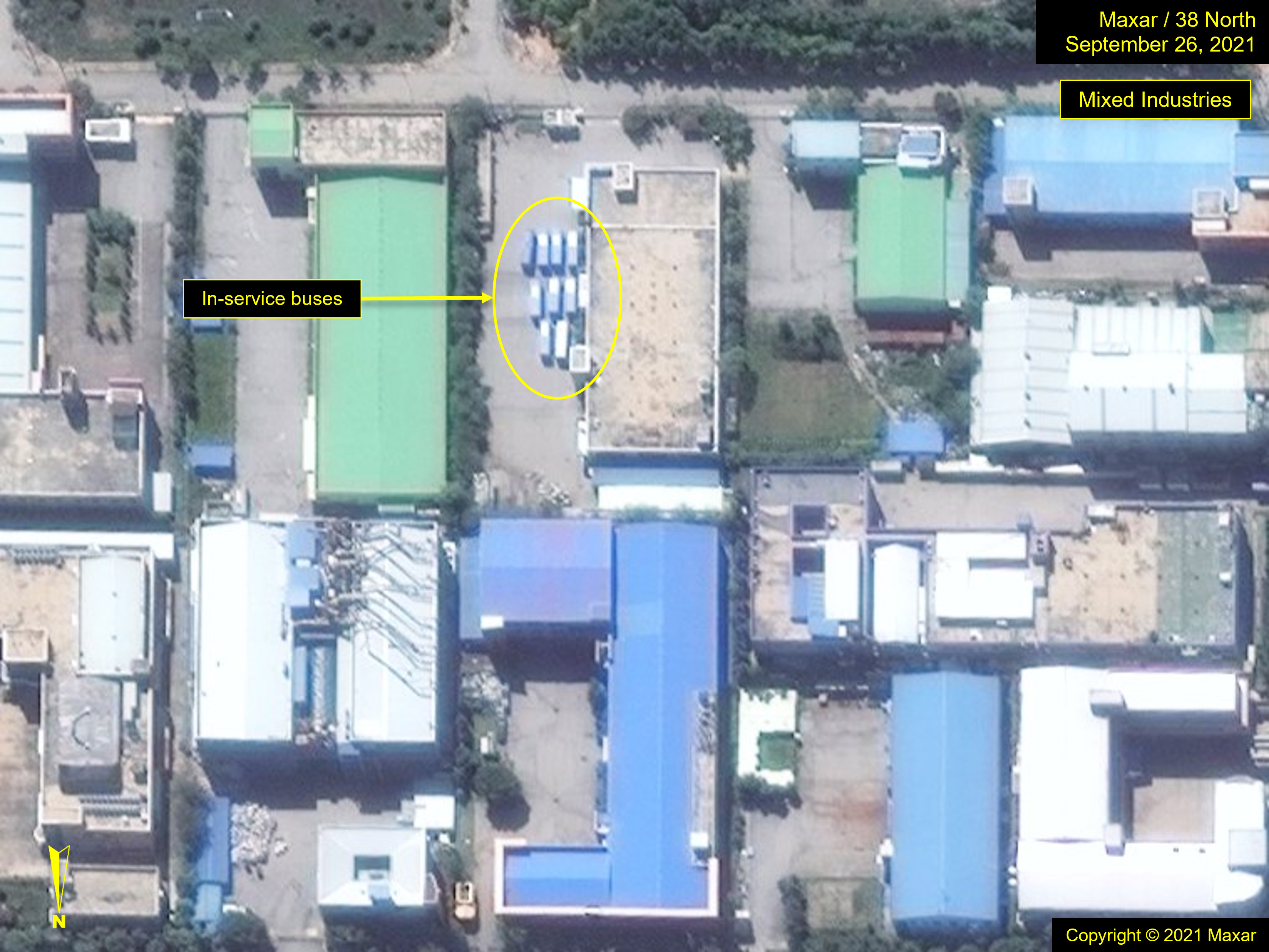
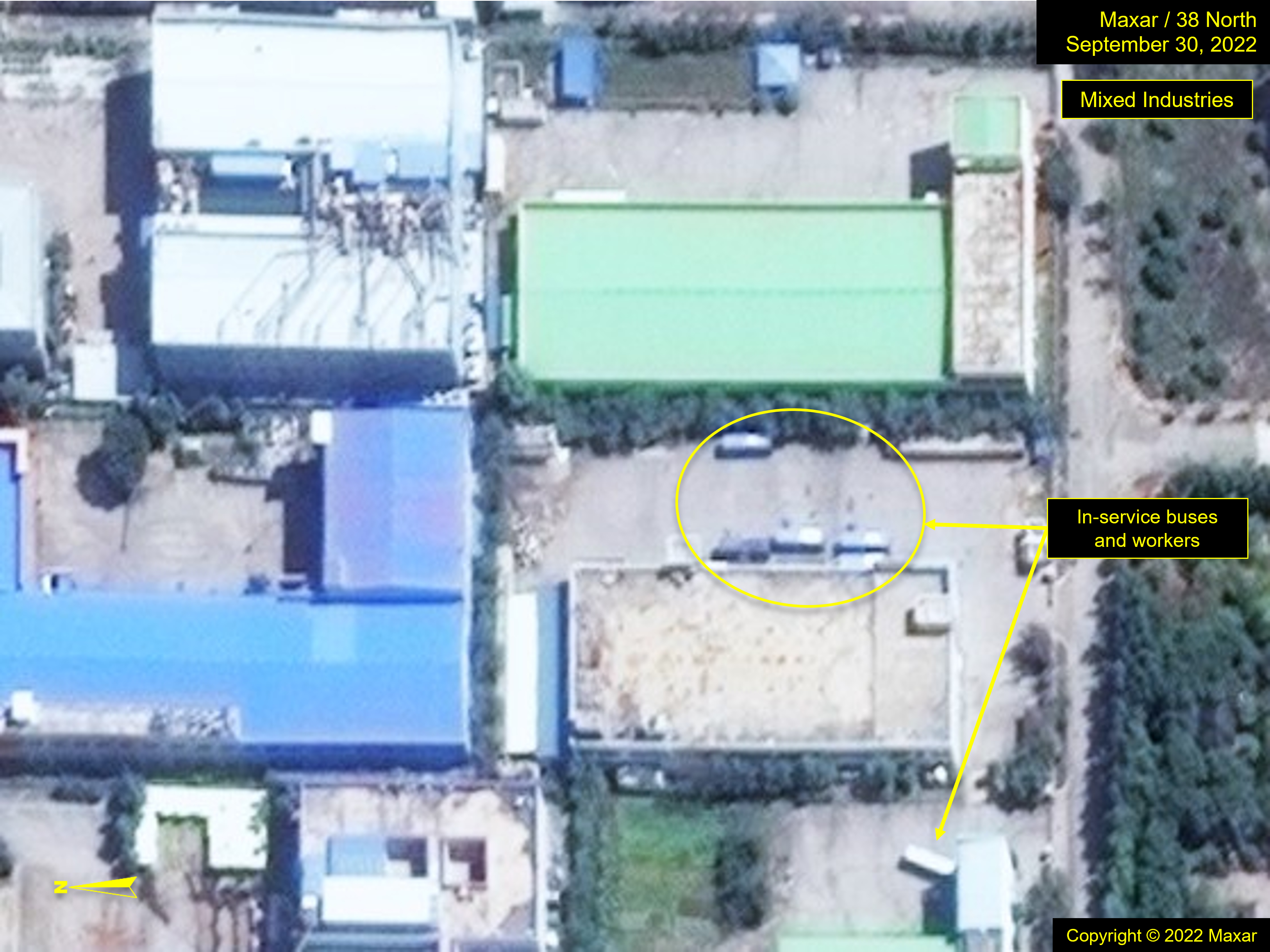
Moreover, several images from 2020 to present show buses parked nearby various factories and sectors. While not enough evidence to fully discern which building(s), if any, are in use, the locations of these buses throughout the site provide some clues as to which factories have been in operation, were being refurbished, or where parts and equipment were being transferred within the KIC or removed from the complex altogether. For example, buses have been observed outside of factories in sectors such as machinery and metals, electronics and electricity, textiles sewing, and apparel, and mixed industry. (See Figures 5-10)
Electronics and Electricity Section
Activity surrounding buildings in this area remained minimal until March 2021, when unidentified materials were observed on the ground within a rectangular enclosure located in the main parking lot. Materials remained through the end of September 2021. The purpose of these materials is unclear.
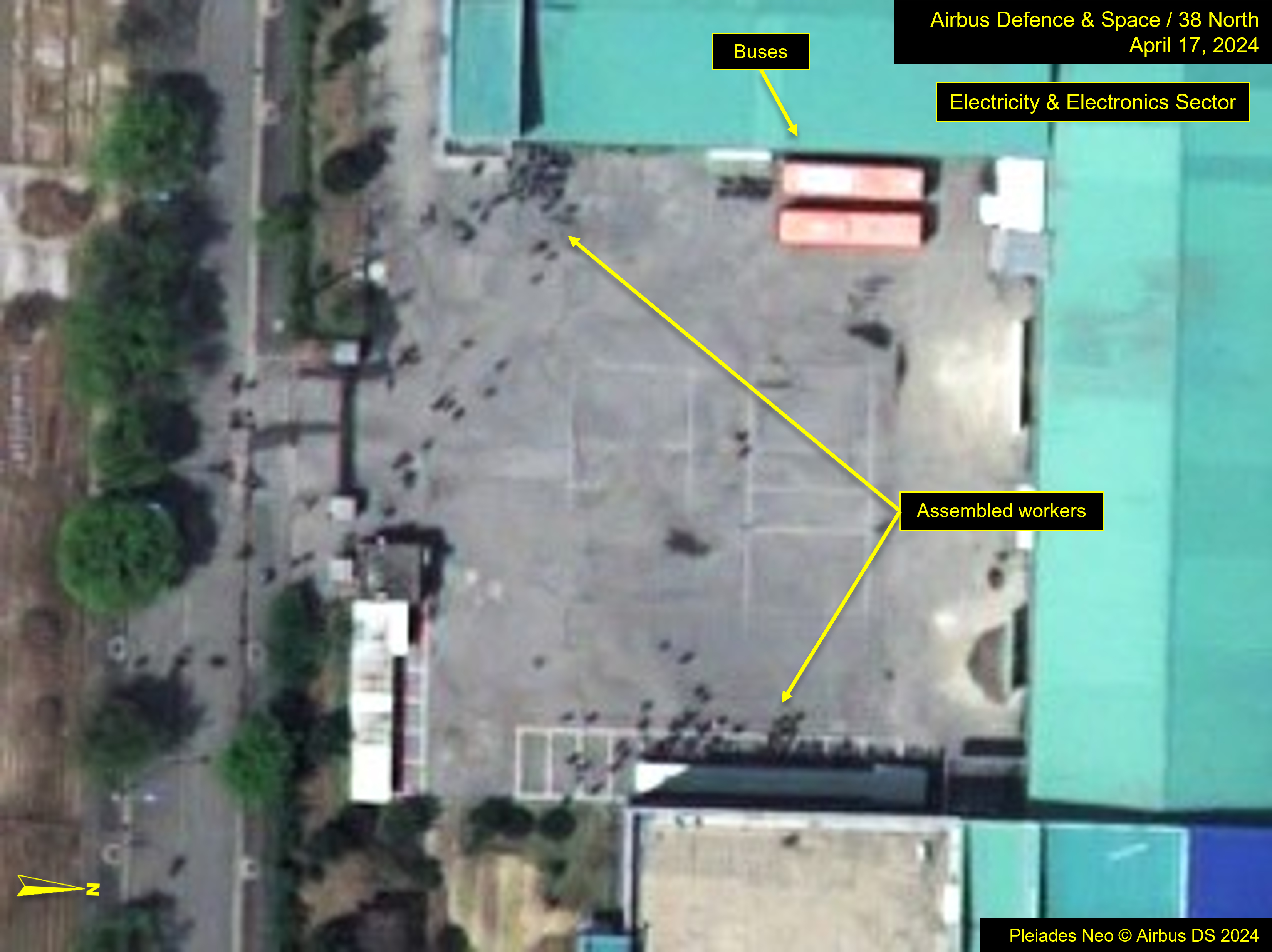
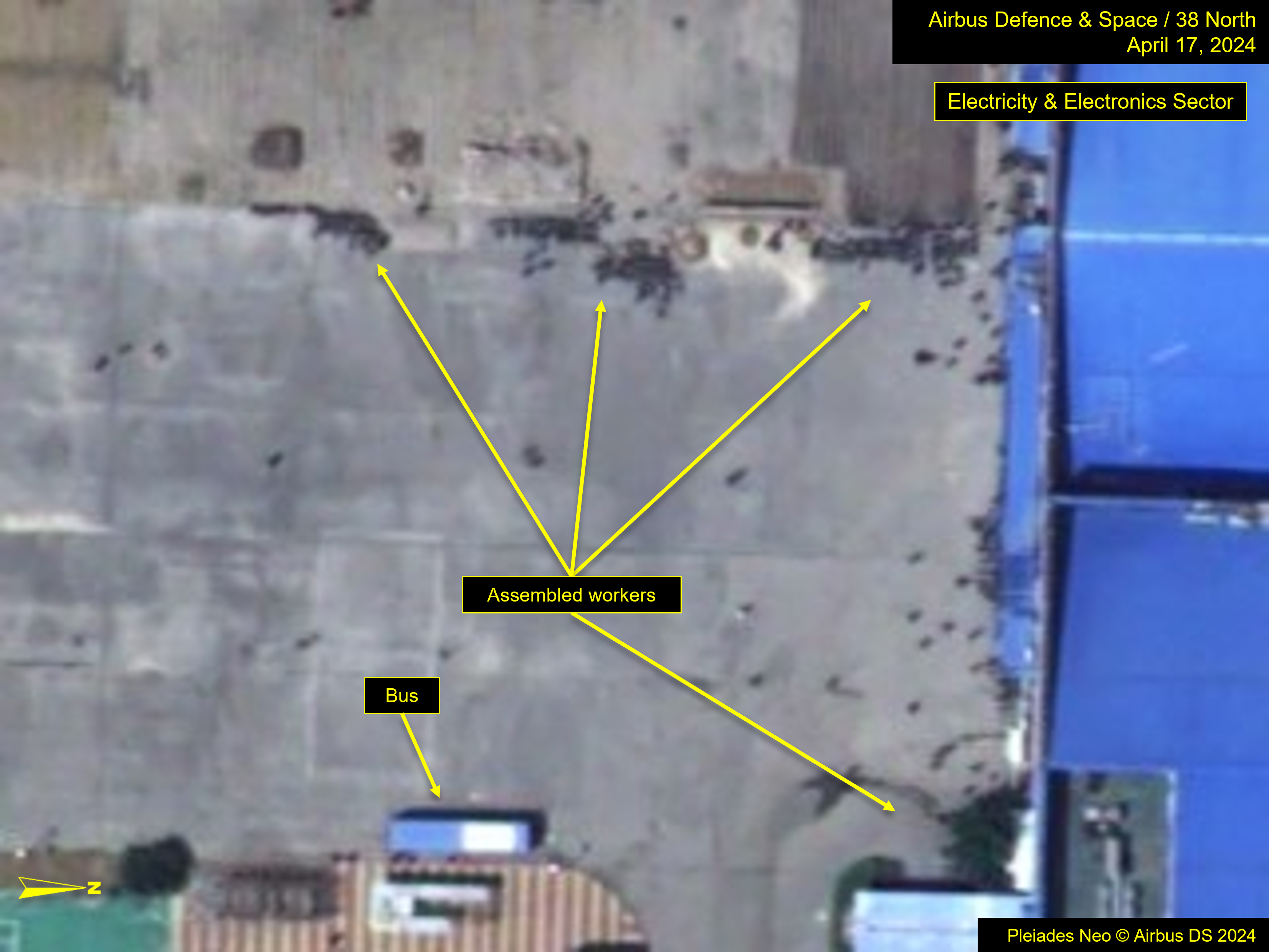
On imagery from April 17, 2024, three buses and large crowds of people—presumably workers—were seen in the area adjacent to Jahwa Electronics and Korea Terminal Industry buildings. The crowds were unusual to the area. Workers may have been gathered for refurbishment activity, training for new plant employees, or cleaning and maintenance at the factories or for their operation, though it cannot be determined with certainty based on imagery alone.
Machinery and Metals Section
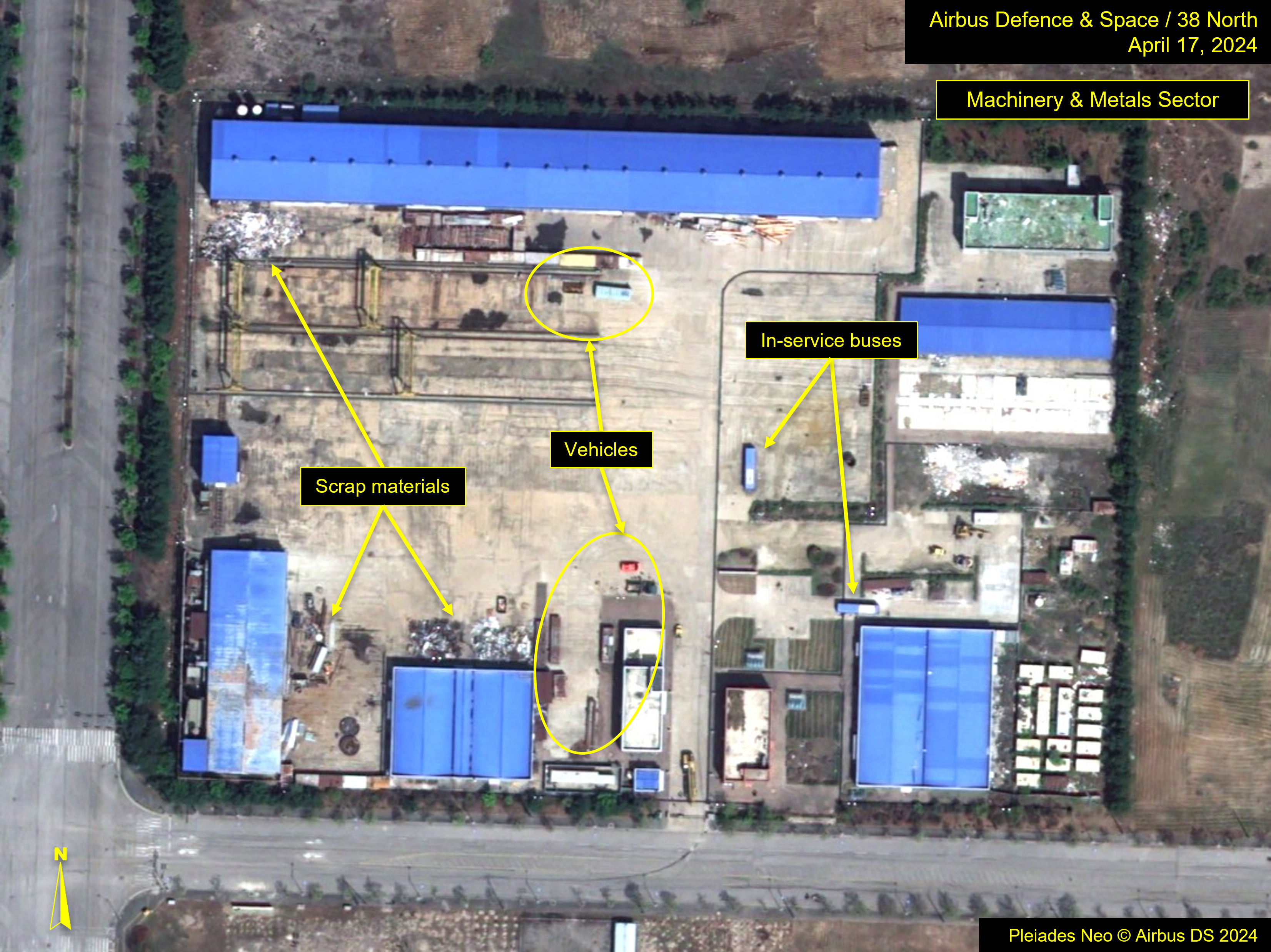
The area surrounding machinery and metals factories remained frozen in time until April 2023, when a mobile crane previously parked in the central lot was observed in a different location, and scrap materials had been removed from one of the buildings and piled outside.
On imagery from April 2024, two buses, several trucks, and other equipment were observed at the site and the amount of scrap material stockpiled had increased. Though the exact nature of the materials is unclear, they vary in nature and do not appear to be sourced from the same place. It cannot be said what exactly the scrap material is a result of, but the fluctuation of the size of the pile does signify that workers have returned to the factory for cleaning and/or refurbishment.
Chemical, Rubber, and Plastics Section
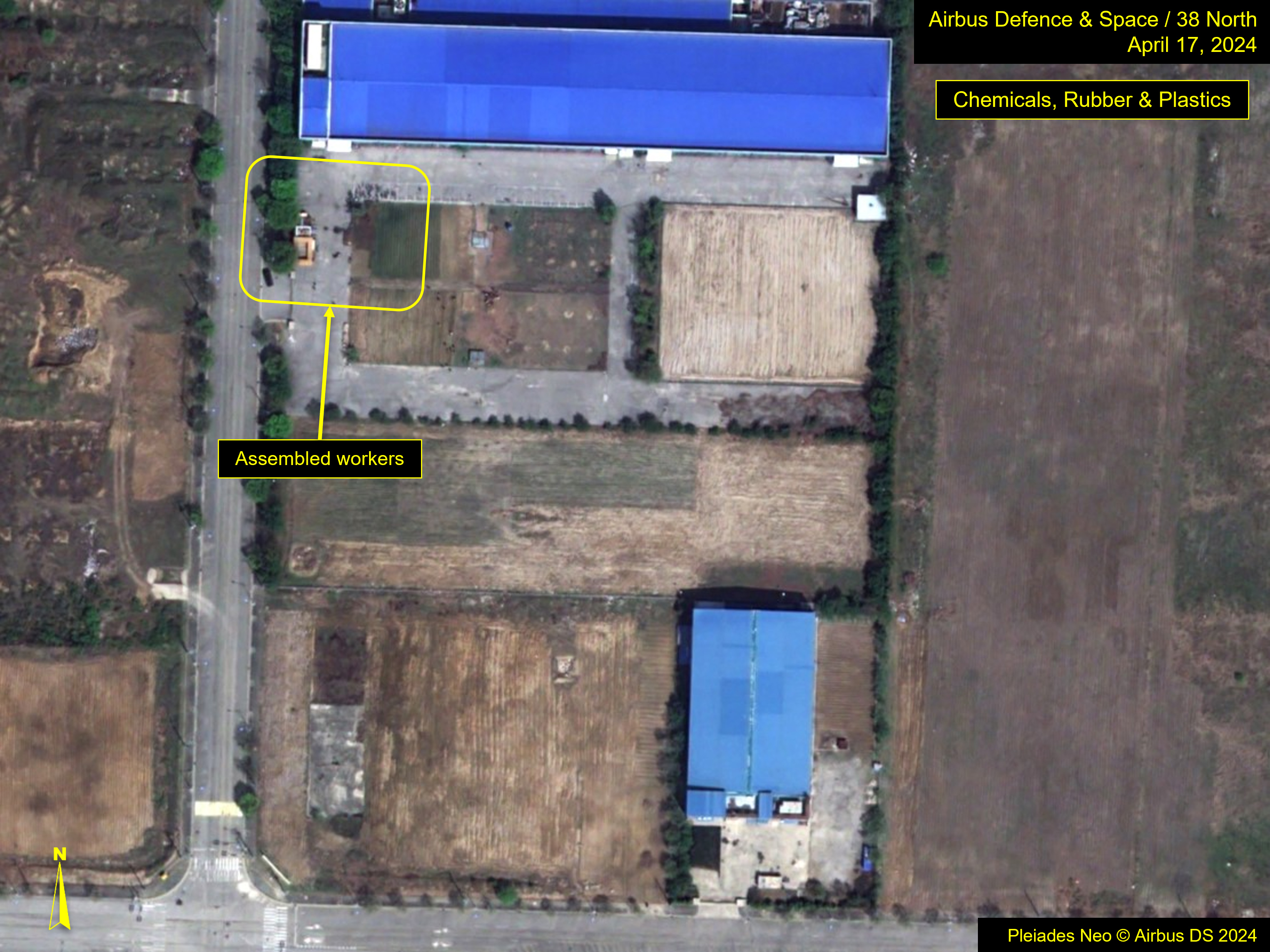
Unidentified materials observed near a compound in the eastern part of this area were gradually removed starting in 2016 until they had been completely removed by April 2020. Much of the material was covered by dark tarping, suggesting the need to protect it from the elements, likely for reuse elsewhere throughout the site.
Imagery from April 17, 2024 showed only one bus was parked outside this same compound, with no additional activity observed.
Textiles, Sewing, and Apparel Section
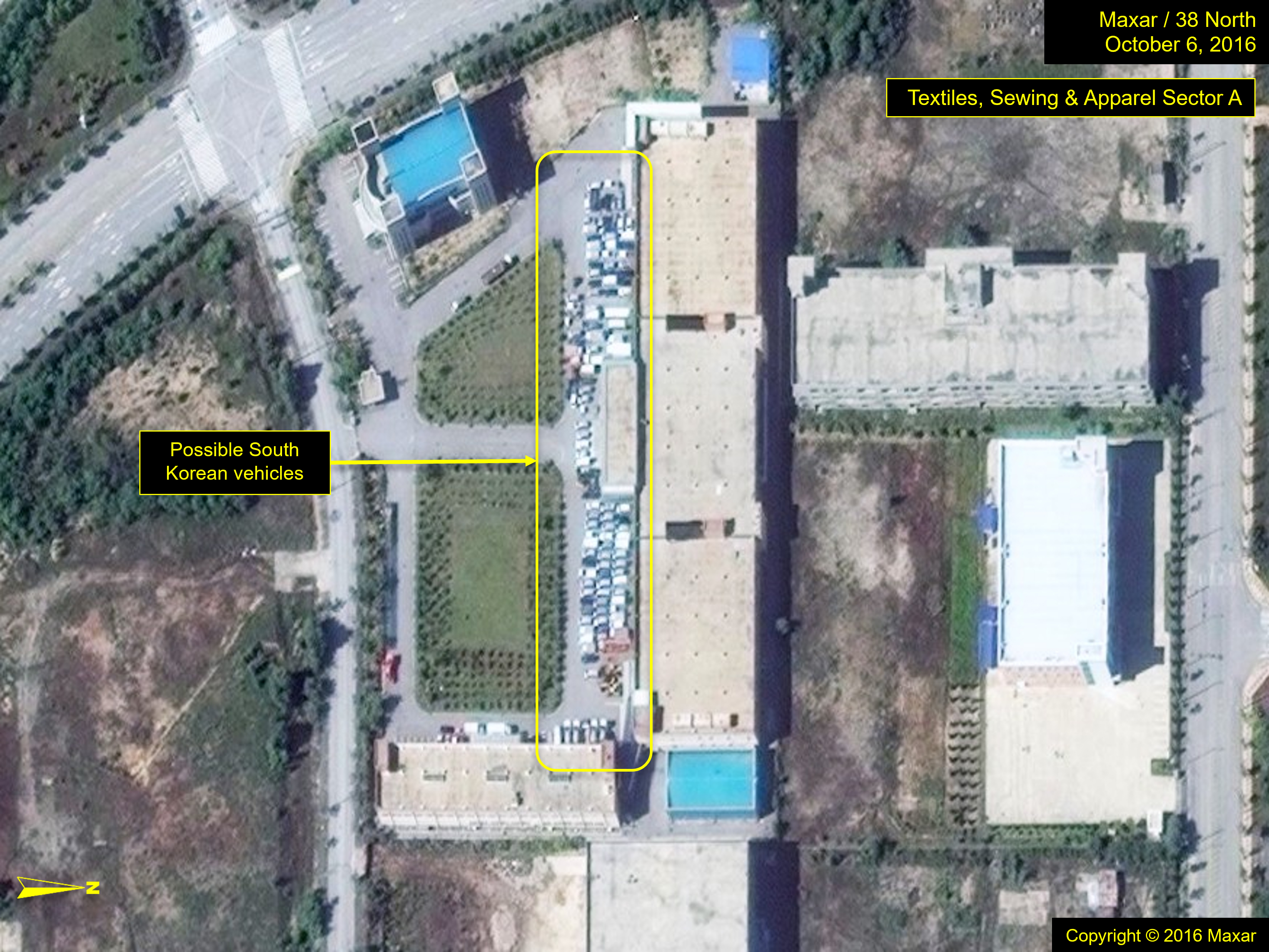
Two areas of the complex house factories that manufacture textiles—the larger is located in the south-central portion of the KIC and the other on the west side. In 2016, a gathering of private vehicles—automobiles, vans, and small trucks—was observed outside of a building within the larger grouping of textile factories. It is possible they belonged to South Korean workers at the KIC. All had been removed by 2017.
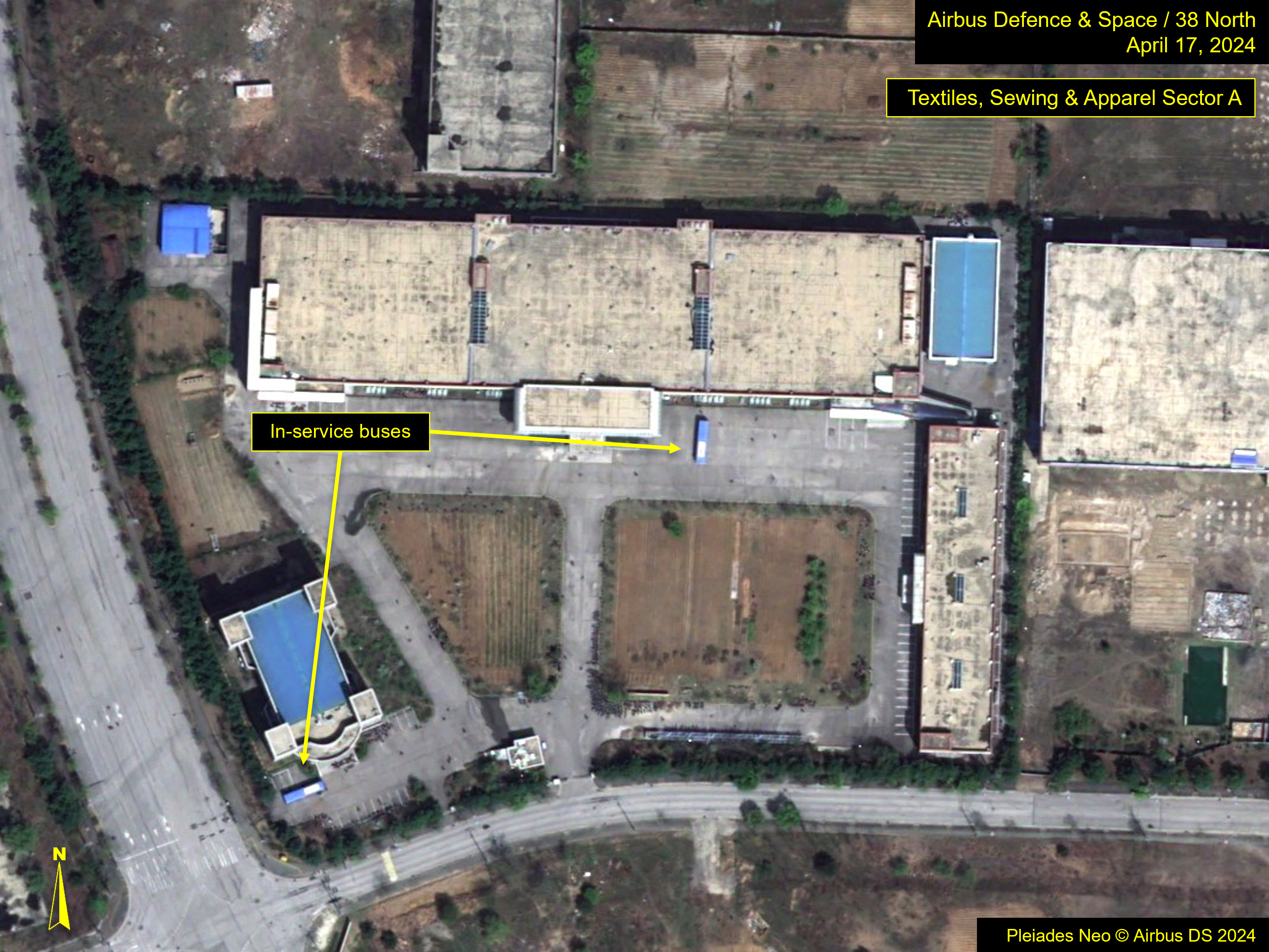
Little activity was observed throughout the area until April 2023, when five buses, a tractor-trailer, and approximately a dozen cars were present. The presence of vehicles continues and can be confirmed as late as imagery dated June 2024.
In the smaller grouping of textile factories, no activity was observed until personnel and buses were seen on imagery from April 17, 2024.
North Korea has been rumored to be utilizing textile factories to develop an industrial base, and prior to the COVID-19 pandemic to operate these facilities to fulfill orders from China. According to RFA, a North Korean official stated that Pyongyang had “renovated and expanded the clothing and footwear factories” at the KIC. While satellite imagery alone cannot confirm these reports, the presence of vehicles and crowds suggests that some kind of activity is occurring in this sector.
Mixed Industries Section
The mixed industries sector is composed of a breadth of different factories, including electronics, car pumps, watches, semiconductors, cosmetics, garments, etc. Unlike most of the other sectors, the mixed industries area revealed activity on imagery from September 26, 2021 where nine buses had parked together next to the Jaeyoung Solutech Telecom Components building. Buses and workers were observed in the same area on imagery from September 2022.
In April of 2023 and 2024, buses continued to be observed in this specific area, as well as scattered near several other factory buildings throughout the sector, suggesting some kind of ongoing operations.
Korea Industrial Complex Corporation Factory Apartments
Located in the southernmost area of the KIC’s boundaries is the Korea Industrial Complex Corporation Factory Apartments, built throughout 2006 and 2007 by the Korea Industrial Complex Corporation and opened to workers in September 2007. The building was reported to be a factory-apartment, housing 33 companies and 2,500 workers from both Koreas and rented for 4,500 won ($4.90 USD at the time) per square meter. A second factory-apartment building was also built by Kaesong Industrial District Management Committee the following year.
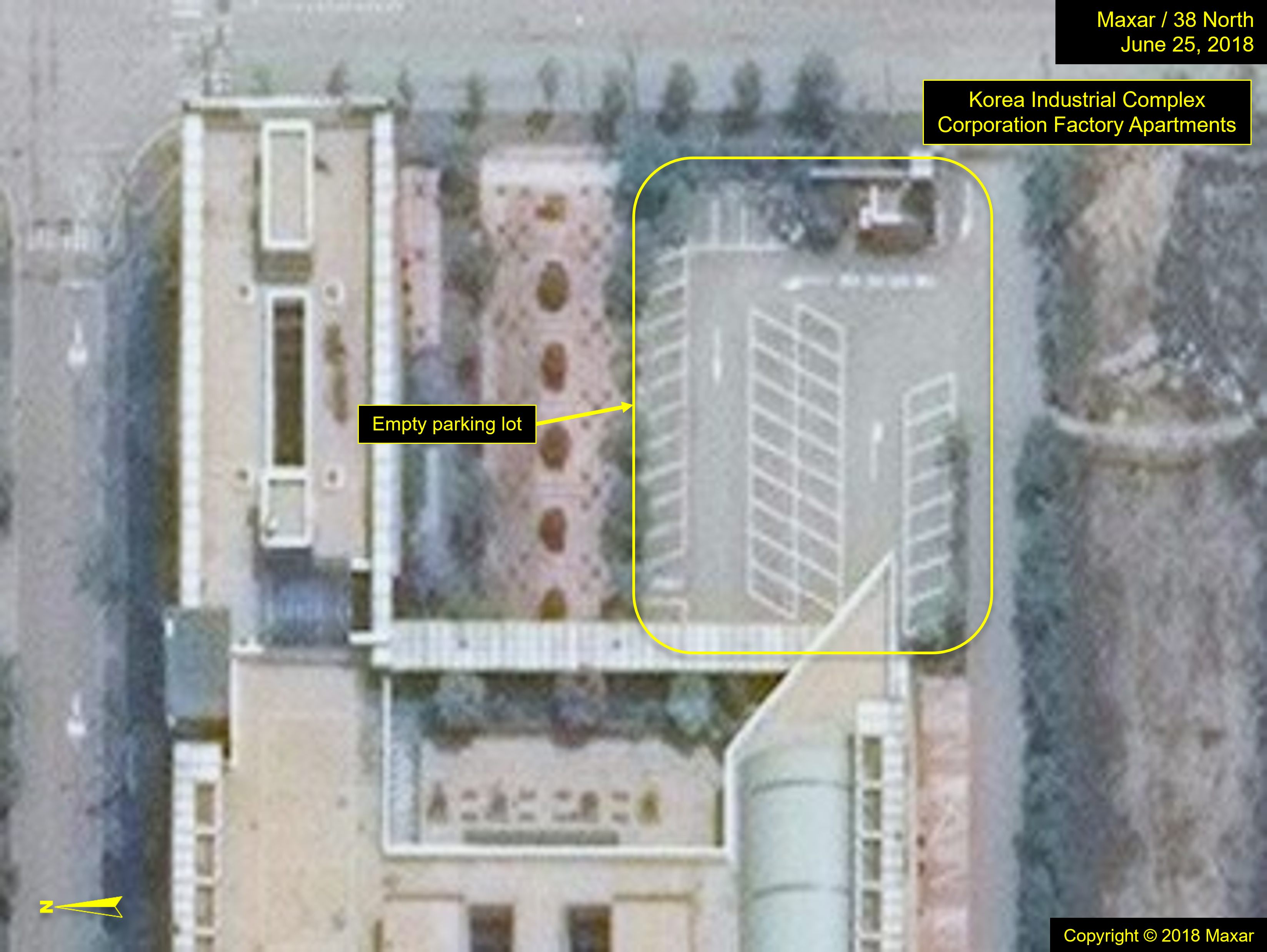
During the construction period, a bus lot located immediately to the west of the building was typically filled with private cars. Discernable activity around the building appeared to cease in 2016.
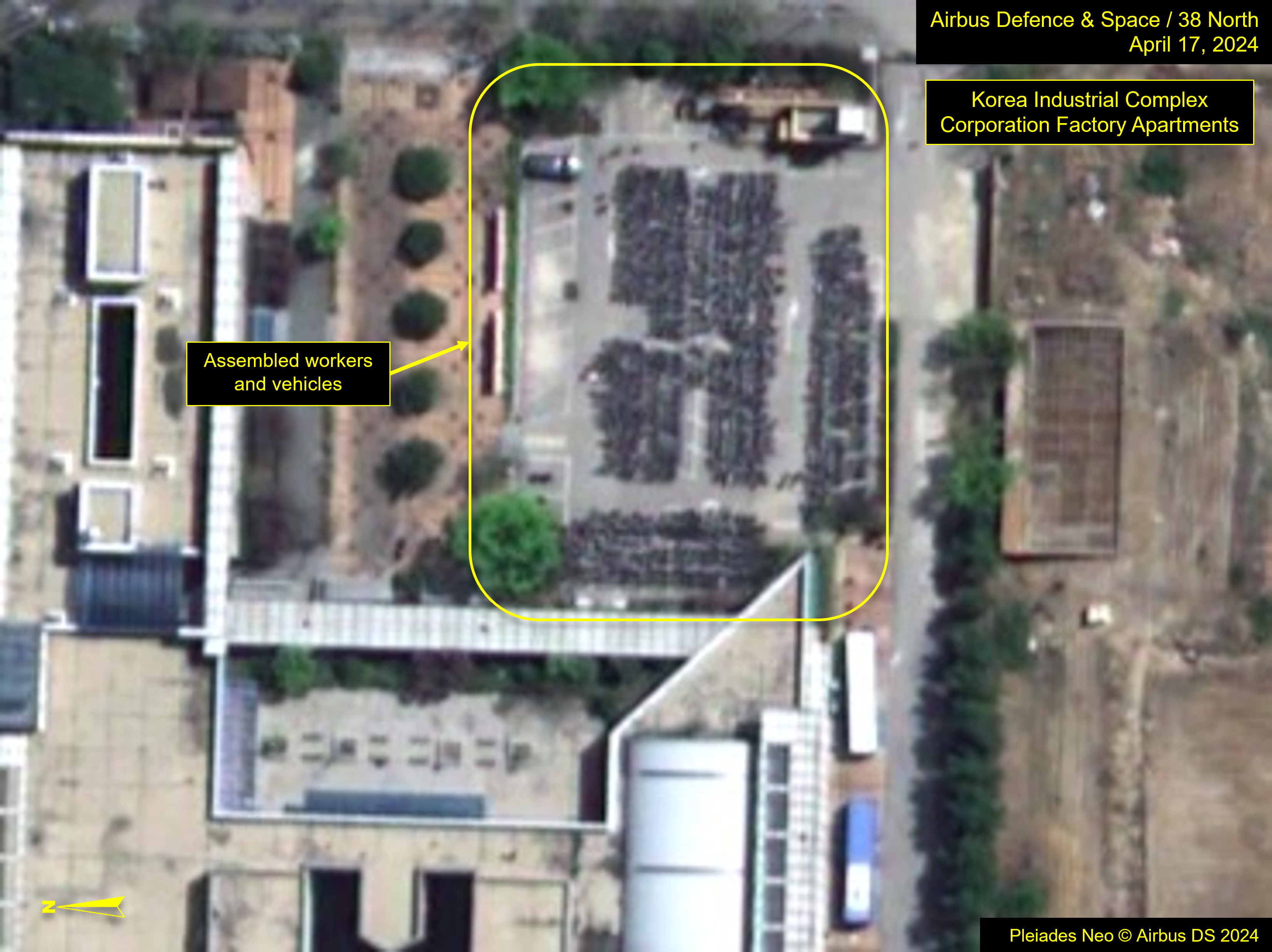
However, imagery from April 17, 2024 revealed two buses and a van, along with scores of people in large, organized groupings or formations in the parking lot. The purpose of this assembly is unclear, though could be attributed to workers living onsite due to the residential nature of the building. This gathering of people was observed on the same day as large crowds were observed in the Electricity and Electronics sector.
Other Support Facilities
Non-manufacturing facilities within the KIC also require monitoring—such as the landfill, the concrete batch plant, and city government offices.
Landfill
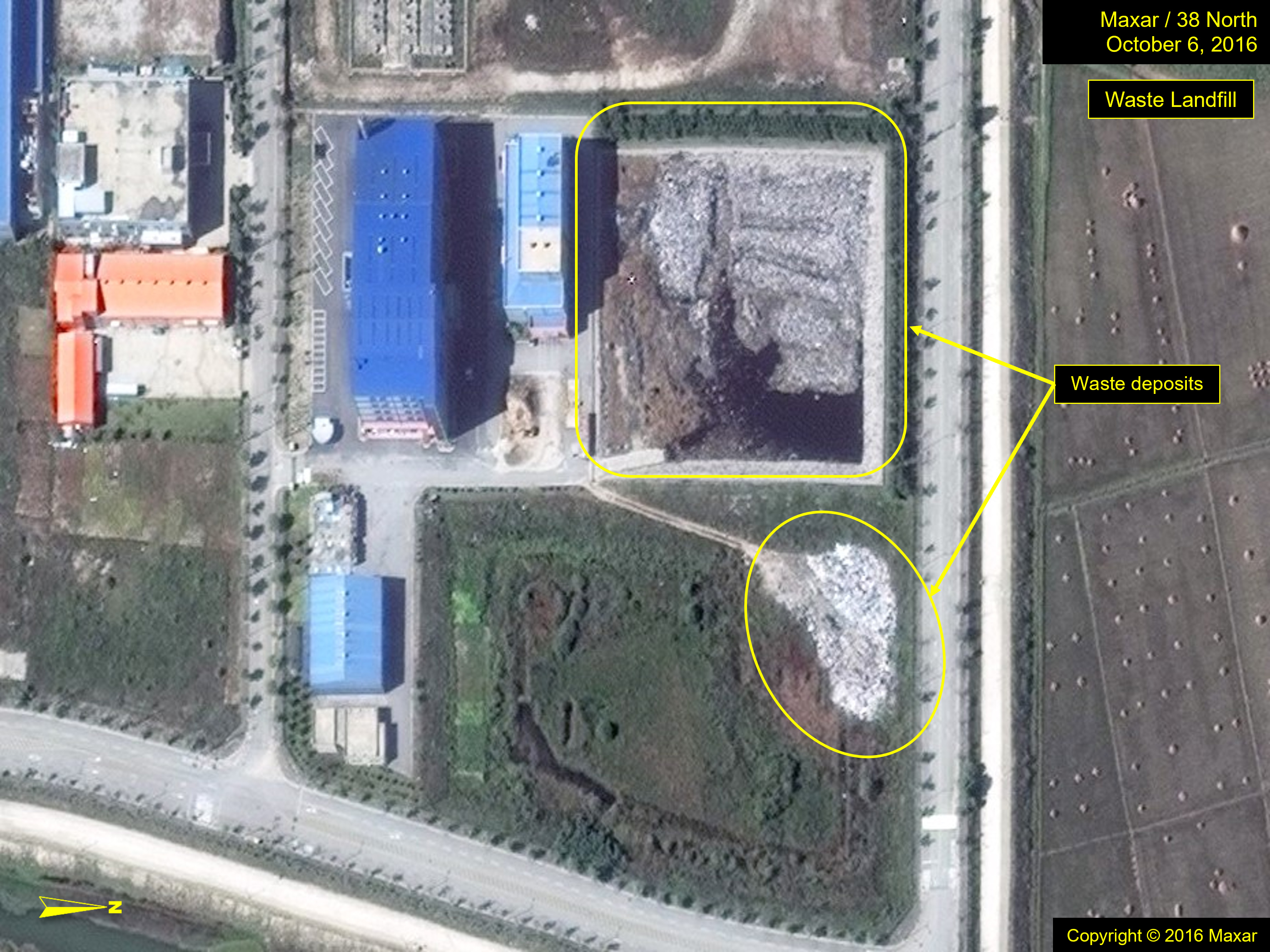
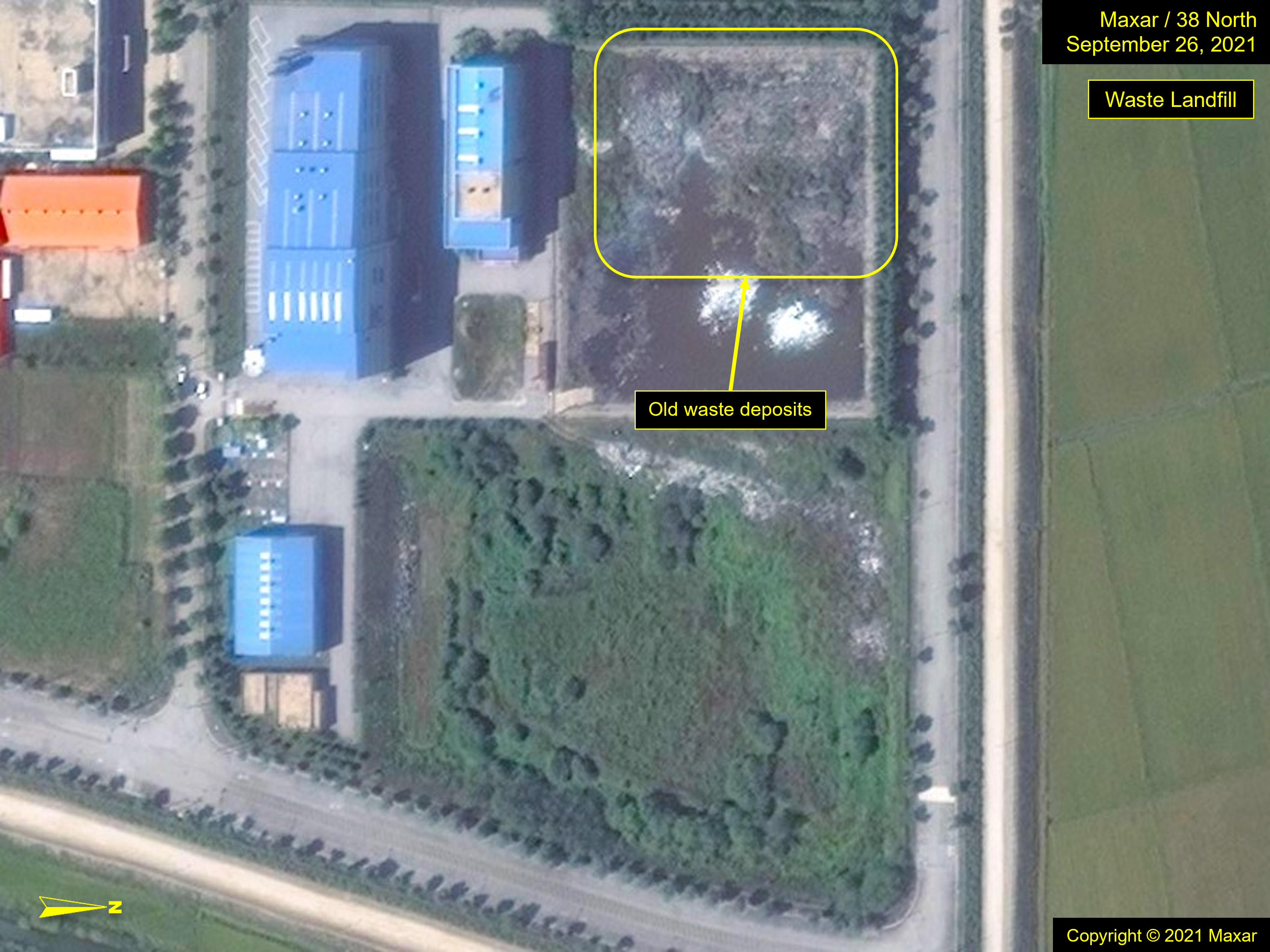
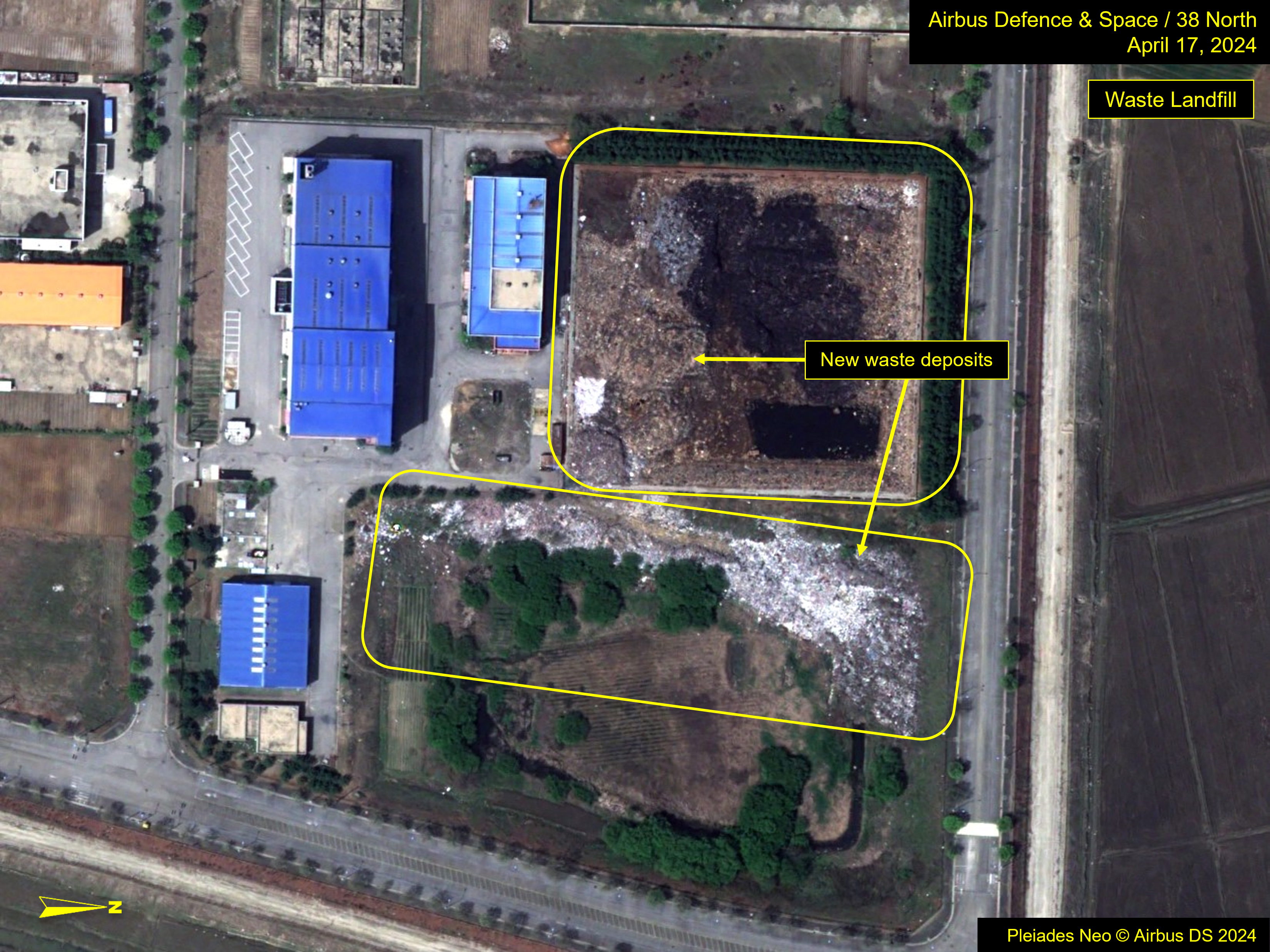
At the landfill, the amount of waste deposited began to increase significantly in 2021 after four years of little observed change. The increase in waste—comparing levels in 2016 to levels in 2024—could indicate that efforts to clean or refurbish factories throughout the complex may be underway, and possibly a sign of growth in operations. For instance, at the east waste pond, there was approximately 1,916 square yards of surface waste in 2016, compared to 3,004 square yards in 2021 and 4,417 in 2024 (0.4, 0.62, and 0.91 acres, respectively), representing more than double of the surface footprint. However, this is not a measure of volume, so the total amount of waste cannot be captured completely.
Concrete Batch Plant
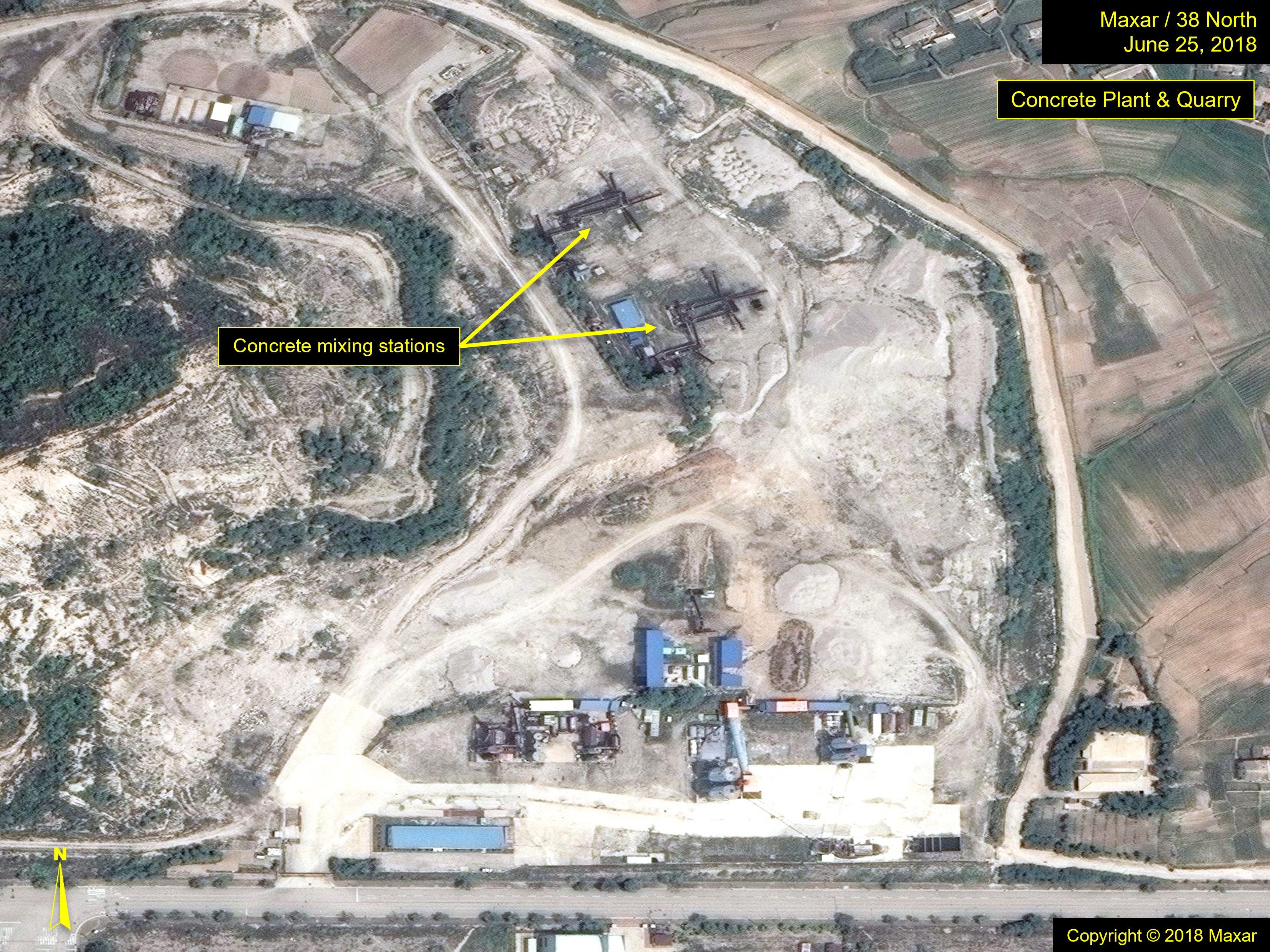
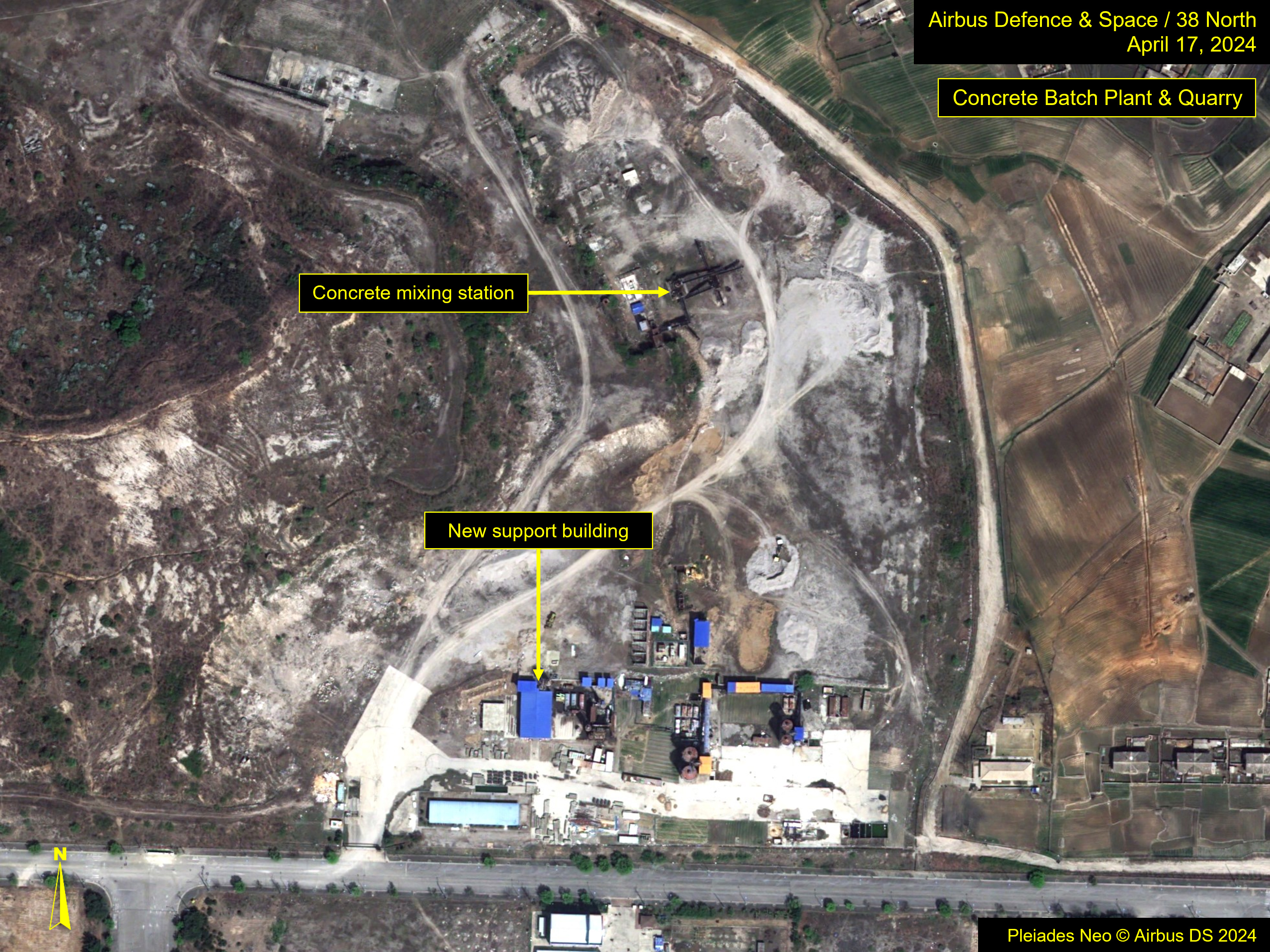
Located at the north end of the complex, a concrete batch plant played a large role in providing materials for the construction of factories at the beginning of Kaesong’s operation. The plant remained dormant until 2021, when imagery revealed subtle signs of activity beginning with the arrival of unidentified linear materials and material having been removed from a pile of aggregate—loosely compacted material fragments.
Imagery from April 17, 2024 revealed the number of mixing stations dropped from two to one, suggesting a lower possible output. A new support building had been added at the south end of the quarry, and vehicles were observed moving bulk materials around the facility. Small piles of aggregate near several factories also suggest some level of refurbishment to those buildings may be ongoing.
City Government Offices
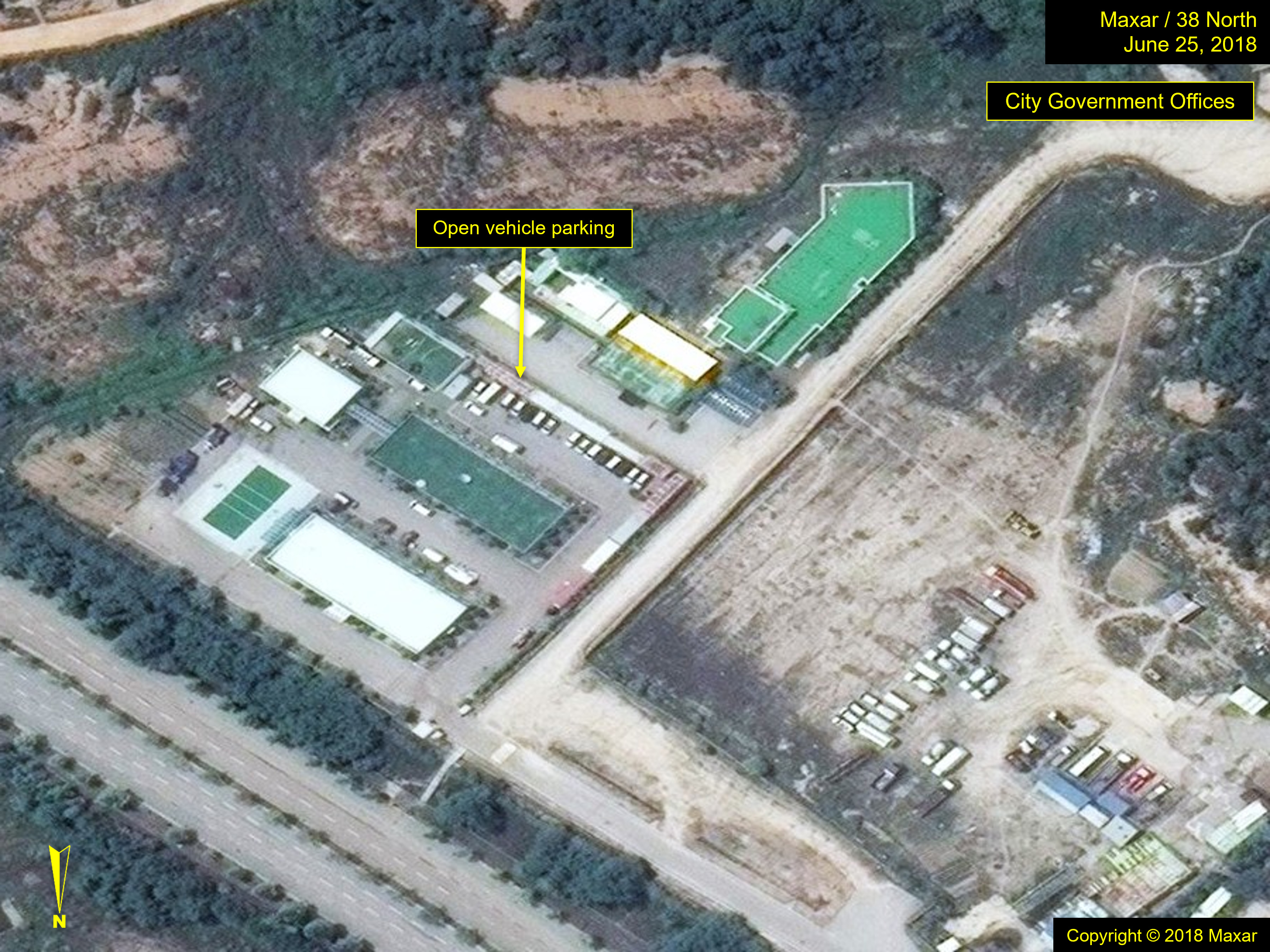
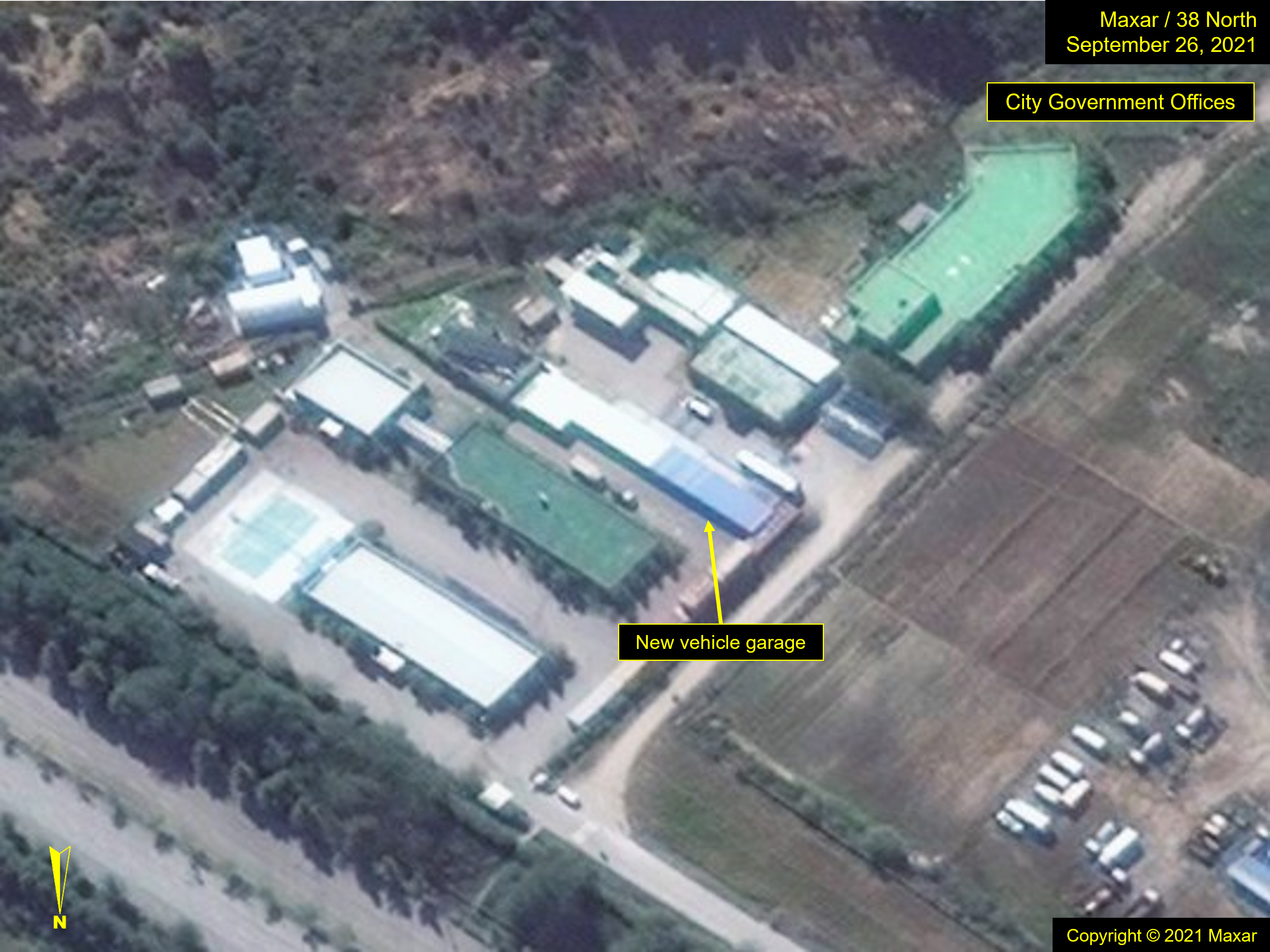
At the City Government offices, a long vehicle shed was built in 2020, covering a previously open parking lane and preventing imagery from capturing whether or not vehicles were parked there. No other activity in the area has been observed.
The framework for the partially demolished Inter-Korean Liaison Office remained in place until April 2024 when the remaining structure was reduced to rubble. The adjacent Kaesong Industrial Zone Management Office was also damaged in the blast, but the structure remains relatively intact.
Feb 10, 2016
Park Gun-hye announces unilateral closure of the Kaesong Industrial Complex.
Source: New York Times
Apr 03, 2013
North Korea bans South Korean workers from entering the KIC.
Soon thereafter, North Korea recalled its own workers from the site and South Korea recalled its remaining workersDec 15, 2004
The first factory was completed and commissioned in the Kaesong Industrial Complex to produce kitchen utensils.
Source: Korean Central News Agency
Look Ahead
Initial indicators of a gradual, but unofficial take-over have been observed as early as 2021. The indicators are more apparent in April 2023 when activity began to increase in each of the industrial sectors when buses, trucks, and scores of people were readily observed. In some sectors, materials and equipment were removed from factories, either for transport elsewhere or consolidation within other factories. It is likely that at least some of the materials and/or equipment were scrapped, evidenced by piles of garbage outside a few of the factories and the ever-increasing amount of waste being deposited in the northeast dump site. The questions remaining are how many of the factories will be used, whether North Korea might maintain control over the complex as a basis for building its own industrial base, or if it might try to shop out the complex to another partner – one whose political relations are more stable than the rocky North-South relations.
Things to Watch
- Are factories being refurbished to be reopened or are parts being taken and utilized elsewhere?
- Is there increased production occurring, and if so, what are the measurable signatures?
- Are new facilities being added, and if so, to what sectors as it may reveal where the DPRK is placing its emphasis?
- Are there signs of future cooperation with South Korea?
About The Authors

Nonresident Fellow, Stimson Center

Senior Fellow, Stimson Center & Director, 38 North

Research Associate, Stimson Center and Producer, 38 North

Methodologies Reviewed by NGA
Publication of this article does not constitute an endorsement of the contents, conclusions, or opinions of the author(s). The published article’s contents, conclusions, and opinions are solely that of the author(s) and are in no way attributable or an endorsement by the National Geospatial-Intelligence Agency, the Department of Defense, the United States Intelligence Community, or the United States Government. For additional information, please see the Tearline Comprehensive Disclaimer at https://www.tearline.mil/disclaimers.