Overview
China's rapid expansion in the petrochemical industry is likely to present significant environmental and human security challenges over the next decade. This study investigates the risks associated with China's petrochemical industry and highlights policies targeting risk management and prevention. Using synthetic aperture radar (SAR) imagery from NGA's Unclassified Data Lake, we look at a case study on the Yangpu Economic Development Zone (EDZ) in Hainan, China's largest island.
Our findings indicate despite strict and plentiful environmental and regulatory policies, enforcement remains weak and petrochemical sector pollution violations will exacerbate risk in the EDZ – an area at high risk of disaster and with the possibility for major human and environmental fallout. Lessons from the Yangpu EDZ offer broad implications for areas around the world balancing industrial growth with human and environmental security.
Activity
Using synthetic aperture radar (SAR) imagery from NGA's Unclassified Data Lake, we looked at a case study on the Yangpu Economic Development Zone (EDZ) in Hainan, China's largest island. We used SAR to differentiate between organic and inorganic structures, paying especially close attention to industrial-level buildings that could suggest factory or major shipment operations. To supplement SAR data from January 2025 and add granular detail and more recent information to our investigation, we employed data from Google Earth (updated May 2025).
We paired open-source and geospatial intelligence with the collection of policies regarding petrochemical industry compliance with safety and environmental standards. A case study of the Yangpu Economic Development Zone (EDZ) in Hainan, China, found policymakers must balance economic expansion with adherence to sustainability commitments and the preservation of human security sectors. We present policy recommendations for not only legislators and diplomats addressing environmental security issues but also practitioners within the petrochemical industry itself, and propose strengthening monitoring systems, increasing regulatory transparency, and integrating dependent oversight with multinational collaboration to ensure sustainable development while protecting human and wildlife populations.
Background
This report employs a variety of terms spanning the breadth of the literature on security and environmental and industrial policy, and we chose to adhere to standard hazards terminology to ensure clarity and consistency. We define hazard as a potentially damaging physical event or process, whether to people, property, or the environment. Threat is the likelihood and capability of that hazard to cause harm, while exposure is the presence of people, assets, or ecosystems in places that could be adversely affected. Vulnerability is the susceptibility of those exposed elements to harm, and risk is the potential for loss resulting from the interaction of hazard, exposure, and vulnerability. We use the term human security to denote the protection of individuals’ lives and livelihoods across physical, economic, environmental, and health dimensions.
While safety is less common in natural hazards research, here we use it to narrowly mean the condition of minimized, acceptable risk to people and critical assets. In our methodology, threat and exposure are the components most amenable to remote assessment via high-resolution SAR and Google Earth imagery, which enable systematic delineation of hazard footprints (or threats) and precise estimations of population and infrastructure within those footprints (exposure). We integrate this with ancillary data from open-source information to characterize vulnerability and quantify overall risk projected across the next decade.
The petrochemical industry is a critical component of modern economies, providing materials essential for infrastructure, manufacturing, and national defense. However, it also carries significant risks: chemical spills, fires, and explosions that can threaten not only economic stability but human and environmental health. These risks are not unique to China– The United States experiences one petrochemical incident every three days and pays more than $477M annually just to address the immediate fallout of these incidents.Gillam, C. (2023). Revealed: the US is averaging one chemical accident every two days. The Guardian, Pollution. https://www.theguardian.com/us-news/2023/feb/25/revealed-us-chemical-accidents-one-every-two-days-average; Spilltracker (2025). The U.S. averages one petro¬chemical incident every 3 days. https://www.spilltracker.org/[1] These patterns underscore the importance of monitoring industrial hazards and assessing vulnerabilities, which we approach using geospatial intelligence.
Petrochemical plants produce commodities around the world in the form of plastics, preservatives, cosmetics, fertilizers, rubber, and safety glass.Raizman, J. (2025). Examples of Petrochemical Products & Their Uses. CPV Manufacturing. https://www.cpvmfg.com/news/examples-of-petrochemical-products-their-uses/[2] As the largest producer in the petrochemical industry, many of China’s strategic alliances have been forged by their need to gain access to necessary precursor materials like oil, ethylene, and natural gas.Emirates Policy Center (2024). The Future of Gulf-China Cooperation in the Petrochemicals Industry. China Research Unit. https://epc.ae/en/details/featured/the-future-of-gulf-china-cooperation-in-the-petrochemicals-industry; Observatory of Economic Complexity (2025). Ethylene in China. Observatory of Economic Complexity. https://oec.world/en/resources/about; Interfax (2024). Russia mulling new potential route for gas export to China, up to 35 bln cubic m through Kazakhstan - deputy PM. Newsroom, Kazan. https://www.interfax.com/newsroom/top-stories/107810/[3] Figure 1, below, displays China outpacing other regions of the world in demand for oil-based petrochemical precursors.
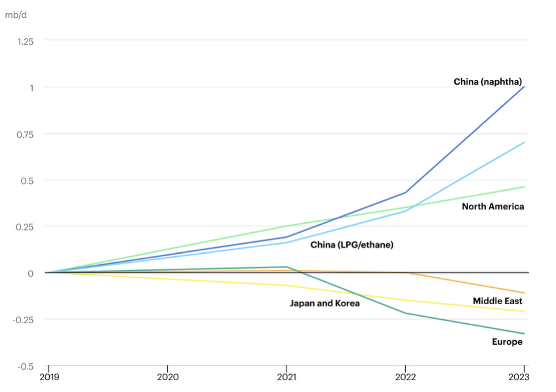
China’s petrochemical demand is expected to continue at this pace and more than triple by 2050.Healy, C. (2023). China’s petrochemical surge is driving global oil demand growth. IEA. https://www.iea.org/commentaries/china-s-petrochemical-surge-is-driving-global-oil-demand-growth; Xin, Z. (2024). Global energy giants ramp up China presence. ChinaDaily, Business. https://www.chinadailyhk.com/hk/article/599256[4] China is on track to experience a 50-60% increase in petrochemical manufacturing capacity by the end of 2025 and is likely to continue growing around 30-35% annually.Bajpai, A. (2024). China's Petrochemical Expansion: Reshaping US and Global Trade. Arcana. https://www.aranca.com/knowledge-library/articles/procurement-research/chinas-petrochemical-expansion-reshaping-us-and-global-trade[5] Not only is China’s petrochemical industry continuing to expand at a rapid rate, but their chemical yield outputs are at around 40% – a staggering number, considering similar industries around the world only produce a combined 15-20% output.Tullo, A. H. (2024). China’s aromatics building boom rattles the petrochemical industry. Chemical & Engineering News, American Chemical Society. https://cen.acs.org/business/petrochemicals/China-aromatics-building-boom-rattles-the-petrochemical-industry/102/i8[6]
The processes associated with petrochemical manufacturing – be it the production of materials, the transportation of its output, or workplace accidents– have significant potential for disaster.Yang, X., Li, Y., Chen, Y., Li, Y., Dai, L., Feng, R., & Duh, Y. (2020). Case study on the catastrophic explosion of a chemical plant for production of m-phenylenediamine. Journal of Loss Prevention in the Process Industries, 67, 104232. https://doi.org/10.1016/j.jlp.2020.104232[7] China has experienced a consistent recurrence of petrochemical accidents resulting in at least 1,273 deaths and more than 3,400 injuries between 2000 and 2020.Zhang, M., & Kim, R. (2020). Occupational health and safety in China: From emergency response to Jiangsu chemical explosion to long-term governance improvement. Journal of global health, 10(1), 010315. https://doi.org/10.7189/jogh.10.010315; Yang, D., Zheng, Y., Peng, K., Pan, L., Zheng, J., Xie, B., & Wang, B. (2022). Characteristics and Statistical Analysis of Large and above Hazardous Chemical Accidents in China from 2000 to 2020. International Journal of Environmental Research and Public Health, 19(23), 15603. https://doi.org/10.3390/ijerph192315603[8] From 2016 to 2018 alone, 620 chemical accidents occurred and at least 728 people died– many incidents involved leaks or explosions of hazardous materials into surrounding areas.Chen, C. & Reniers, G. (2020). Chemical industry in China: The current status, safety problems, and pathways for future sustainable development. Safety Science, 128(104741). https://doi.org/10.1016/j.ssci.2020.104741; Zhang, N., Shen, S., Zhou, A., & Chen, J. (2019). A brief report on the March 21, 2019 explosions at a chemical factory in Xiangshui, China. Process Safety Progress, 38(2). https://doi.org/10.1002/prs.12060[9] China experiences one major petrochemical incident approximately every 15 days, and due to their workplace safety standards may be more likely to experience incidents that result in injury or death.Xiang, Y., Wang, Z., Zhang, C., Chen, X., Long, E. (2022). Statistical analysis of major industrial accidents in China from 2000 to 2020. Engineering Failure Analysis, 141(106632). https://doi.org/10.1016/j.engfailanal.2022.106632; Liang, H., Yan, T., & Zhao, W. (2024). Comprehensive assessment of recent major chemical accidents in China and path to sustainable solutions. Smart Construction and Sustainable Cities, 2(1). https://doi.org/10.1007/s44268-023-00024-0[10]
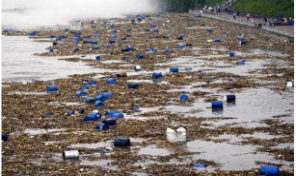
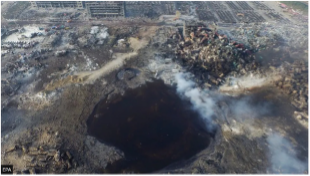
In addition to the human cost, petrochemical disasters in China can devastate local and far-reaching ecosystems and cause billions of dollars in economic losses.China Internet Information Center (2010). Chemicals washed into major NE China river. Top News, Xinhua. http://www.china.org.cn/environment/2010-07/29/content_20597100.htm; BBC (2016). Tianjin chemical blast: China jails 49 for disaster. World News, China. https://www.bbc.com/news/world-asia-china-37927158[11] Stabilizing these incidents puts incredible strain on first responders and emergency personnel, with one such incident spanning three buildings requiring 563 firefighters and 113 fire engines.Broadwith, P. (2022). Deadly explosion and fire at petrochemical plant in China. Chemistry World, News. https://www.chemistryworld.com/news/deadly-explosion-and-fire-at-petrochemical-plant-in-china/4015861.article[12] Figure 2-4 in the carousel below contain examples of the devastation caused by petrochemical accidents in China. Chemical spills like the Songhua River incident can contaminate vast water systems and threaten drinking water supplies, fisheries, and agricultural use for years, creating long-term ecologic damage that is costly and difficult if not impossible to remediate. Large-scale explosions like those in Tianjin and Jiangsu can cause catastrophic loss of life and mass injuries, overwhelm regional medical systems, and displace surrounding communities. Beyond the immediate devastation, these disasters often cripple local economies and disrupt or destroy critical infrastructure, potentially disrupting global supply chains. In each case, recovery is prolonged, complex, and costly, involving hazardous material cleanup, environmental restoration, and reconstruction, all while eroding public trust in both industry and regulators.
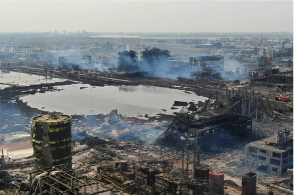
Industrialized coastal areas in China have a higher rate of petrochemical disaster and may suffer some of the greatest consequences.Yang et al., 2022[13] Their coastal regions are highly desired areas for real estate, tourism, and manufacturing companies needing easier access to ports.Chang, G., Jiang, C., Chang, K., & Alam, B. (2013). Land Prices and Intracountry Industrial Relocation in China: Theory and the Yangtze Delta Area Case. The Chinese Economy, 46(2), 54-73. https://doi.org/10.2753/CES1097-1475460203; Bai, C., Li, Q., & Ouyang, M. (2014). Property taxes and home prices: A tale of two cities. Journal of Economics, 180(1), 1-15. https://doi.org/10.1016/j.jeconom.2013.08.039; Theurillat, T. (2021). Urban growth, from manufacturing to consumption and financialization: the case of China’s contemporary urban development. Regional Studies, 56(8), 1244–1258. https://doi.org/10.1080/00343404.2021.1901871[14] Coastlines are also more likely to be home to major fishing industries in China, which produce 60% of the world’s farmed fish.Turner, A. & Meado, A. (2021). The Fish Farms of Hainan Island. NASA, Earth Observatory. https://earthobservatory.nasa.gov/images/148940/the-fish-farms-of-hainan-island[15] Petrochemical industries are known to diminish the capacity of local ecosystems to sustain life and significant chemical pollutants are increasingly found in nearshore and offshore locations across China.Sun, L., Wang, J., Zhang, H., & Xu, M. (2020). The Characteristics and Mechanism of Changes in the Marine Environmental Capacity of the Estuaries of Haizhou Bay in Northern Jiangsu from 2006 to 2016. Journal of Marine Science and Engineering, 8(10), 787. https://doi.org/10.3390/jmse8100787; Huang, R., Liu, Q., Zhao, Y., Shi, W., Xu, M. (2021). Pollution status of polycyclic aromatic hydrocarbons in surface sediments off the Jiangsu coastal zone, East China: A case study of Rudong. Marine Pollution Bulletin, 166(112253). https://doi.org/10.1016/j.marpolbul.2021.112253[16]
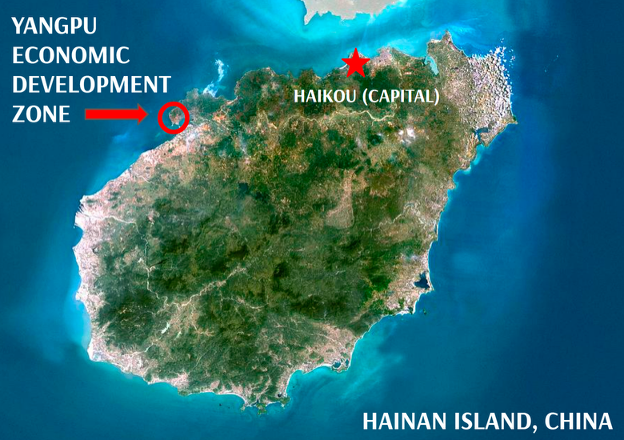
To analyze how the petrochemical industry in China may develop over the next decade and present challenges for environmental health and human security, we conducted a case study of the new EDZ in Hainan, China and performed a risk assessment of how its petrochemical expansion may present challenges for local and regional safety. Lessons learned may help to inform China’s adoption and implementation of policies related to the petrochemical sector. Figure 5 below provides the location of the EDZ on the island of Hainan.
Research Statement
By conducting a case study and risk assessment of the Yangpu EDZ and integrating satellite imaging from the National Geospatial-Intelligence Agency’s (NGA) Unclassified Data Lake (NUDL), we project the potential environmental and human security challenges China may face over time with its expanding petrochemical industry. Specifically, we examine how patterns of land use and land cover within the EDZ may shape societal risk by influencing both exposure to and potential impact from petrochemical incidents, focusing on the proximity of residential areas, public facilities, and critical infrastructure to petrochemical sites. We highlight relevant policies targeting risks and identify policy voids that must be addressed to mitigate these challenges.
Methods
To project challenges China may face over the next decade with its expanding petrochemical industry, we conducted a case study and risk assessment of the Yangpu EDZ across three main phases:
- Conduct a case study of the Yangpu EDZ to identify relevant stakeholders across the petrochemical industry, human security (housing, schools, recreation, hospitals, etc.) and ecosystem and environmental zones.
- Collect geospatial intelligence (GEOINT) from NUDL and Google Earth to identify vulnerable stakeholders and project risk of disaster fallout from local petrochemical industries.
- Document preventative, regulatory, and monitoring policies relevant to the regional petrochemical industry.
To collect data for the case study and policy analysis, we pulled documents from open-source locations including peer-reviewed academic publications (PDFs and HTMLs) sourced from both Western/United States and Chinese journals; Chinese-language public forums (text posts); Chinese policy documents and government reports (PDFs); news publications (HTMLs); statements from the Chinese government and political leadership (HTML, PDFs and text); and business records (CSV and PDFs) on petrochemical manufacturers in Hainan, published by Dun & Bradstreet, Inc. (N = 2,852).Link to business record repository: https://www.dnb.com/business-directory/company-information.chemical_manufacturing.cn.hainan.html?page=2[17]
For geospatial data extracted from NUDL obtained as high-resolution raster imagery (JPEG and GeoTIFF formats suitable for manual and software-assisted analysis), we bounded our spatial search parameters within a five-mile radius of each edge of the 12-sq mile Yangpu EDZ to capture both coastal and land imagery and performed multiple searches to ensure depth of coverage, returning a total of 53 images across 10 days from 12/14/2024 to 1/29/2025. Returns included both electro-optical (panchromatic / multispectral) and synthetic aperture radar (SAR) scenes. For each return, we recorded standard metadata, like the platform, modality (SAR), and any provider quality flags. We then applied a uniform filtering rubric:
- de-duplicate near-identical collects;
- exclude scenes with poor quality, perhaps due to weather conditions;
- ensure images were compared during similar tidal stages to minimize changes in coastal imagery.
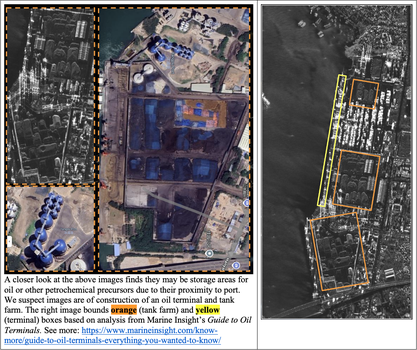
The highest-resolution image within the January 2025 collection window was selected for analysis. To support accurate imagery-based identification of petrochemical infrastructure, we also consulted industry reference materials, including Marine Insight’s Guide to Oil Terminals and other technical documentation to familiarize ourselves with common facility layouts, storage tank configurations, and related operational structures.
Discussion
Case Study
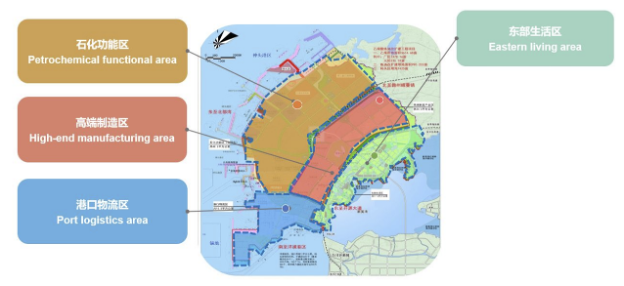
Established in 1992 as a major stakeholder in the Hainan Free Trade Port, the Yangpu EDZ was the first in China to open to foreign businesses and has an operating capacity of more than 100 million-tons, with 42 shipping berths catering largely to the petrochemical industry.Global Investment Service (2021). Hainan Free Trade Port Investment Guide. China Daily. https://regional.chinadaily.com.cn/pdf/HainanFreeTradePortInvestmentGuide.pdf[18] Situated on the tropical island of Hainan, the EDZ is also home to a booming tourism industry, foreign real estate investment and international schools, and domestic homes and businesses.Belt and Road Portal (2023). Yangpu Economic Development Zone. Parks and Zones. https://eng.yidaiyilu.gov.cn/p/0MVP7IDS.html[19] The EDZ’s industrial planning layout, designed by the Yangpu Economic Development Zone Administrative Committee and displayed in Figure 6 below, calls for isolating human living spaces away from the petrochemical functional area. The layout was designed to minimize risk to the population from petrochemical incidents and to preserve the EDZ’s tourist industry and resident quality of life.Poon, C. H. (2022). The Hainan Free Trade Port (4): Development of Port Economy. HKTDC Research, Analysis and News. https://research.hktdc.com/en/article/OTY4NTU5NzM4[20]
Human Security Stakeholders: Foreign businesses; tourism and hotels; residential areas; small businesses; meat and food processing; community farms; schools; hospital; sports
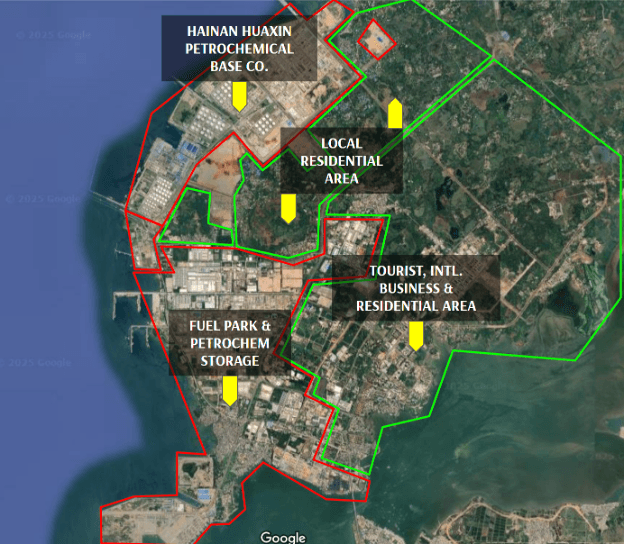
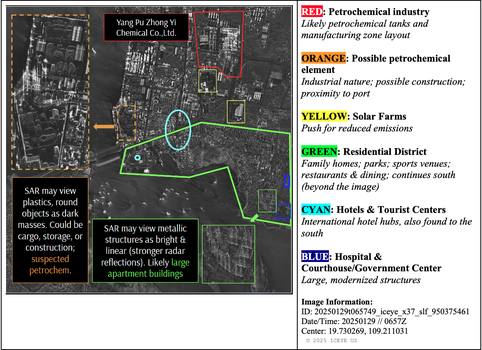
Using information from satellite imagery, we confirmed the spatial relationship illustrated in the graphic was only partially accurate: petrochemical facilities occupy a contiguous industrial zone along not only the EDZ’s north coast and inland area, but its related processes stretch down into its southernmost coastal areas. Residential, educational, and commercial zones within the eastern living area bordered many petrochemical sites, for uses including storage, industrial runoff, and shipment zones. Moreover (and discussed further below), we found evidence of residential areas even within the petrochemical functional area displayed in orange in Figure 6. The failure of imagery to support this mapping underscores the importance of highlighting areas at risk of exposure and risk in the event of a petrochemical incident.
Based on our analysis of open-source information, we found the Yangpu EDZ has a meat processing industry that works with more than 100,000 tons of product a year, alongside more than five other international food processing plants that reach $7B in production value annually.Unless otherwise specified, all monetary amounts are in $USD. Shumin, C. (2024). International food processing industry hub to open in Yangpu. Hainan Free Trade Port, Latest News. http://en.hnftp.gov.cn/News/Latest/202403/t20240304_3449465.html[21] There are also community farms, a large English-language university scheduled to open in September 2025, other international schools, a hospital, hotels, and leisure areas like sports arenas and theaters.Xinran, L. (2022). In the afternoon: Old and new in Yangpu District. SHINE: Beyond a Single Story. https://www.shine.cn/feature/district/2202212154/#:~:text=It%20also%20provides%20access%20to%20a%20neighborhood,the%20two%20neighboring%20residential%20compounds%20have%20become; Hainan Bielefeld University (2024). BiUH President Prof. Dr. Juergen Kretschmann’s Speech at the Yangpu Press Conference. Hainan Bielefeld University of Applied Sciences. https://www.hainan-biuh.edu.cn/en/2024/07/05/prof-dr-juergen-kretschmann-president-of-biuh-speech-at-yangpu-press-conference/; Global Investment Service, 2021[22]
Ecosystem & Environmental Stakeholders: Migratory birds; seafood industry; natural water scarcity; coastal and groundwater pollution; air pollution
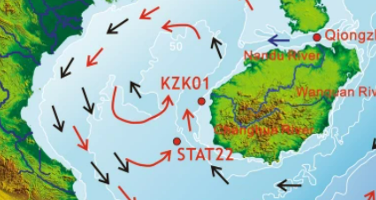
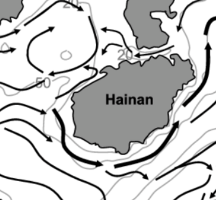
Despite the saturation of residential and related zones, satellite imagery and open-source reports indicate persistent chemical and heavy metal pollutants in both groundwater and ocean water sources, harming the seafood industries across Hainan and creating the potential to devastate migratory birds that use Hainan as a winter haven.Li, P., Cao, J. Diao, X., Wang, B., Zhou, H., Han, Q., Zheng, P., Li, Y. (2015). Spatial distribution, sources and ecological risk assessment of polycyclic aromatic hydrocarbons in surface seawater from Yangpu Bay, China. Marine Pollution Bulletin, 93(2), 53-60. https://doi.org/10.1016/j.marpolbul.2015.02.015; Zhang, M., Yang, C., Cai, G., Li, S., Nie, X., Zhou, S. (2023). Assessing the effects of heavy metals and polycyclic aromatic hydrocarbons on benthic foraminifera: The case of Houshui and Yangpu Bays, Hainan Island, China. Frontiers in Marine Science, 10. https://doi.org/10.3389/fmars.2023.1123453; Hou, Q., Pan, Y., Zeng, M., Wang, S., Shi, H., Huang, C., Peng, H. (2023). Assessment of groundwater hydrochemistry, water quality, and health risk in Hainan Island, China. Scientific Reports, 13(12104). https://www.nature.com/articles/s41598-023-36621-3; Du, Y., Ren, Z., Zhong, Y., Zhang, J. (2024). Spatiotemporal pattern of coastal water pollution and its driving factors: implications for improving water environment along Hainan Island, China. Frontiers in Microbiology, 15(1383882). https://doi.org/10.3389/fmicb.2024.1383882; Zhang & Kim, 2020; Mao, Z. (2022). A Map of Hainan’s Water Birds for island nature lovers. HICN, Hainan. https://www.hicn.cn/system/2022/03/01/032711889.shtml[23] Using satellite imagery to overlay industrial infrastructure with natural resource locations, we identified areas where proximity to petrochemical facilities intersects with sensitive environmental zones including coastal wetlands, fisheries, and groundwater recharge areas. Imagery-assisted mapping also revealed water-scarce regions that coincide with industrial demand, highlighting zones where human and ecosystem exposure to contamination (and the harm caused by it) may be greatest.Xiaodong, Z., Mingwen, X., Wensheng, C., Guowen, W. (1999). WATER RESOURCE AND ITS FUNCTIONAL ALLOCATION IN YANGPU ECONOMIC DEVELOPMENT ZONE, HAINAN ISLAND. Journal of Natural Resources, 14(1), 22-27. https://doi.org/10.11849/zrzyxb.1999.01.003[24] Seasonal variations in ocean and air currents visualized through combined satellite and environmental datasets (seen in the Figure 7 and 8 image carousel) show potential pathways for pollutants from the EDZ to spread across southwestern Hainan, northward to China’s mainland, and even toward Vietnam’s east coast, emphasizing the regional scale of environmental risk.Chen, C., Lai, Z., Beardsley, R., Xu, Q. (2012). Current separation and upwelling over the southeast shelf of Vietnam in the South China Sea. Journal of Geophysical Research, 117(3033). https://doi.org/10.1029/2011JC007150; Liang, D., Wu, S., Xu, G., Xia, C., Gao, F., Lin, Y., Du, J., & Jia, L. (2023). Paleoenvironmental changes in the coastal zone of the northwest South China Sea during the last 13 kyr. Scientific Reports, 13(13540). https://doi.org/10.1038/s41598-023-40721-5[25]
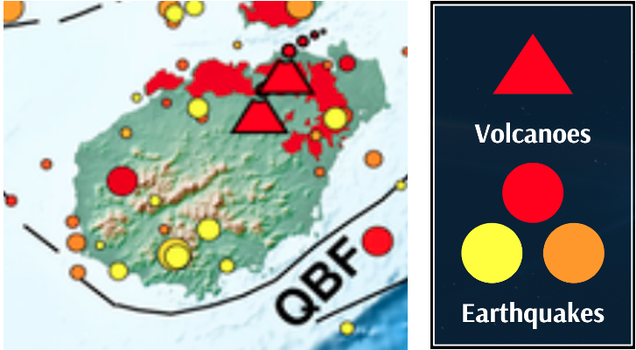
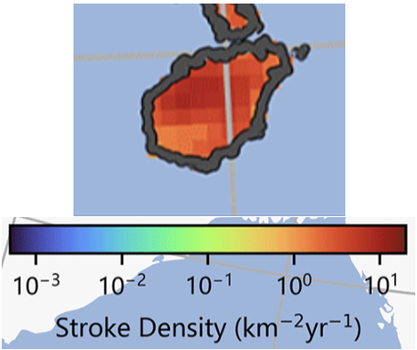
The potential for natural disasters in the Yangpu EDZ is also high, which could exacerbate risk of disaster for petrochemical industries. Hainan is situated near major fault lines and Yangpu itself has experienced many earthquakes, some severe, and is less than a hundred miles away from two major active volcanoes.Lu, H., Lei, J., Zhao, D., Xu, Y.-G., Sun, C., & Hu, X. (2022). Pn anisotropic tomography of Hainan Island and surrounding areas: New insights into the Hainan mantle plume. Journal of Geophysical Research, 127. https://doi.org/10.1029/2021JB023609[26] Moreover, Hainan has the highest prevalence of lightning strikes and related casualties in China, with the EDZ in a high-risk zone.Gao et al., 2015; Hansen, K. (2020). Cloud Building Over Hainan. NASA, Earth Observatory. https://earthobservatory.nasa.gov/images/146761/cloud-building-over-hainan; Zheng, J. (2022). Lightning Hazard Assessment in Hainan Island Based on Hierarchical Analysis Model. Science and Technology, 3(3). https://doi.org/10.54097/ajst.v3i3.2541[27] To convey the severity of the EDZ’s risk of natural disaster, Figures 9 and 10 (image carousel) present information on volcanoes, earthquakes, and lighting strikes in Hainan.
Petrochemical Industry Stakeholders: Based on publicly available business records, we found the three largest petrochemical stakeholders in the area are Sinopec Hainan Petrochemical, with a more than 25-million-ton output; Sinopec’s Yangpu Oil Terminal, the largest petroleum reserve in China; and the Hainan Jinhai Pulp & Paper Co. which receives more than $3.3B annually from the Chinese government.SINOPEC (2023). SINOPEC Hainan Petrochemical Co., Ltd. Refiners & Petrochemicals. http://www.sinopec.com/listco/en/000/000/061/61226.shtml; Si, K. (2019). Sinopec launches Yangpu oil products terminal. SeatradeMaritime News. https://www.seatrade-maritime.com/terminals/sinopec-launches-yangpu-oil-products-terminal; Asia Pulp & Paper Co. (2025). Pulp Business Unit. Businesses and Products. https://www.app.com.cn/en/zhijiang[28]
NUDL & Geospatial Intelligence (GEOINT)
The case study of the Yangpu EDZ leveraged geospatial intelligence to directly link identified hazards, human security stakeholders, and environmental vulnerabilities to observable industrial infrastructure. Using satellite imagery from the National Geospatial-Intelligence Agency’s (NGA) Unclassified Data Lake (NUDL), primarily from the ICEYE collection, we mapped the locations of the three largest petrochemical stakeholders (Sinopec Hainan Petrochemical, Sinopec’s Yangpu Oil Terminal, and Hainan Jinhai Pulp & Paper Co.), and analyzed their proximity to residential areas, schools, hospitals, tourism zones, and environmental resources.ICEYE US uses synthetic aperture radar (SAR) and specializes in the coverage of hazardous events and disasters. See more: https://www.iceye.com/en-us/[29] Imagery analysis included identification of storage tanks, pipelines, shipping berths, and ancillary structures, which were cross-referenced against hazard maps showing fault lines, volcanic activity, lightning prevalence, and coastal/groundwater contamination.
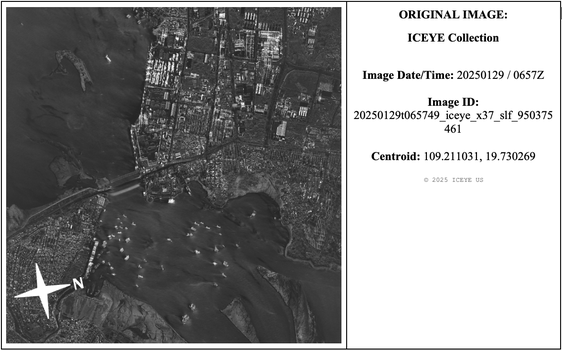
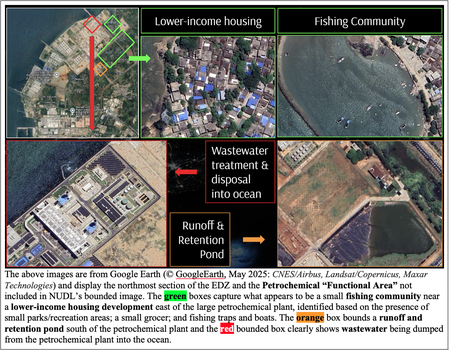
Supplementary Google Earth Imagery filled spatial and temporal gaps in the NUDL collection and provided additional context for visual confirmation of land use, zoning, and environmental features. By overlaying these GEOINT-derived infrastructure maps with hazard and exposure layers, we could more precisely assess potential human and ecological risks like pathways for chemical spills, population exposure following industrial accidents, and the vulnerability of natural resources. Figure 11 contains the final selected NUDL image and its unique S3 URL code. Visual bounding boxes of the image are also provided below, which served as the analytic basemap for this GEOINT-informed assessment.
Policy Analysis
Policymakers in the Yangpu EDZ will likely face significant challenges in the decade ahead as they balance economic expansion with adherence to sustainability commitments made by Hainan. The Chinese Air Pollution Prevention and Control Law imposes strict emission limits upon industrial plants and requires them to employ air filtration systems, submit emissions reports, and comply with national clean air targets, though public access to this data is restricted and punishments are often low with fines that are less expensive than the investments required to be compliant with green technologies.The National People’s Congress of the People’s Republic of China. (2004). Law of the People’s Republic of China on Prevention and Control of Environmental Pollution by Solid Waste. http://www.npc.gov.cn/zgrdw/englishnpc/Law/2007-12/12/content_1383723.htm; Hainan Provincial Bureau of International Economic Development. (2023). 2023 Hainan Free Trade Port Investment Guide. Invest in Hainan. http://www.investhainan.cn/; Xiu, C., & Li, T. (2023). Construction of the Hainan Free Trade Port from the perspective of regional cultural development. Frontiers in Earth Science, 10. https://doi.org/10.3389/feart.2022.1032953[30] The national Dual Carbon policy seeks to promote carbon neutrality and renewable energy transmissions, and while petrochemical firms are encouraged to adopt green technologies and participate in China’s Emissions Trading System (ETS), participation is voluntary and green programs see minimal engagement.Hou, S., Xu, B., Lin, L., Zhang, L., Zhao, X., Liu, J., & Pan, K. (2020). Research on Construction of Standard System for Development of Green Economy in Hainan Province. IOP Conference Series: Earth and Environmental Science, 508(1), 012083. https://doi.org/10.1088/1755-1315/508/1/012083[31]
Petrochemical plants in the Yangpu EDZ frequently exceed permitted pollution levels despite the fact that the EDZ has a Water Pollution Preventions and Control Law that mandates strict wastewater treatment processes for petrochemical plants near coastal ecosystems.Han, S. S. (2021). Interim measures of the customs for the collection and administration of the taxes on the domestic sales of goods with added value from processing in the Yangpu bonded port area -- tax -- Hainan Free Trade port. Hainan Free Trade Port. http://en.hnftp.gov.cn/policies/Tax/202107/t20210716_3330100.html[32] The Marine Ecological Red Line policy further restricts industrial discharge into sensitive marine habitats to protect Hainan’s fisheries and tourism-driven economy, while the Hazardous Waste Control Law dictates strict containment, labeling, and disposal of toxic petrochemical refinement byproducts.National People's Congress, 2004[33] The detail figures above includes a visual example of two possible violations: wastewater disposal into the ocean, and the runoff-retention pond south of the plant.
Although the Department of Ecology and Environmental Protection of Hainan Province is responsible for approving Environmental Impact Assessments for all new petrochemical projects, the process favors economic growth over environmental protection even in the face of strong local opposition of petrochemical projects.Xiu & Li, 2023; Aizhu, C. (2014, April 18). As opposition grows, China defends plans for petrochemical plants. ZAWYA. https://www.zawya.com/en/business/as-opposition-grows-china-defends-plans-for-petrochemical-plants-nu643o6t[34] Despite challenges with protest and freedom of speech in China, protests against the petrochemical industry have occurred across the country.Reuters (2008). Hundreds protest against China chemical plant. Reuters. https://www.reuters.com/article/economy/hundreds-protest-against-china-chemical-plant-idUSPEK122797/; Watts, J. (2011). China orders petrochemical plant shutdown after protests. The Guardian, Pollution. https://www.theguardian.com/world/2011/aug/14/china-petrochemical-plant-shutdown-protest; Associated Press (2012). Chinese protest over chemical factory. The Guardian, Pollution: China. https://www.theguardian.com/world/2012/oct/28/chinese-residents-protest-chemical-factory; Sudworth, J. (2014). China Maoming environmental protest violence condemned. BBC News, China. https://www.bbc.com/news/world-asia-china-26849814; EJ Atlas (2021). Protest against proposed relocation of Gaoqiao paraxylene (PX) plant into Jinshan, Shanghai, China. Global Atlas of Environmental Justice. https://ejatlas.org/print/protest-against-gaoqiao-paraxylene-px-plant-relocating-in-jinshan-shanghai-china[35] The “Free Trade Zone” status of the Yangpu EDZ provides foreign investors with reduced tariffs, tax exemptions, and streamlined regulatory procedures that can weaken environmental oversight and limit intervention.Han, 2021[36] As state-owned enterprises dominate the petrochemical sector in Yangpu and across China, corporate transparency and accountability may be reduced.Dong, Q., & Bian, Z. (2024). Meeting International Economic and Trade Rules: A Case Study of Hainan Free Trade Port, China. World Customs Journal, 18(1), 81–99. https://doi.org/10.55596/001c.116748[37] Despite the findings from our analysis of GEOINT from NUDL and Google Earth positioning lower-income housing next to petrochemical plants, the Yangpu Industrial Park Expansion Plan mandates petrochemical projects must be constructed away from residential areas to reduce public health risks.Xiu & Li, 2023[38] Moreover, instances of illegal hazardous waste dumping have been reported that suggest insufficient oversight and inadequate water tracking mechanisms.Chu, J., & Knudsen, S. H. (2018). Vindicating public environmental interest: Defining the role of Environmental Public Interest Litigation in China (thesis). Vindicating public environmental interest: defining the role of environmental public interest litigation in China. University of Washington Libraries, Seattle.[39]
Ultimately, regulatory bias favoring economic growth might be alleviated by independent oversight and the establishment of third-party environment auditing agencies. The effectiveness of policies compromised by weak monitoring infrastructure, inconsistent enforcement, and corporate lobbying could be improved by strengthening penalty structures and revoking operating licenses for repeat offenders that would deter systematic non-compliance. Introducing formal grievance mechanisms that allow citizen-led environmental reviews could also improve public trust and policy responsiveness. One of the primary challenges is the lack of real-time environmental monitoring systems, which limits the government’s ability to track pollution levels and detect violations. Expanding public transparency through open-access pollution databases could enhance accountability and citizen engagement in environmental policy.
Conclusion
We found a wide variety of regulations and policies dictating careful state and manufacturer control over the petrochemical industry. However, combining geospatial analysis with open-source information, our findings painted a vastly different picture: pollution and development violations exposed weak enforcement of these policies, and vulnerable populations and ecosystems in the EDZ appear to be at increased risk of disaster. Combining environmental hazards with apparent disregard for developmental layout plans, the EDZ’s industrial ecosystem presents serious concerns for the coming years.
Considering the Yangpu EDZ was the first to open to foreign businesses and is a Free Trade Zone, the opportunities for environmental and safety collaboration between China and the United States may be highest in these areas and serve to bolster strategic partnerships towards a mutually beneficial human security goal. Safety and emissions partnerships, particularly those seeking to prevent accidents or develop contingency plans in the case of disaster, may benefit both China and the United States as well as other regions around the world handling petrochemical industries.
With access to a greater number of higher-resolution images and the ability to track changes over time, future research would benefit from pairing images of ecosystem degradation and the expansion of human security areas and petrochemical infrastructure to establish direct associations between development; to check visual compliance with enacted policies to protect human and environmental security; and to establish the degree of risk faced by stakeholders based on distance from petrochemical manufacturing plants. Moreover, we would propose a future project pairing GEOINT with existing data on water and air quality, fish and marine wildlife health, or even population data may allow researchers to track changes in the local systems over time and highlight the most relevant policies targeting areas of concern.
While China, Hainan, and the Yangpu EDZ have enacted a series of preventative measures and policies to mitigate the environmental risks associated with petrochemical production, enforcement challenges and economic pressures undermine their effectiveness and are coupled with weak penalty enforcement and regulatory loopholes allowing firms to bypass compliance requirements with minimal repercussions. Increased monitoring efforts– a meaningful step towards environmental protections– have raised concerns that wastewater treatment facilities are failing to meet government standards. If these trends continue, Hainan’s marine and wildlife biodiversity, as well as the island’s human population, may face irreversible damage in the span of a few years, undermining the sustainability commitments made by the Yangpu EDZ.
Look Ahead
As China continues to grow and diversify their economy, the government will be faced with challenges balancing competing priorities including the growth of profitable sectors, environmental preservation, and protecting their population. Hainan Island and the Yangpu EDZ represent a microcosm of those national decisions and the lasting effects they have on all stakeholders. Continued monitoring of the development of the Yangpu EDZ could provide insight into how the Chinese government is choosing to balance those priorities nationwide.
Things to Watch
- Will existing safety and environmental policies in the PRC be strengthened or more diligently enforced?
- Will China seek outside assistance in developing their petrochemical industry, especially as it relates to human and environmental security?
- Will satellite imagery be able to detect expanding petrochemical storage or manufacturing areas into residential areas of the EDZ?
