
Overview
The Arctic plays a pivotal role in Russia's liquified natural gas (LNG) ambitions, leveraging its vast natural gas reserves and strategic geographic advantages. In 2022, LNG accounted for approximately 52% of Russia's energy portfolio, and despite global sanctions, production is projected to grow by 11% annually through 2035. With gas exports dropping by 55% since 2021, Russia has shifted focus to LNG via the Northern Sea Route that connects the Arctic Ocean to the Pacific and Atlantic Oceans.
The oil and gas industry comprises three key segments: upstream, midstream, and downstream. Public attention on sanctioned LNG exports tends to focus on the final stages of the midstream and downstream sectors—from transporting extracted resources to refining and processing. This research addresses gaps in the understanding of earlier phases by examining the history and current operational status of upstream infrastructure at two operational Russian Arctic LNG facilities.
Activity
Recent satellite imagery reveals ongoing construction at Yamal LNG Facility, including additional storage tanks, and the operational deployment of Arctic LNG 2 Facility's Train 1 (T1), with preparations underway for Train 2 (T2). Vessel traffic at both facilities highlights sustained activity, though export logistics are facing seasonal and geopolitical constraints.
Methodology
This research project examines the two operational LNG terminals in the Russian Arctic along with their supporting infrastructure, including airports and ports. The study first established a timeline of activities using open-source information on the history, development, and current status of the terminals. To validate and refine this timeline, 58 publicly available multispectral and synthetic aperture radar (SAR) images from Maxar, Sentinel, and Landsat from 2003 to 2024 were processed and analyzed manually, providing a more detailed understanding of the terminals' construction and operational history. The analysis focused on the development of physical infrastructure at the facilities and surrounding areas that contributed to increased operational capabilities. Finally, the images were annotated to visually represent key findings from the analysis.
Arctic LNG Terminals and Supporting Infrastructure
The article provides a comprehensive overview of Russia’s two currently operational Arctic LNG facilities—Yamal LNG and Arctic LNG 2—detailing their development history, construction timelines, and present-day operational status from 2003 through 2024. It also includes a status assessment of three additional proposed Arctic LNG sites, examining their evolving planning stages, projected timelines, and the broader implications of geopolitical and logistical constraints on their development.
Yamal LNG Facility
Background & Facility Overview
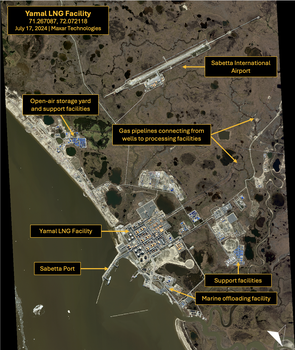
The Yamal LNG facility (71.267087, 72.072118), one of Russia’s two operational Arctic LNG plants, is located in Yamal-Nenets Autonomous Okrug, the world’s largest natural gas producing region that accounts for approximately 80% of Russia’s gas production and approximately 15% of global gas production.Novatek, “Сообщение ПАО «НОВАТЭК» в отношении танкеров ледового класса Arc7 [Statement of PJSC Novatek Regarding Arc7 Ice-Class Tankers],” Novatek Official Website, November 22, 2024, https://www.novatek.ru/ru/press/releases/index.php?id_4=3507.[1] The Yamal LNG facility started as and remains a joint venture between Russia’s Novatek (50.1%), France’s Total (20%), China’s National Petroleum Corporation (20%), and China’s Silk Road Fund (9.9%), despite Western sanctions against Russia for the invasion of Ukraine.Yamal LNG, “About the Project,” Yamal LNG Official Website, accessed November 18, 2024, http://yamallng.ru/en/project/about/.[2] While Novatek operates the facility, the presence of major foreign stakeholders may also influence the midstream and downstream processes.
LNG trains are central to an LNG plant. Also known as liquefaction plants, LNG trains convert the natural gas extracted from the ground into liquid by removing impurities and cooling it to approximately -162°C. This change in form, from gas to liquid, decreases the volume to 1/600th of its original gaseous state.National Grid, “What Is Liquefied Natural Gas (LNG)?,” National Grid Official Website, accessed December 4, 2024, https://www.nationalgrid.com/stories/energy-explained/what-is-liquefied-natural-gas-lng.[3] The Yamal LNG facility itself consists of three 5.5 million metric tons per annum (Mmtpa) trains and one 0.9 MMtpa train, the plant has a nameplate capacity of 17.4 MMtpa.Yamal LNG, “Yamal LNG’s Share in Global LNG Production,” Yamal LNG Official Website, accessed December 4, 2024, http://yamallng.ru/en/press/news/43995/.[4] In 2020, the plant produced 18.8 million tons—larger than the anticipated capacity due to the cold climate— and accounted for more than 5% of the global LNG market.Yamal LNG, “Yamal LNG Reaches 30 Million Tons of LNG Produced since Launch of the Project,” Yamal LNG Official Website, June 21, 2021, http://yamallng.ru/en/press/news/38811/.[5] Tens of wells at the nearby Yuzhno-Tambeyskoye gas field supply the plant.High North News, “Novatek’s Yamal LNG to Be Commissioned and Begin Production,” High North News, November 30, 2017, https://www.highnorthnews.com/en/novateks-yamal-lng-be-commissioned-and-begin-production.[6]
Additional to the LNG trains, the Yamal LNG facility consists of a high pressure (HP) flare, fractionation facilities, refrigerant, three condensate storage tanks, a boil-off gas (BOG) flare, four LNG storage tanks (with two new tanks under construction), a power generation facility, utilities, inlet gas area, a probable sanitary wastewater facility, and administration.
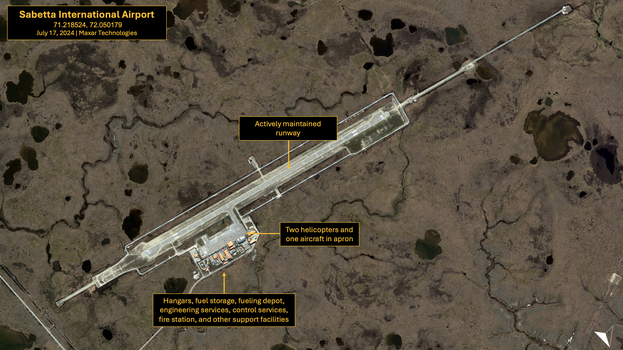
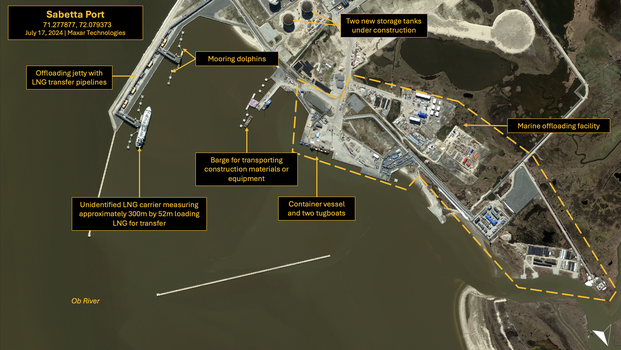
As seen in the latest accessible cloud-free high-resolution satellite imagery from Maxar taken on July 14, 2024, the Yamal LNG facility is supported by Sabetta port and a marine offloading facility to the east, Sabetta International Airport approximately five kilometers to the southwest, and a number of open-air storage yards and support facilities such as worker housing surround the facility.
History & Development
Prior to the construction of the Yamal LNG facility, Sabetta port, and the Sabetta International Airport, the area hosted minimal infrastructure for early exploration of gas fields after Russia’s interest in increasing LNG output grew in the 1990s.Vitaly Yermakov, “Arctic LNG 2: The Litmus Test for Sanctions Against Russian LNG,” OIES Energy Comment, Oxford Institute for Energy Studies, October 2024.[7]
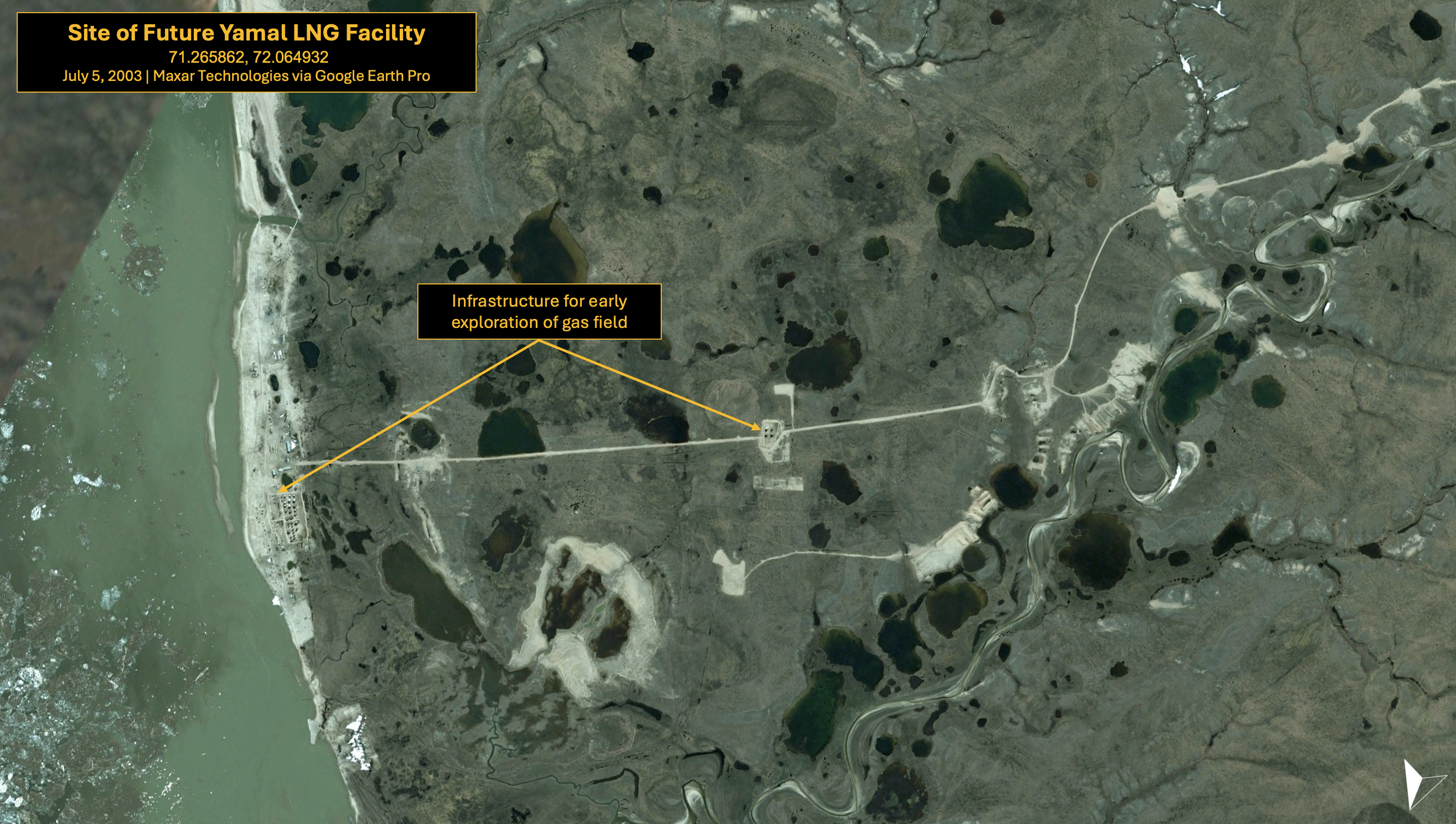
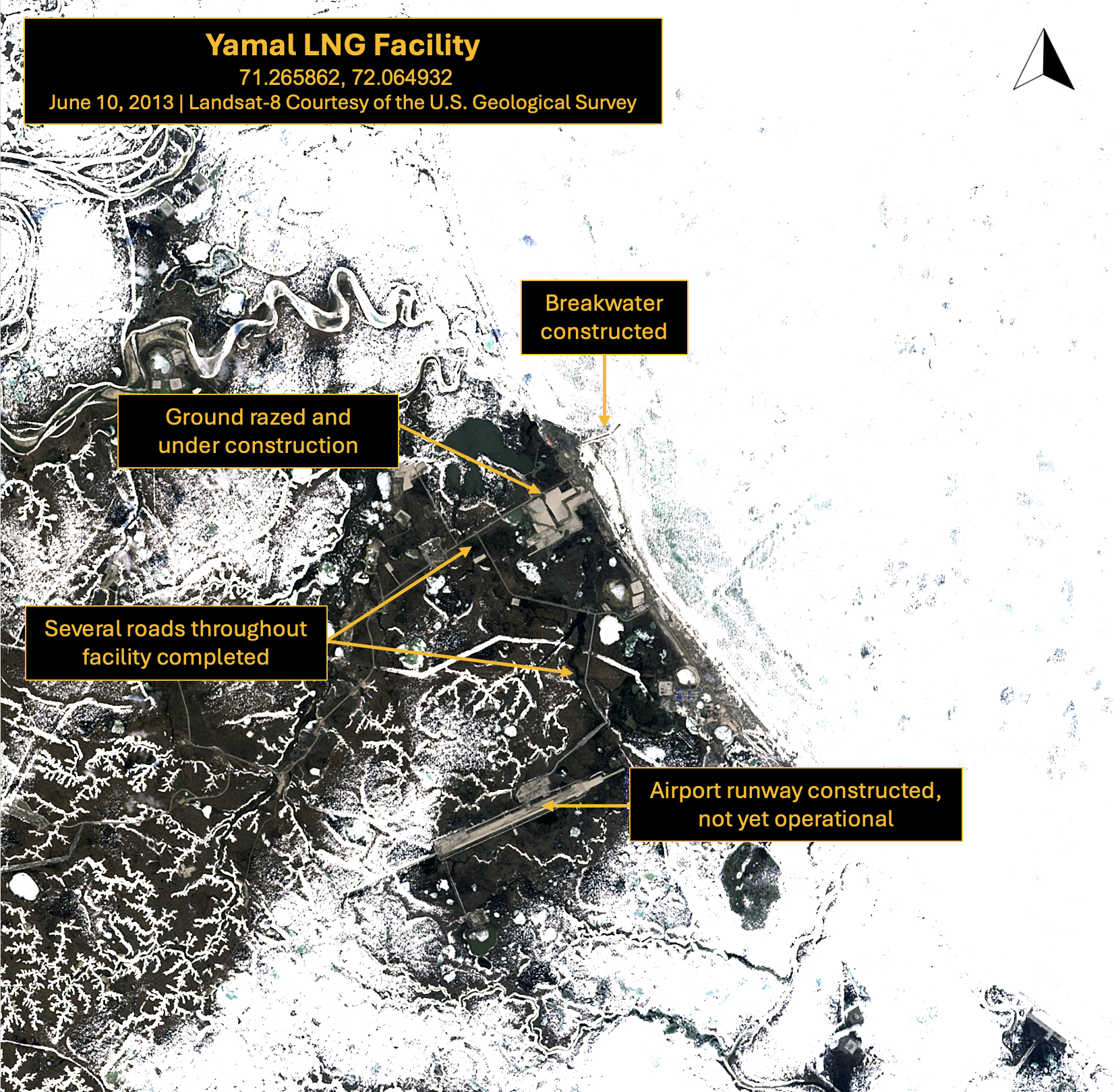
The Yamal LNG facility project was officially approved by the Russian government in 2010 and officially licensed three years later in 2013, when facility construction started.Novatek, Yamal LNG: An International Gas Export Project, Novatek Official Website, March 20, 2013, https://www.novatek.ru/common/upload/doc/2013_03_20_Yamal_LNG_ENG.PDF; International Gas Union, 2017 World LNG Report, 2017, https://www.igu.org/resources/2017-world-lng-report/.[8] The facility’s two supporting infrastructures, the Sabetta port and Sabetta International Airport, were also operational around this time, with the port’s berths operational since November 2013 and the airport’s first landing occurring in December 2014.Stéphane Le Galles and Michael Borrell, Yamal LNG: Delivering World-Class LNG Project, Investor Day Presentation, TotalEnergies, 2017, https://www.totalenergies.com/media/document/yamal-lng-overview.[9] A medium-resolution Landsat-8 image from June 10, 2013 shows the development of a breakwater at what would later become the port, and the airport runway visible. It also shows the completion of the main roads throughout the facility and its surrounding areas, as well as the beginning of construction of the plant grounds.
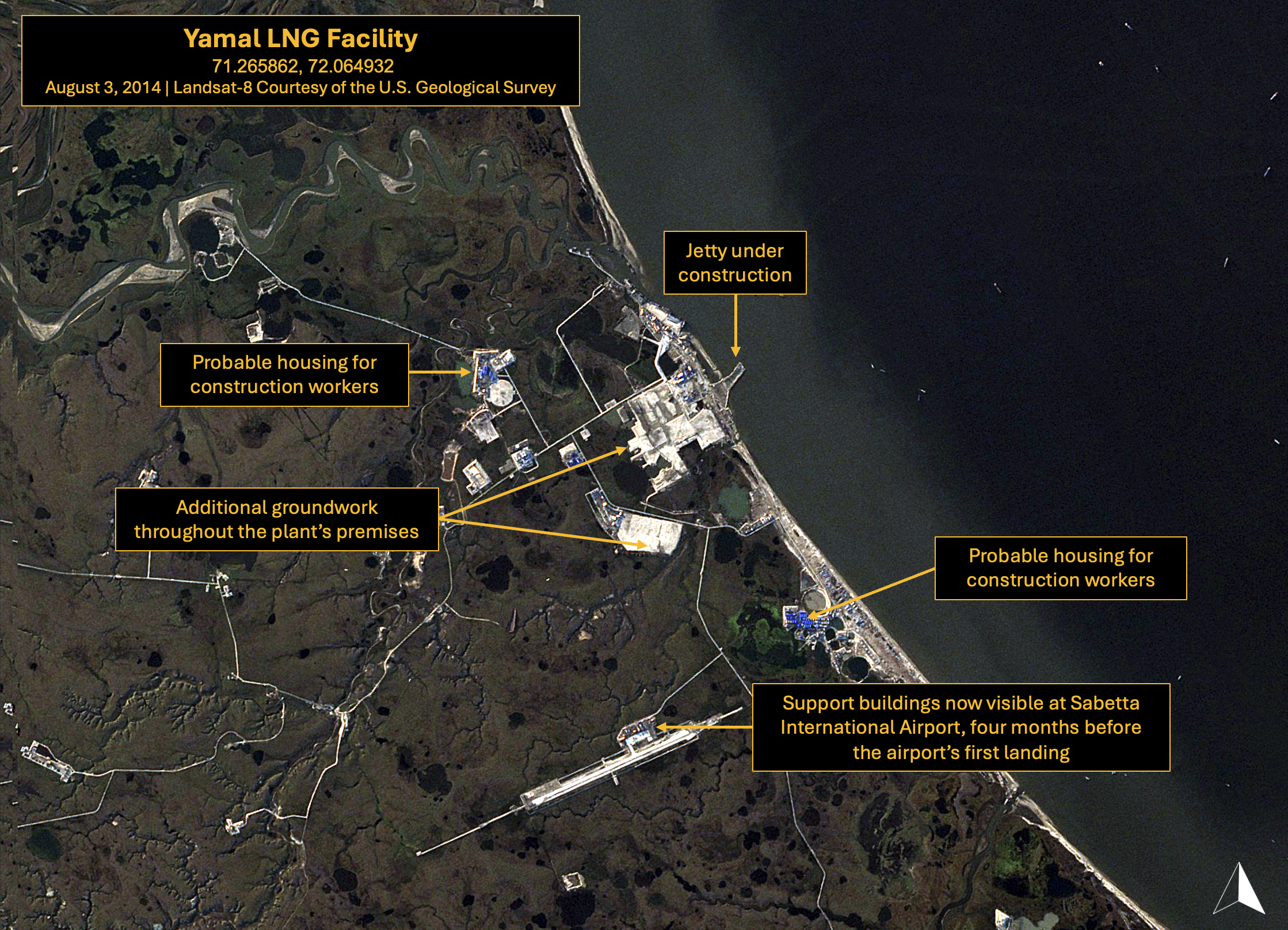
Another Landsat-8 image taken 14 months later, on August 3, 2014, shows considerable progress at the facility, port, and airport. The port’s jetty is now under development, and several structures are visible at the airport next to its apron. Blue-roofed support facilities, probably housing for construction workers, are seen to the northwest and southeast of the main plant area. Groundwork throughout the plant’s premises is also visible.
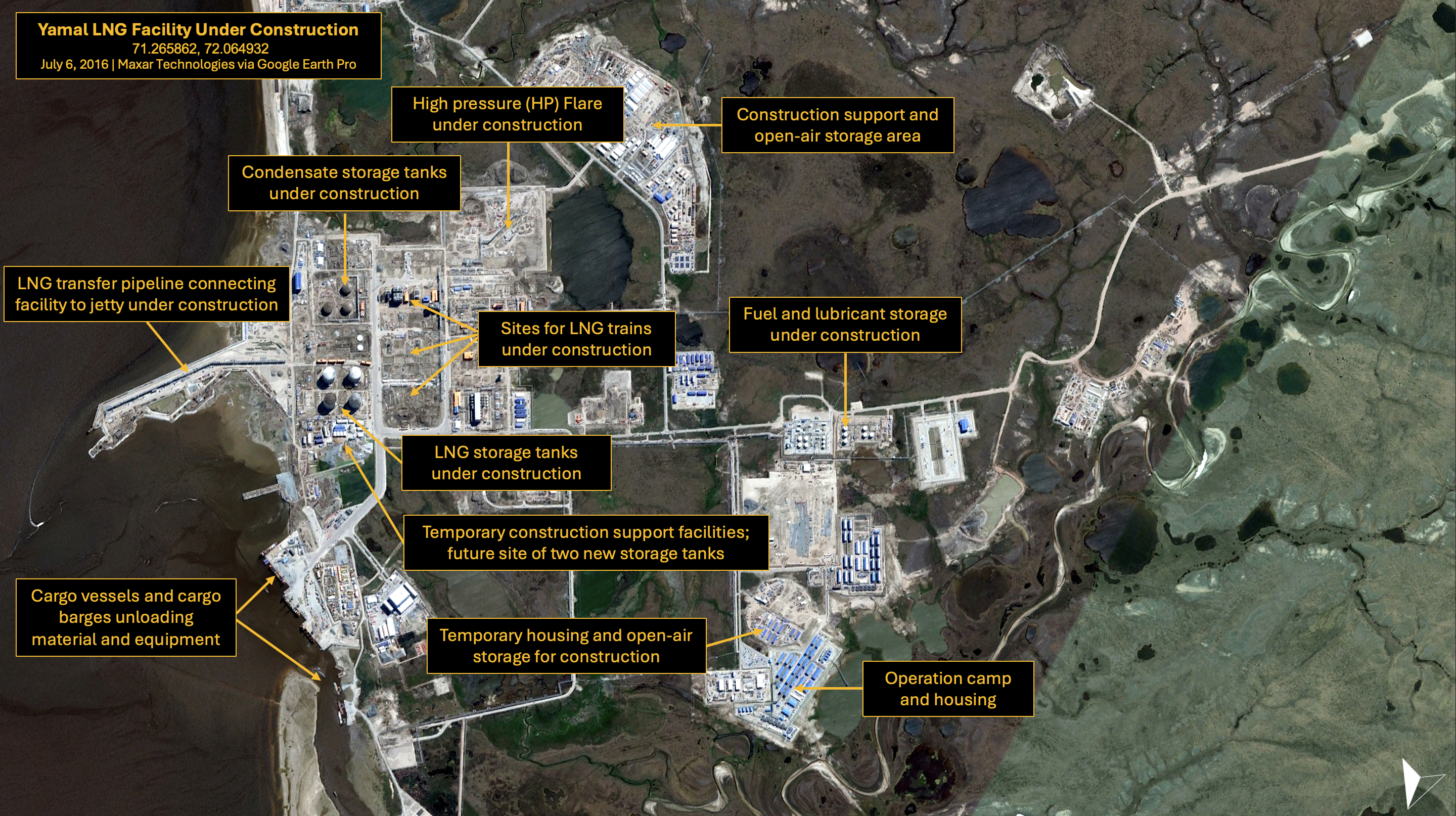
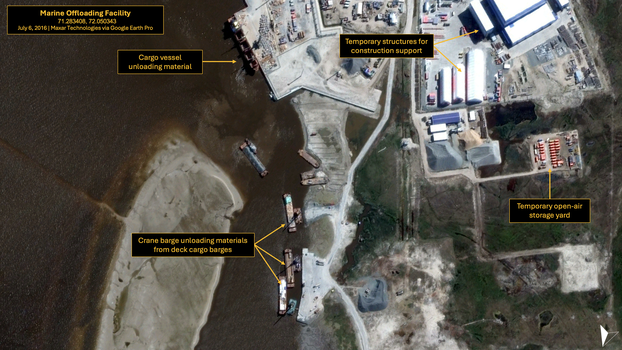
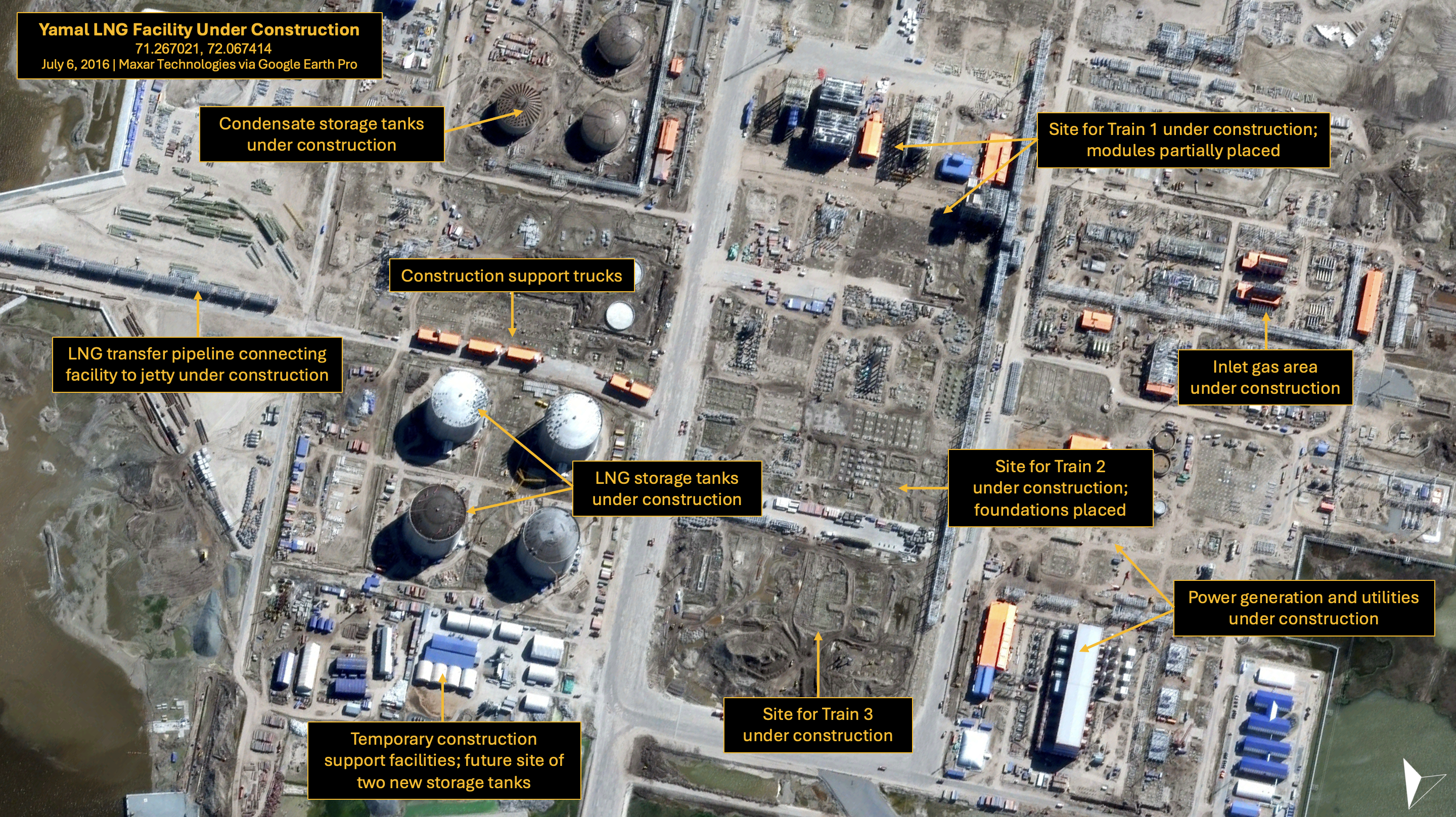
The construction process at the facility is better observed in the next available feasible high-resolution Maxar image, taken two years later, on July 6, 2016. Given the harsh Arctic conditions, the speed of the construction is notable and indicates the high priority of the development of the Yamal LNG facility. Because the Arctic’s permafrost makes construction challenging, 122 modules for the Yamal LNG facility had been fabricated and shipped by 10 different yards from China and Indonesia.Stéphane Le Galles and Michael Borrell, Yamal LNG: Delivering World-Class LNG Project, Investor Day Presentation, TotalEnergies, 2017, https://www.totalenergies.com/media/document/yamal-lng-overview. Modules were fabricated from shipyards in China (Tianjin, Penglai, Qingdao, Zhangjiagang, Qidong) and Indonesia (Batam).[10]
The area is seen bustling with activity, especially at Sabetta port’s marine offloading facility, where several cargo vessels and cargo barges are seen unloading material and equipment. Also at the jetty, mooring dolphins—fixed structures used to secure vessels via ropes—are seen under construction.
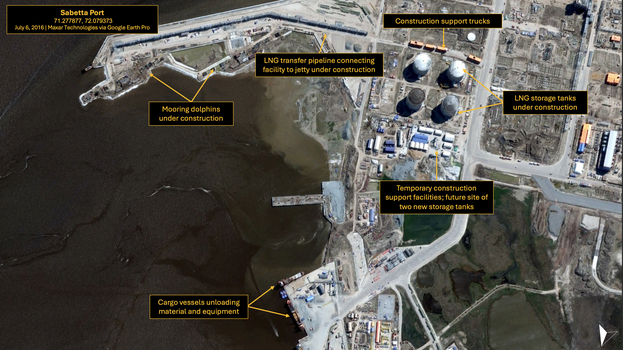
At the central area of the Yamal LNG facility, storage tanks for both condensate and LNG were under construction, with all roofs raised but external work ongoing. East of the tanks, LNG transfer pipelines used to connect the facility to the jetty were also being installed. Temporary construction support facilities were seen throughout the area, as well as materials, equipment, and trucks. Sites for the first three train sites are observed to be at various stages, with the site for Train 1 showing the most progress with some modules and structures partially placed. The site for Train 2 shows most of the foundations for its modules and structures installed, whereas the site for Train 3 mostly shows ground razing and partial placement of building foundations in place. To the west of the train sites, additional facilities such as power generation, utilities, and inlet gas areas are also under construction.
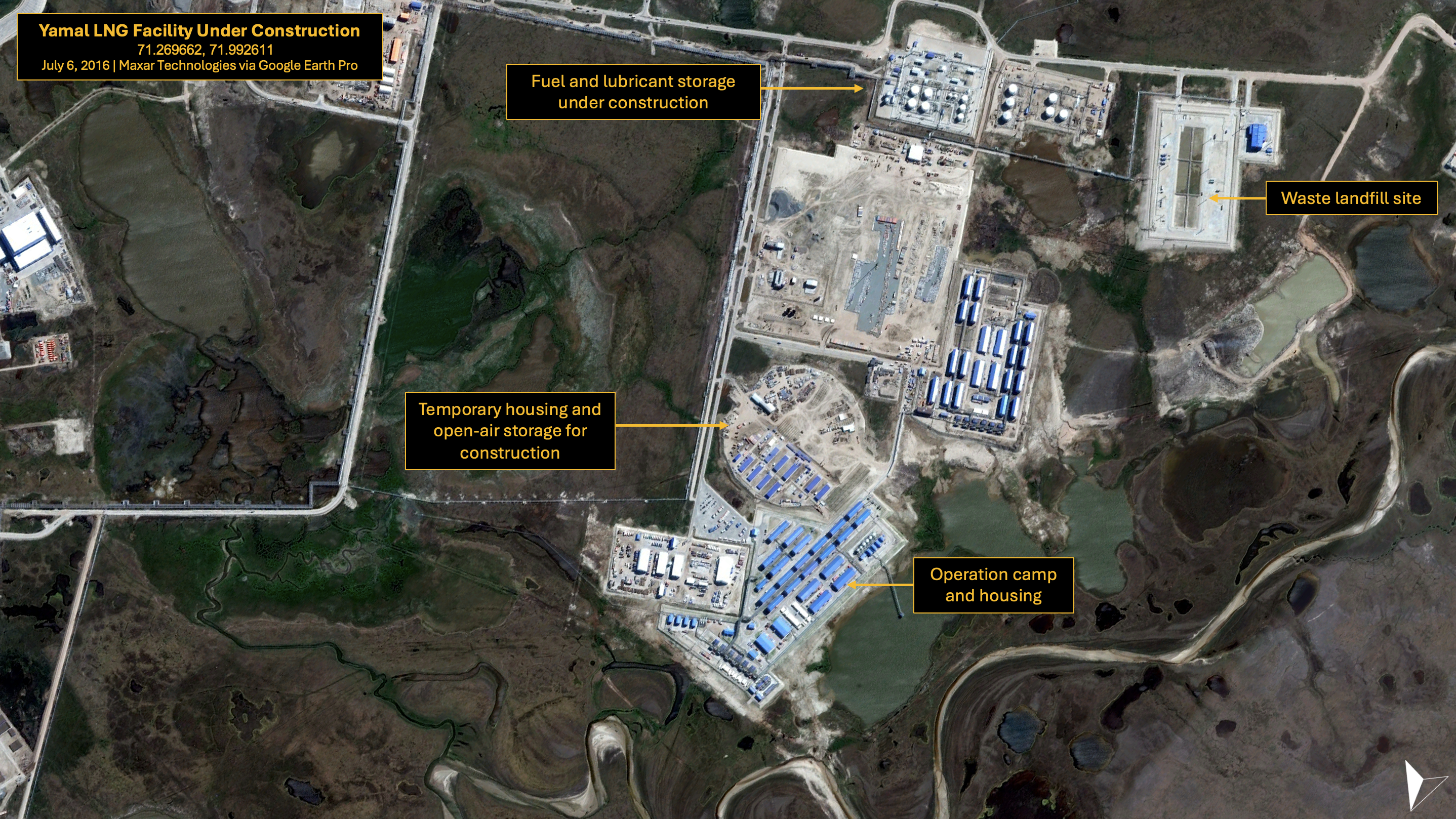
Northeast of the central section, an operation camp and housing for construction workers were observed, along with temporary housing and open-air storage for materials in a round paved area. A fuel and lubricant storage site is under construction, and the waste landfill site to the north is observed near completion.
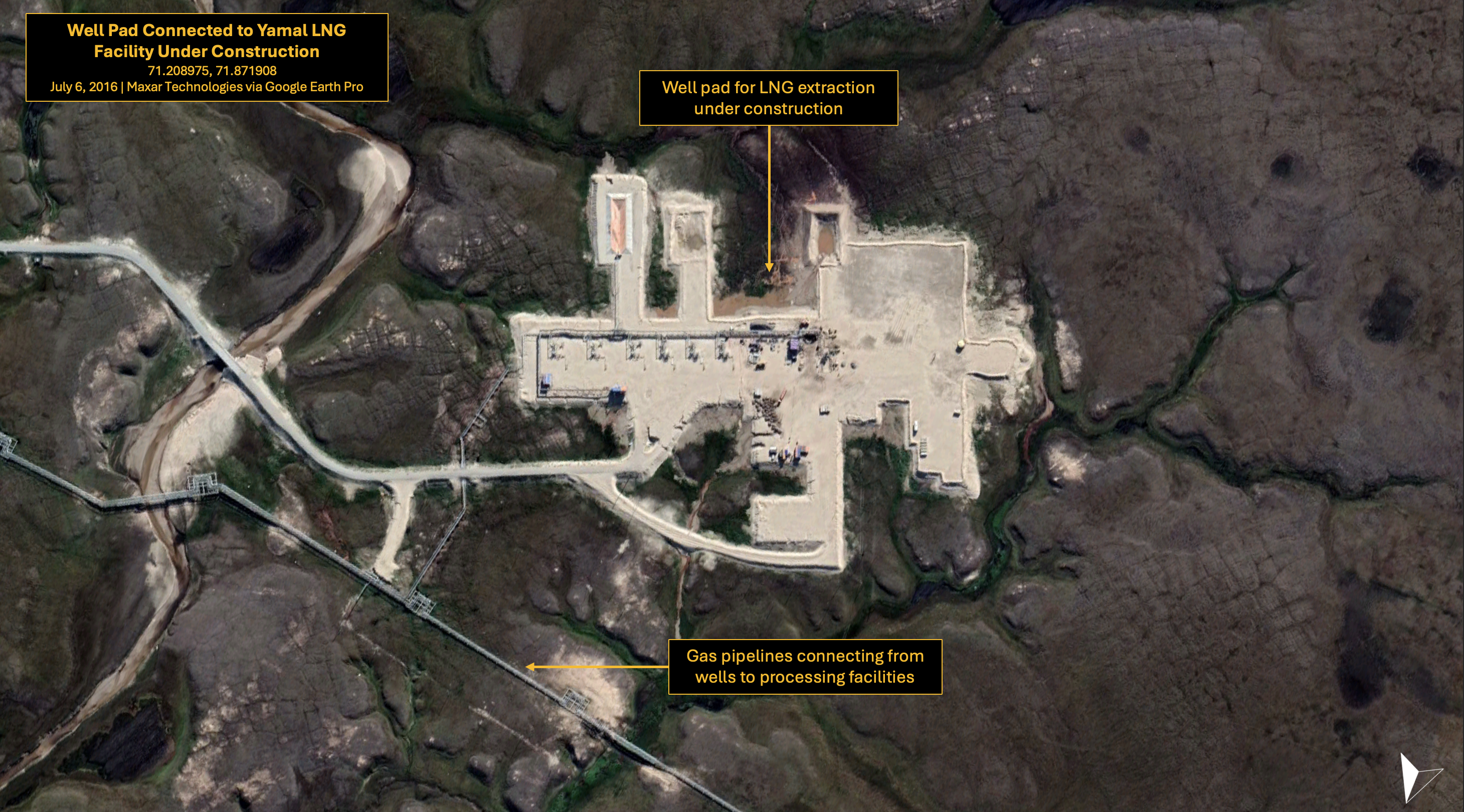
In addition to the construction of the Yamal LNG facility and the jetty at Sabetta port, tens of well pads for LNG extraction were observed under construction in the surrounding Yuzhno-Tambeyskoye gas field.
The first gas-in of Train 1 of the Yamal LNG facility started on September 10, 2017, signifying the commencement of the final commissioning phase and marking a pivotal milestone in the development of the project as it prepared to produce its first batch of liquefied natural gas later that year.Stéphane Le Galles and Michael Borrell, Yamal LNG: Delivering World-Class LNG Project, Investor Day Presentation, TotalEnergies, 2017, https://www.totalenergies.com/media/document/yamal-lng-overview.[11] Facility operations officially started on December 8, 2017, when Vladimir Putin attended the opening ceremony.Presidential Executive Office, “Meeting on the Yamal LNG Plant Launch,” President of Russia Official Website, December 8, 2017, http://en.kremlin.ru/events/president/news/56338.[12] Concurrently with these developments, the Yamal LNG project also included the building of a new class of ship. Christophe de Margeris, the first of these Yamalmax-class tankers with the highest commercial ice classification of Arc7 was completed in August 2017.The Arctic Institute, “The Complexities of Arctic Maritime Traffic,” The Arctic Institute, October 23, 2019, https://www.thearcticinstitute.org/complexities-arctic-maritime-traffic/.[13]
By August 2018, the Russian government and Novatek announced that the Yamal LNG plant’s second train was operational six months ahead of schedule. Its first shipment was announced, adding an additional 5.5 MMtpa of LNG capability, leading to a total of 11 million tons per year from the Yamal LNG facility in less than a year of the first train’s gas-in.The Russian Government, “Launch of the Third Stage of the Yamal LNG Plant,” The Russian Government, December 11, 2018, http://government.ru/en/news/35055/.” TotalEnergies, “Yamal LNG Begins Gas Exports from Second LNG Train,” TotalEnergies, August 9, 2018, https://totalenergies.com/media/news/press-releases/yamal-lng-begins-gas-exports-second-lng-train.[14] Its third train started operations later in November 2018, twelve months ahead of the original schedule.Novatek, “Yamal LNG Realized LNG Commissioning in Record Time,” Novatek Official Website, August 9, 2018, https://www.novatek.ru/en/press/releases/printable.php?print=1&id_4=2563&%25253bfrom_4=2&mode_20=all&quarter_3=0; Novatek, “Yamal LNG Commenced Third LNG Train Production,” Novatek Official Website, November 22, 2018, https://www.novatek.ru/en/press/releases/index.php?id_4=2828; TotalEnergies, “Russia: Yamal LNG Starts Up Train 3 Twelve Months Ahead of Schedule and Achieves Its Full Capacity,” TotalEnergies, December 11, 2018, https://totalenergies.com/media/news/press-releases/russia-yamal-lng-starts-train-3-twelve-months-ahead-schedule-and-achieves-its-full-capacity.[15]
A year later, in November 2019, Russia’s Novatek announced that in that year the plant produced more than 16.5 million tons of LNG, exceeding its annual nameplate production capacity with the three trains in operation.Yamal LNG, “Yamal LNG Exceeds Annual Nameplate Production Capacity,” Yamal LNG Official Website, November 29, 2019, http://yamallng.ru/en/press/news/37916/.[16] Its high output levels were supported by ship-to-ship LNG transshipment by LNG tankers such as Vladimir Rusanov, Vladimir Voronin, and Nikolay Yegenov.Novatek, “Yamal LNG Completes First Ship-to-Ship LNG Transshipment in Norway,” Novatek Official Website, November 26, 2018, https://www.novatek.ru/en/press/releases/printable.php?id_4=2833&from_4=20 ; World Maritime News, “Yamal LNG Ships 20 Million Tons of LNG,” World Maritime News, August 19, 2019, https://worldmaritimenews.com/archives/281757/yamal-lng-ships-20-million-tons-of-lng/ ; Pacific Maritime, “Yamal LNG Ships 30 Million Tons of LNG,” Pacific Maritime, June 1, 2020, https://pacmar.com/yamal-lng-ships-30-million-tons-of-lng/.[17] These tankers allowed for the successful loading of LNG cargo from the Yamal LNG facility to lower ice-class tankers, then ultimately to customers in Europe.Novatek, “Yamal LNG Completes First Ship-to-Ship LNG Transshipment in Norway,” Novatek Official Website, November 26, 2018, https://www.novatek.ru/en/press/releases/printable.php?id_4=2833&from_4=20.[18]
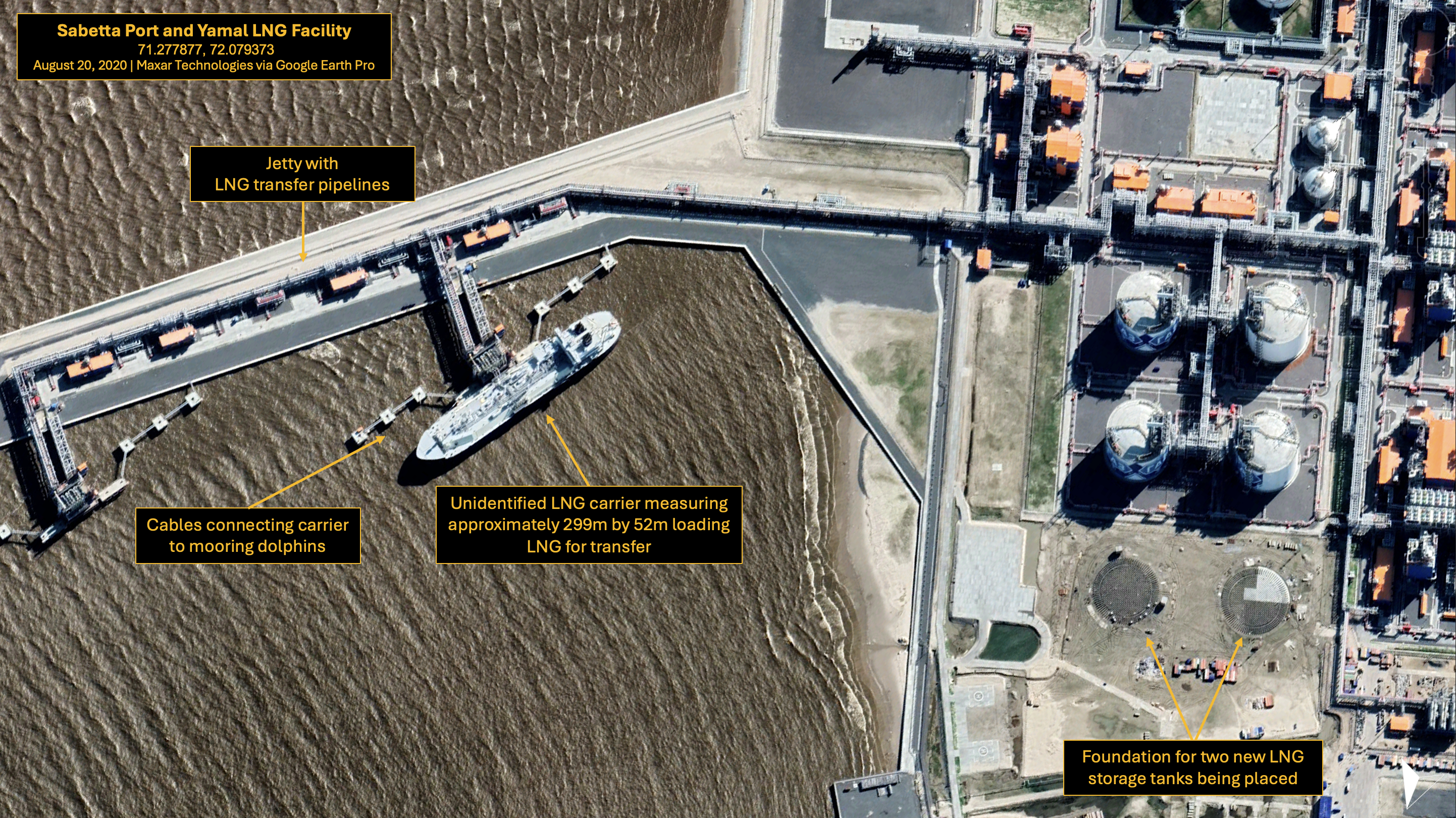
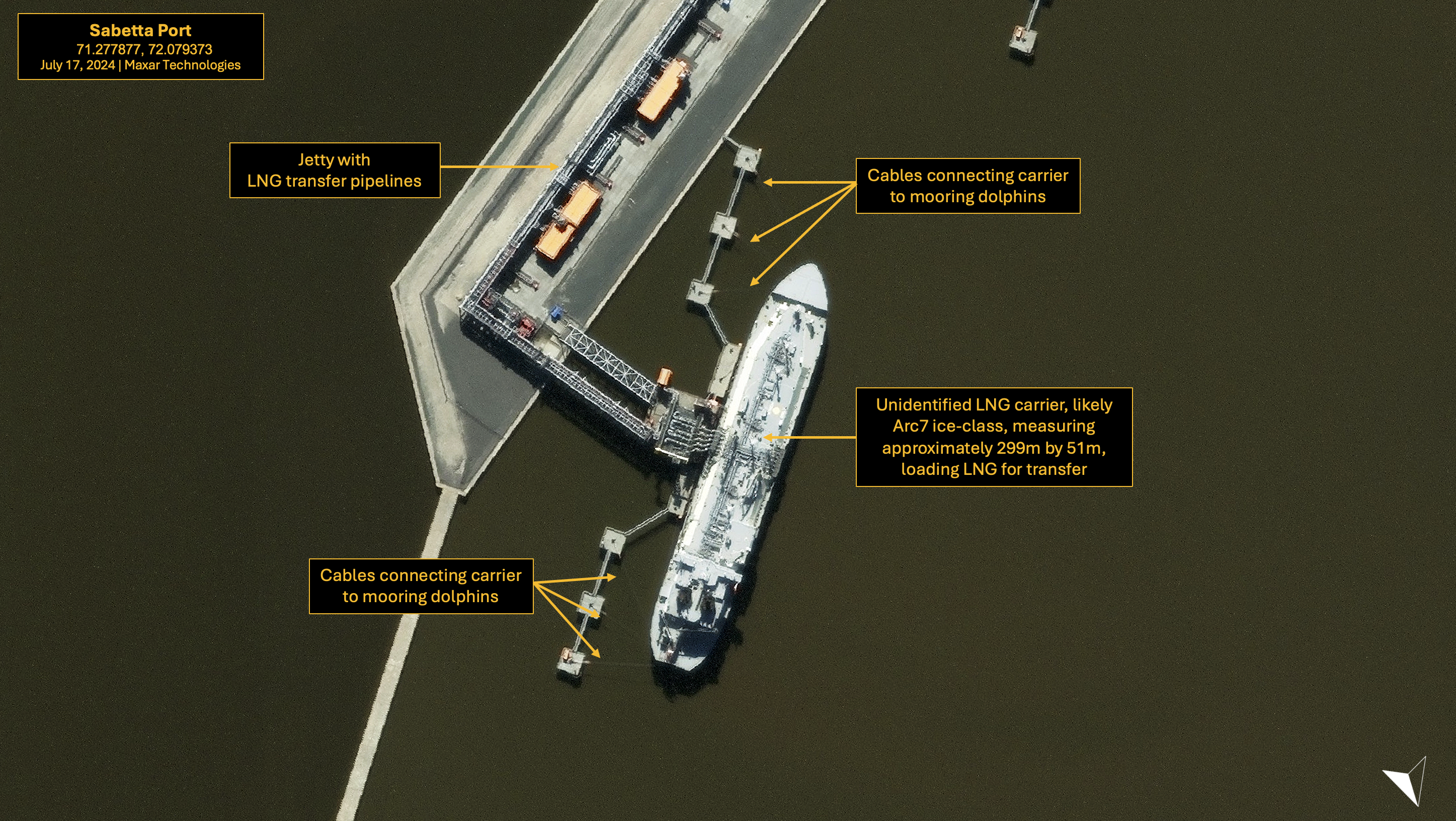
Maxar imagery taken during this period of elevated output, specifically on August 20, 2020, shows indicators of significant levels of activity. At the jetty, an unidentified LNG carrier—potentially a Yamalmax class— which measures approximately 299 meters by 52 meters, is berthed, presumably to load LNG for transfer. North of the jetty and immediately north of the four LNG storage tanks, the foundation for what would later become two new storage tanks is being placed. Although it is yet unclear whether the tanks will store LNG or other materials such as condensate or fuel, the Yamal LNG facility's production exceeding its expected nameplate capacity suggests the tanks will likely be used to store LNG to support the increased output.
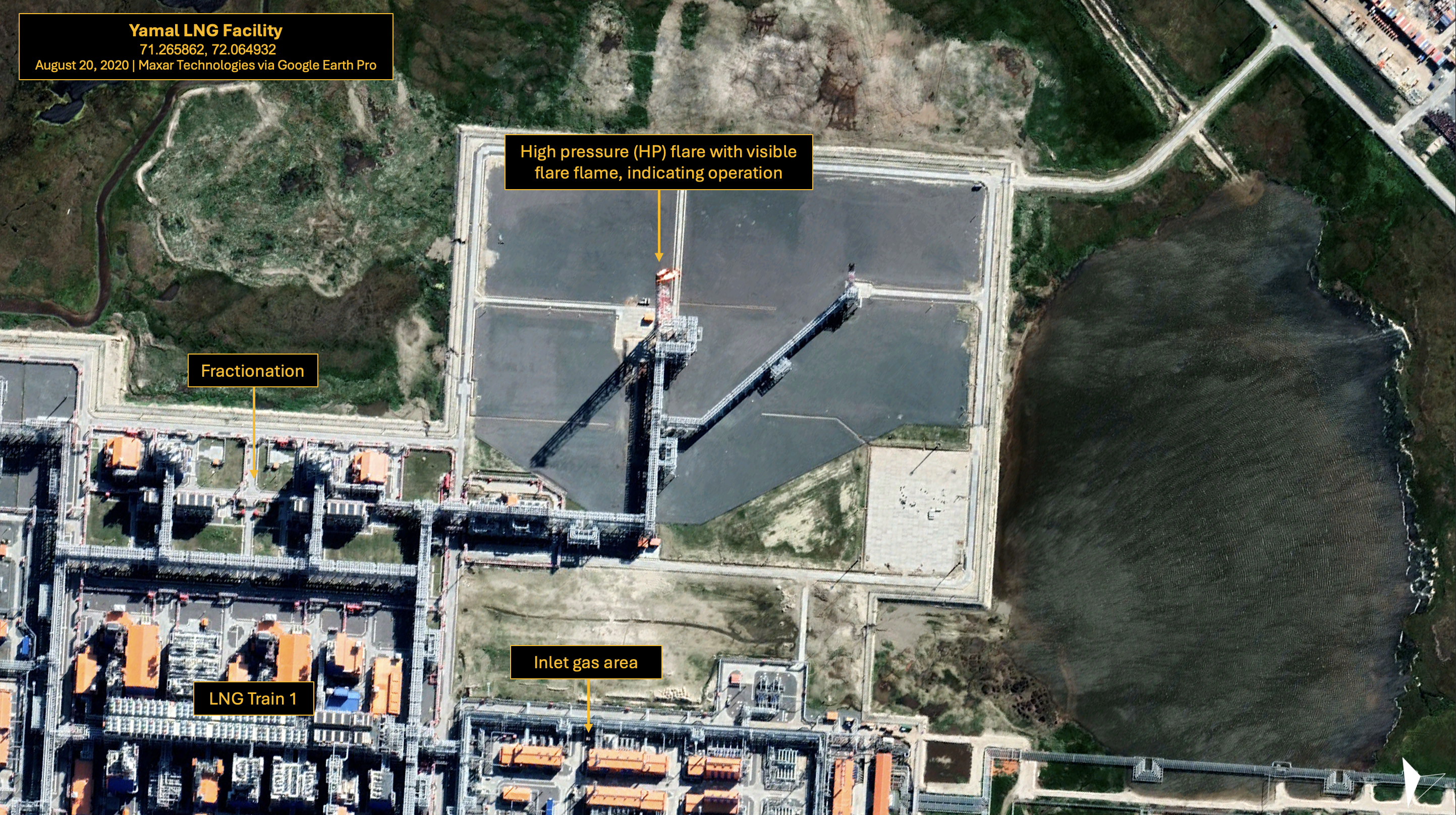
Another observed sign of activity is the flare flame observed at the HP flare, indicating the controlled burning of excess gases released from the processing or storage systems.
In June 2021, the Yamal plant’s fourth and smallest LNG train came online after delays set the operation of the liquefaction unit back by three years.Upstream Online, “Yamal LNG Brings Troubled Fourth Train Online at Huge Russian Project,” Upstream Online, January 20, 2021, https://www.upstreamonline.com/lng/yamal-lng-brings-troubled-fourth-train-online-at-huge-russian-project/2-1-1018793.[19] Two months later, Train 1 underwent maintenance and halted operations temporarily from August 1 to August 19, 2021.LNG Prime, “Novatek to Shut First Yamal LNG Train for Maintenance,” LNG Prime, July 14, 2021, https://lngprime.com/asia/novatek-to-shut-first-yamal-lng-train-for-maintenance/23968/.[20] Such temporary halts for maintenance are part of standard practice for operational safety, performance optimization, and management.
Recent Developments & Operational Status
In May 2023, Novatek announced that Yamal LNG achieved a remarkable milestone of producing its billionth cubic meter of gas, indicating sustained successful operations at the plant.Novatek, “NOVATEK Shipped First Cargo from Arctic LNG 2,” Novatek Official Website, October 20, 2023, https://www.novatek.ru/en/press/releases/index.php?id_4=5736.[21] A month later, Train 2 underwent a temporary shutdown for scheduled maintenance.TASS, “Novatek Launches First Line of Arctic LNG 2 Plant,” TASS, October 19, 2023, https://tass.com/economy/1673749.[22] In August 2023, train 3 also underwent a similar maintenance halt in operation, and it was announced that no halt for repair was anticipated in 2024.TASS, “Novatek Launches First Line of Arctic LNG 2 Plant,” TASS, October 19, 2023, https://tass.com/economy/1673749[23]
An analysis of 58 satellite images, including multispectral and synthetic aperture radar (SAR) data, from May 2023 to November 2024 show recent developments and the operational status of the Yamal LNG facility.
The latest high-resolution image, taken by Maxar on July 17, 2024, shows detailed changes to the LNG facility since the latest publicly available image from August 2020 on Google Earth Pro [see Figure 1 above]. The most notable changes to the facility include the continued construction of two new storage tanks north of the four pre-existing LNG storage tanks at the facility, likely to support the increased output capacity of the plant. West of these two new tanks, a wide road and round perimeter has been razed. The purpose of this unidentified work is yet unclear. However, the shape of this construction is similar to the ground area of what had previously been temporary housing for construction support to the west, next to the permanent operation camp and housing. Future monitoring will be required to identify the purpose of this groundwork.
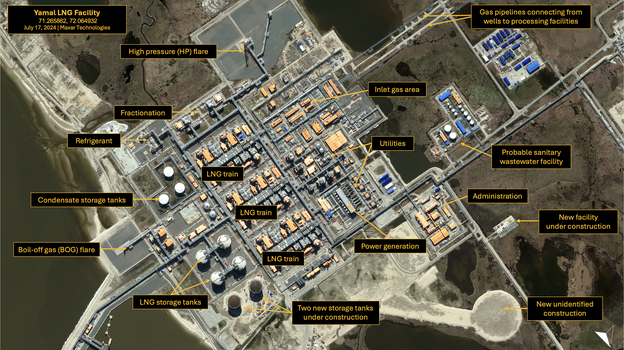
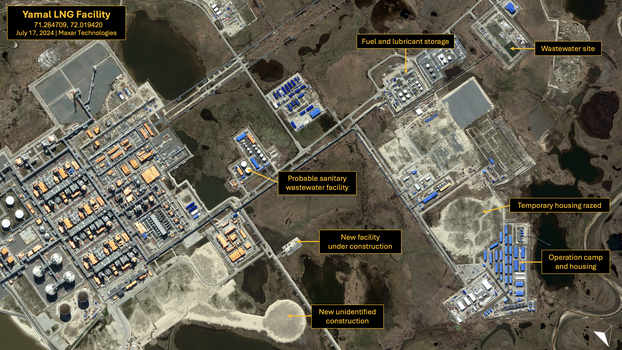
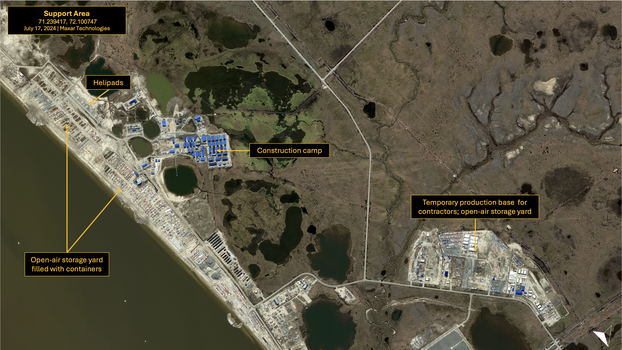
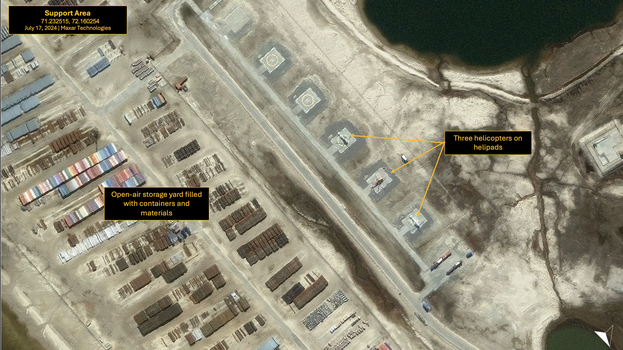
Further southeast of the Yamal LNG facility in July 2024 is the support area, serving as an open-air storage yard filled with containers and materials, six helipads, construction camp, and temporary production base for contractors. Three helicopters were observed on helipads.
The Sabetta International Airport, approximately five kilometers southwest of the Yalam LNG facility, is operational, with an actively maintained runway and two helicopters and one aircraft observed on the apron. Its active maintenance and consistent presence of aircraft indicate its ongoing support of operations at the Facility [see Figure 2 above].
Throughout the study period, the continued presence of vessels on Maxar imagery at Sabetta port indicated high levels of activity at the Yamal LNG facility. Forty-nine of the 58 analyzed images show one or two vessels, consistent in size with that of an Arc7 tanker, moored at the jetty. This pattern of activity indicates sustained high levels of LNG processing and export from Yamal, despite increased Western pressure such as the EU sanctions package in response to the Russian invasion of Ukraine.European Commission, “Commission Proposes New Energy Transition Framework for LNG Imports,” European Commission Press Corner, October 18, 2024, https://ec.europa.eu/commission/presscorner/detail/en/ip_24_3423.[24] It also supports the open source reports that Yamal LNG has resumed ship-to-ship cargo transfers as the direct Northern Sea Route to Asia becomes more challenging to navigate in the winter. Ship-to-ship transfers are expected to become more frequent in the coming year due to the aforementioned EU sanctions package and ban on transshipment.Energy Intelligence, “Arctic LNG 2: Challenges Amid Sanctions and Market Shifts,” Energy Intelligence, October 2024, https://www.energyintel.com/00000193-44cc-d000-ab9b-deec494c0000.[25]
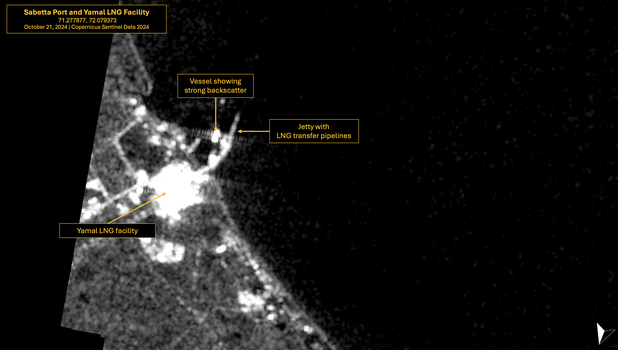
Two more recent images studied— one a medium-resolution Landsat-8 image taken on October 15, 2024, and another a Sentinel-1 SAR image taken on October 21, 2024—show the presence of vessels, likely LNG carriers, moored at the jetty. In the Sentinel image, the vessel shows strong backscatter and stands out against the low to no backscatter of the water. In addition, in the Landsat-8 image–the latest multispectral image analyzed—one of the two storage tanks is now externally complete, with white roofing. Visible HP flare flame also indicates operation at the facility.

Insights & Future Analysis
The Yamal LNG facility exemplifies the scale and ambition of Russia's Arctic energy strategy. Imagery analysis shows the development of the facility and its high production capacity. The facility's support infrastructure and activity observed at these sites also show that the plant will continue to maintain a critical, if not growing, role in Russia's energy production despite external pressures such as sanctions or seasonal navigation barriers. Future monitoring of the facility's ongoing expansions, particularly the new tank sites and evolving logistics at Sabetta port, will be essential to understand Yamal LNG's operational trajectory, as well as Russia's Arctic resource management and energy security.
Arctic LNG 2 Facility
Background & Facility Overview
The second of Russia’s two operational LNG plants in the Arctic is the Arctic LNG 2 facility (71.009482, 73.806917). It is located approximately 68 kilometers to the southwest across the Ob River from the Yamal LNG facility and in the Gydan Peninsula. The facility is owned by OOO Arctic LNG. This is a joint company formed by Russia’s Novatek (60%), France’s Total (10%), China National Petroleum Corporation (10%), China National Offshore Oil Corporation (10%), and the Japan Arctic LNG (10%).Vitaly Yermakov, “Arctic LNG 2: The Litmus Test for Sanctions Against Russian LNG,” OIES Energy Comment, Oxford Institute for Energy Studies, October 2024.[26] Arctic LNG 2 exports gas from the nearby Salmanovskoye (Utrenneye) oil and gas condensate field, which was discovered in 1979.Ramboll CIS, Arctic LNG 2 Project: Environmental, Social and Health Impact Assessment – Nontechnical Summary, August 2020.[27] While Novatek operates the facility, the presence of major foreign stakeholders may also influence the midstream and downstream processes.
The Arctic LNG 2 facility is notable for its use of gravity-based structures (GBS). This platform is designed to rest on the seabed and therefore does not require construction into the Arctic terrain which can be susceptible to permafrost thawing. The GBS terminals, which consist of processing (liquefaction) equipment and LNG storage tanks, reduce the need to develop additional infrastructure in the harsh conditions of the Arctic.GTT, “GTT Signs Contract for Three GBS Units for Arctic LNG 2 Project,” GTT Official Website, June 18, 2019, https://gtt.fr/news/gtt-signs-contract-three-gbs-units-arctic-lng-2-project.[28] Although only two GBS are at the site now, a total of three are planned for the Arctic LNG 2 facility. The GBS are built at another shipyard in the dry dock of the NOVATEK-Murmansk LLC shipyard and taken to the facility site.Ramboll CIS, Arctic LNG 2 Project: Environmental, Social and Health Impact Assessment – Nontechnical Summary, August 2020.[29] Although Arctic LNG 2 is Novatek’s first facility with GBS, it plans to build additional LNG facilities with them in the future.Novatek, Unlocking Arctic Potential: Expanding Our Global LNG Footprint to 2030, Investor Meetings Presentation, April 2020.[30]
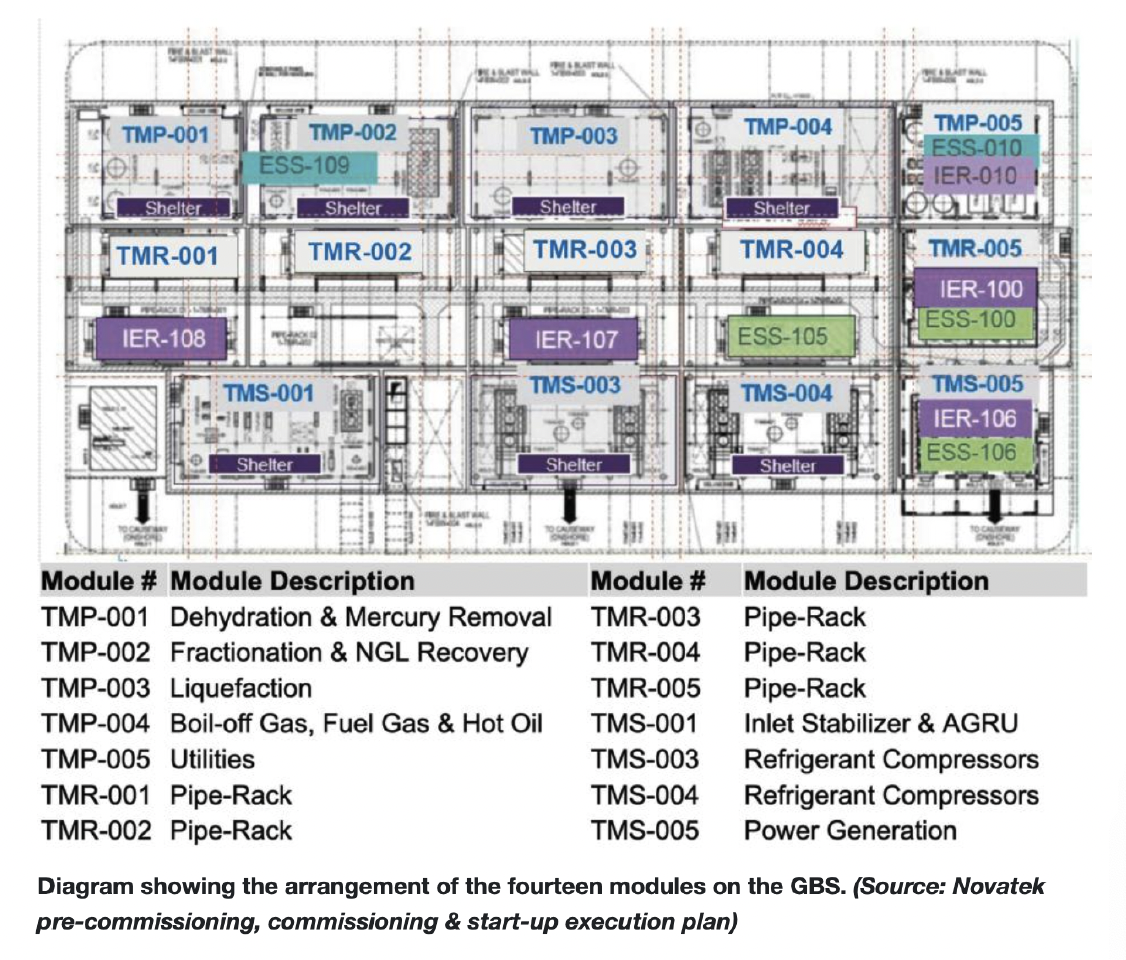
In addition to the LNG trains, the Arctic LNG 2 facility consists of a flare system, operations control administration, utilities, well pads, power generation, waste treatment and disposal facility, helipads, and more.High North News, “Novatek on Track to Commission Train 2 of Arctic LNG 2 in 2024, with Final Module Leaving Chinese Yard,” High North News, October 18, 2023, https://www.highnorthnews.com/en/novatek-track-commission-train-2-arctic-lng-2-2024-final-module-leaving-chinese-yard.[31]Ramboll CIS, Arctic LNG 2 Project: Environmental, Social and Health Impact Assessment – Nontechnical Summary, August 2020[32]
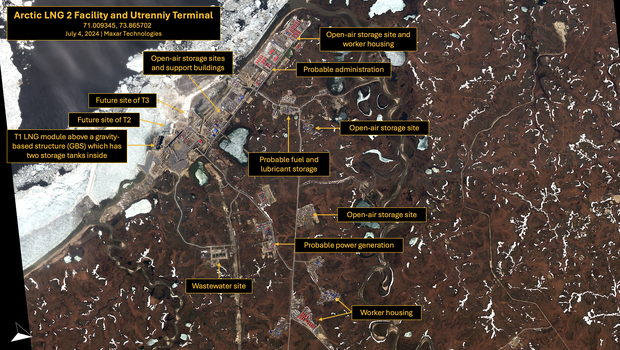
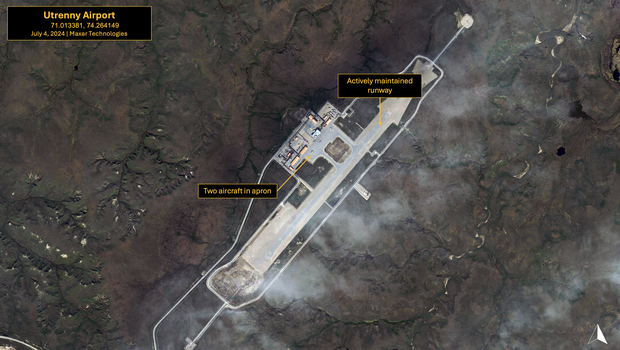
The latest accessible cloud-free high-resolution multispectral image from Maxar taken on July 4, 2024, shows the Arctic LNG 2 facility is supported by Utrenny Airport, approximately 15 kilometers to the east, and the Utrenny Terminal, where the GBS are located. Additionally, a number of open-air storage yards and support facilities such as worker housing surround the facility.
History & Development
In March 2017, Russia’s Novatek announced plans to build Arctic LNG 2, following the successful start of construction of the Yamal LNG facility. Arctic LNG 2 was originally planned to be completed by 2023, as “the Gydan and Yamal peninsulas have a vast resource base that allows the production of over 70 million tonnes [per annum]...comparable to the LNG production in Qatar.”The Maritime Executive, “Russian Firm Looks to Build Second Arctic LNG Plant,” The Maritime Executive, February 14, 2023, https://www.maritime-executive.com/article/russian-firm-looks-to-build-second-arctic-lng-plant.[33]
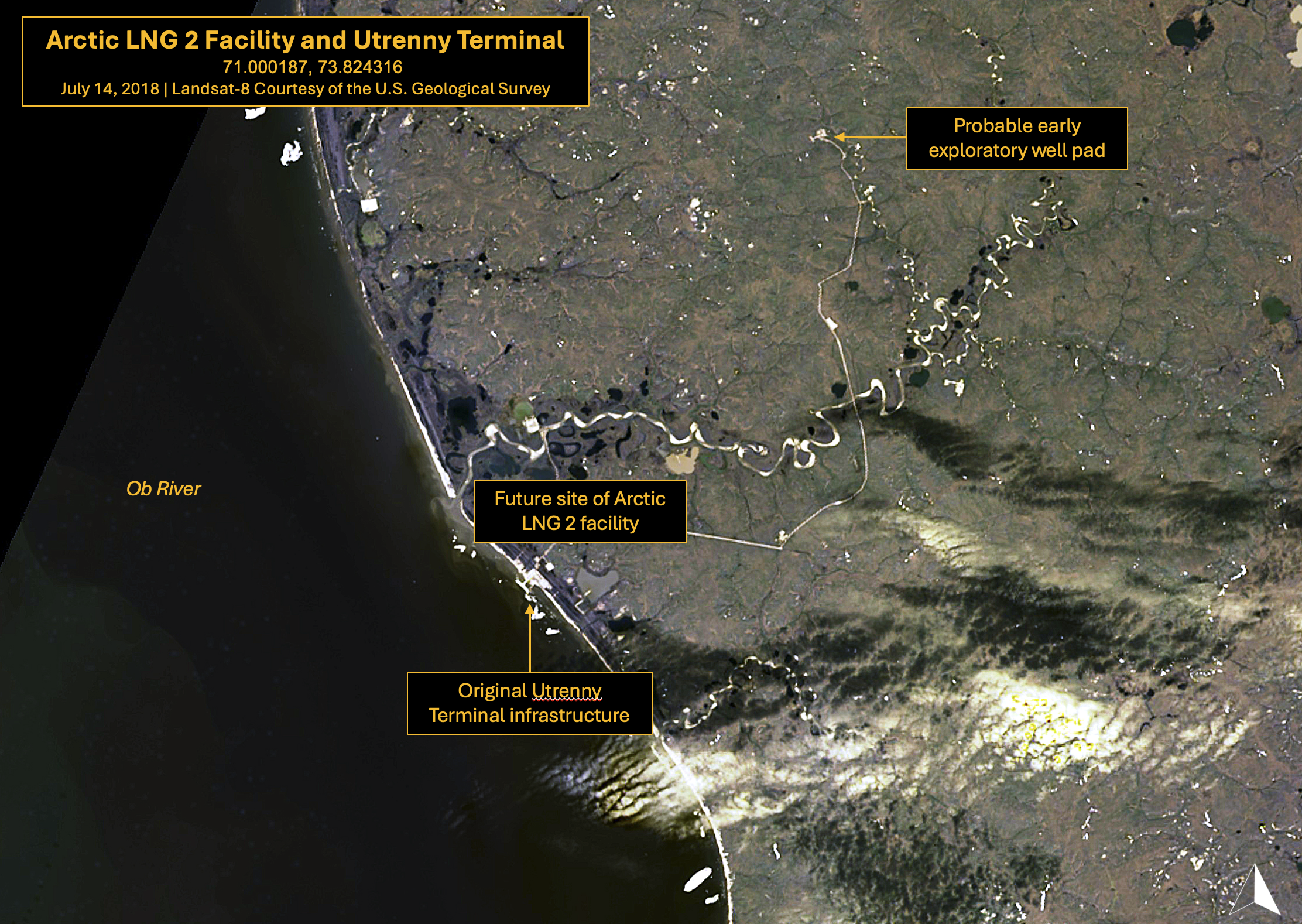
Landsat-8 images taken on July 14, 2018, show the site prior to the start of the facility construction. It shows minimal infrastructure, including a probable early exploratory well pad as well as a small pier located at what would later become the Utrenny Terminal.
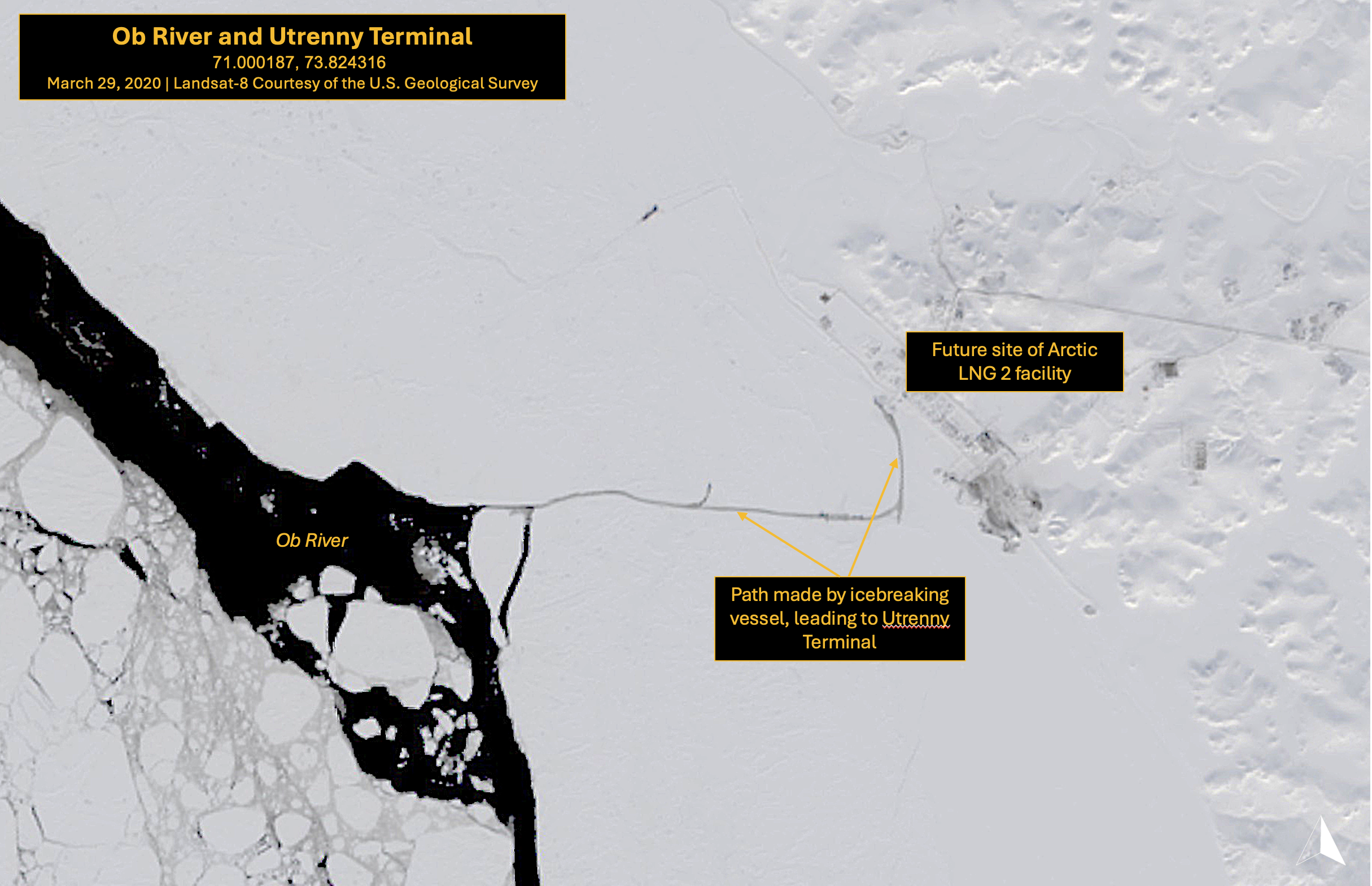
By March 2020, the construction site had received 20,000 tons of construction material, delivered by nuclear-powered icebreaking cargo vessels. Open source reporting indicated that the vessel, Sevmorput, had made two similar deliveries in the summer of 2019 and several more were planned in 2020.High North News, “Construction of Novatek’s Arctic LNG 2 Project Ahead of Schedule,” High North News, April 16, 2020, https://www.highnorthnews.com/en/construction-novateks-arctic-lng-2-project-ahead-schedule[34]
During this time period, a Landsat-8 image from March 2020 shows the harsh Arctic conditions at the construction site, with most of the Ob River shore frozen and covered in ice and snow. In the river, what seems to be a trail made by the aforementioned icebreaker is observed.
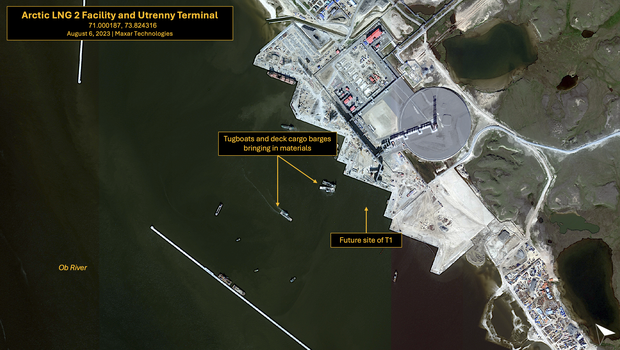
Construction at the facility, terminal, and the airport continued the following years, with the Utrenny Airport landing its first plane in June 2021.Offshore Technology, “Arctic LNG 2 Project, Russia,” Offshore Technology, accessed December 4, 2024, https://www.offshore-technology.com/projects/arctic-lng-2-project-russia/.[35] Two years later, a Maxar image taken on August 6, 2023, shows the facility still under construction but several structures complete. Most notably, this image is the last accessible high-resolution image of the Utrenny terminal before T1 was seen at its intended site, as shown in the next accessible image taken on August 13, 2023. Prior to T1’s arrival, August 6, 2023, Maxar imagery shows several tugboats and deck cargo bringing in construction material to the Terminal.
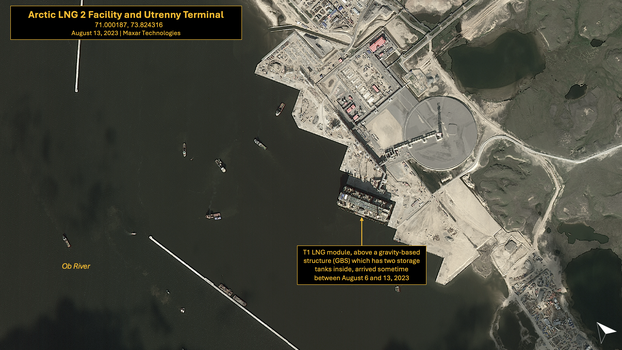
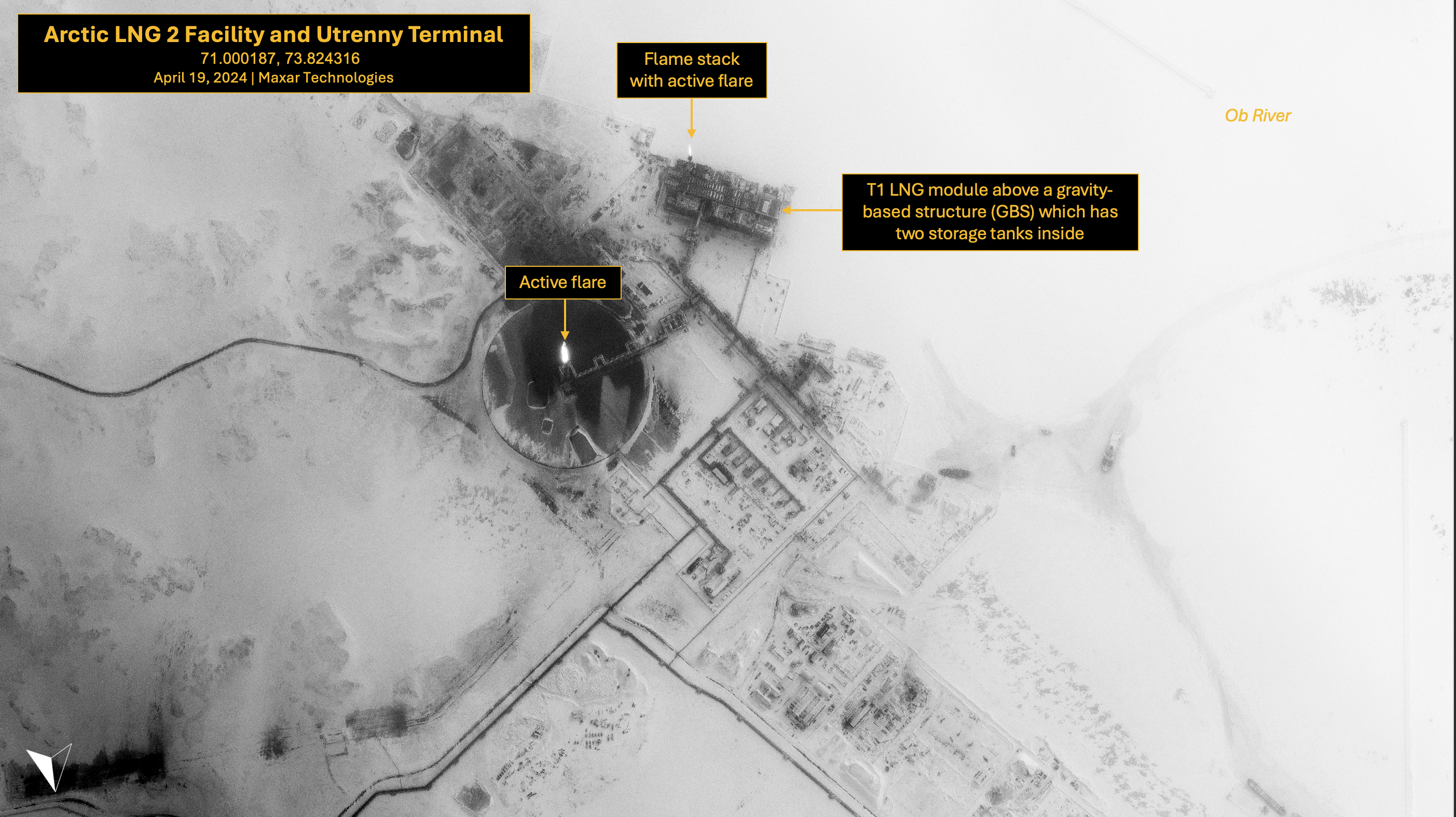
With T1 in place, the train was commissioned four months later in December 2023, when operations and production at the facility officially started.Upstream Online, “Arctic LNG 2’s Second Train Nears Commissioning After Power Plant Arrival,” Upstream Online, October 17, 2023, https://www.upstreamonline.com/energy-security/arctic-lng-2s-second-train-nears-commissioning-after-power-plant-arrival/2-1-1732100; Reuters, “Russia's Novatek to Start Delivering Equipment for Arctic LNG 2’s Next Phase in July,” Reuters, June 27, 2024, https://www.reuters.com/business/energy/russias-novatek-start-delivering-equipment-arctic-lng-2s-next-phase-july-2024-06-27/.[36] Although cloud-free and feasible satellite images are rare in the winter and early spring months, an image taken on April 19, 2024, show active flares at the onshore facility as well as at the flame stack on T1, indicating operation.
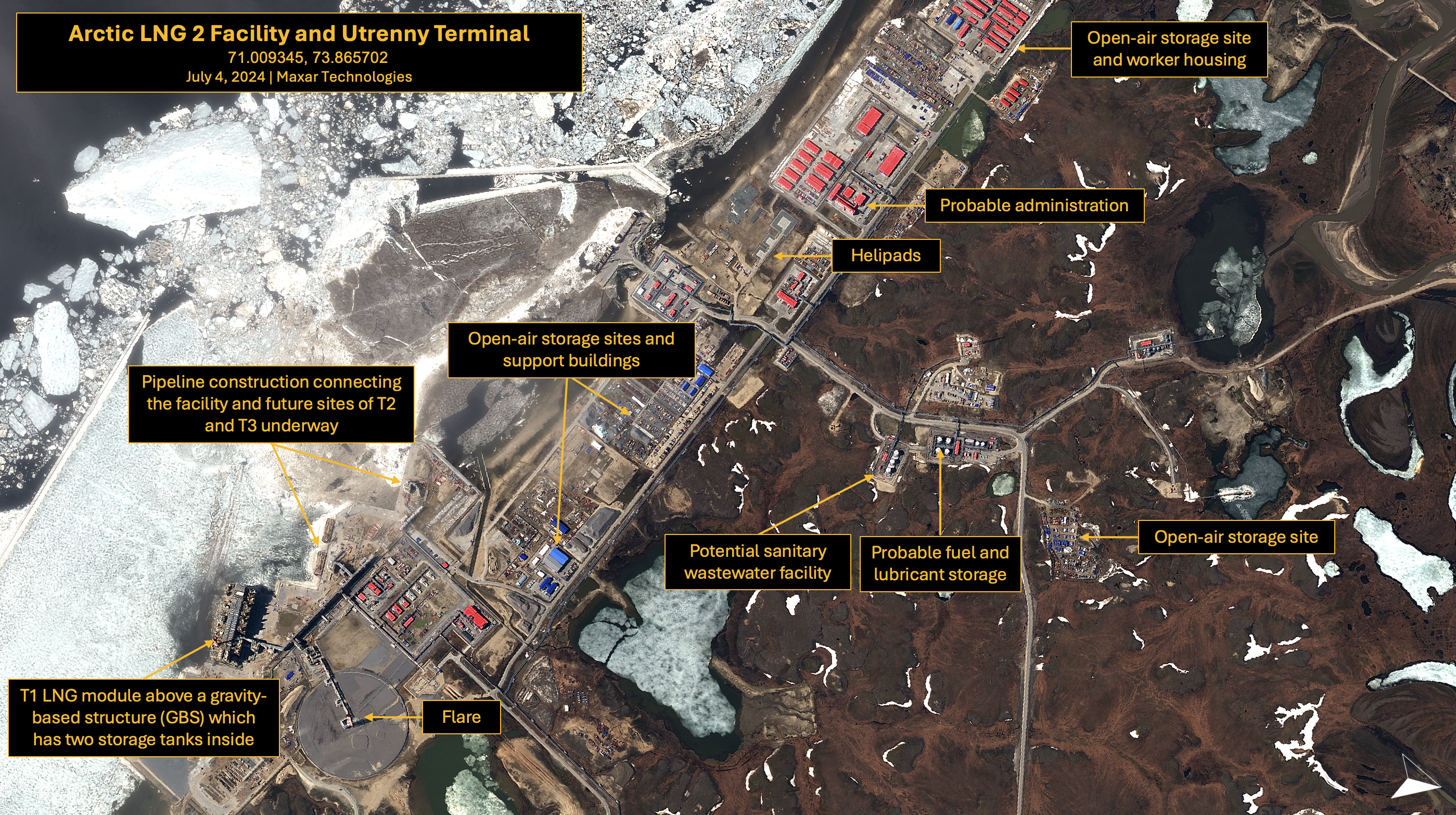
The latest available multispectral image of the facility at the time of analysis, captured on July 4, 2024, shows the progress of the construction and operational status of the site. [see Figure 23 above]
The image shows the T1 module in operation, with an active flare observed at its flame stack. Additionally, pipeline construction connecting the onshore facility and the future sites of T2 and T3 is underway. Surrounding the terminal, structures are seen still under construction, with roofing underway. Further south onshore are various open-air storage sites, three helipads, administration buildings, and worker housing.
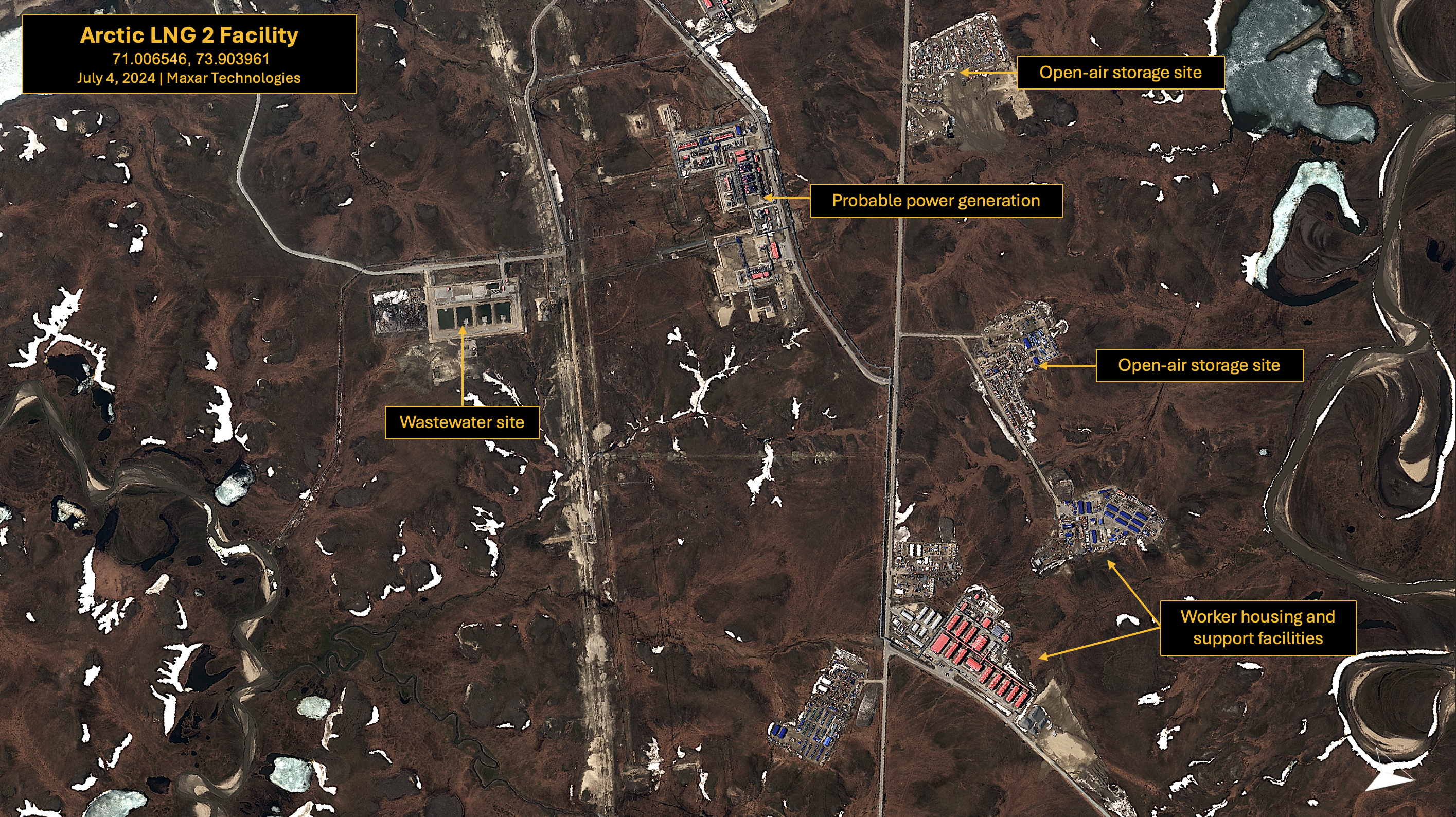
Inland to the east is additional facility support, including a wastewater site, several open-air storage sites, probable power generation, as well as worker housing and support buildings.
A few months later, in December 2023, Novatek had faced significant delays in the construction of the plant due to Western sanctions over Russia’s invasion of Ukraine. Novatek issued force majeures to warn that it will not be able to honor contractual obligations due to the pressure. Western sanctions have singled out the Arctic LNG 2 project as a priority, with the U.S. Assistant Secretary for Energy Resources explaining to the U.S. Senate Foreign Relations Committee that “our objective is to kill that [Arctic LNG 2] project.”High North News, “New US Sanctions Target Russia’s Arctic LNG 2: ‘Our Objective Is to Kill the Project,’” High North News, November 1, 2023, https://www.highnorthnews.com/en/new-us-sanctions-target-russias-arctic-lng-2-our-objective-kill-project.[37]
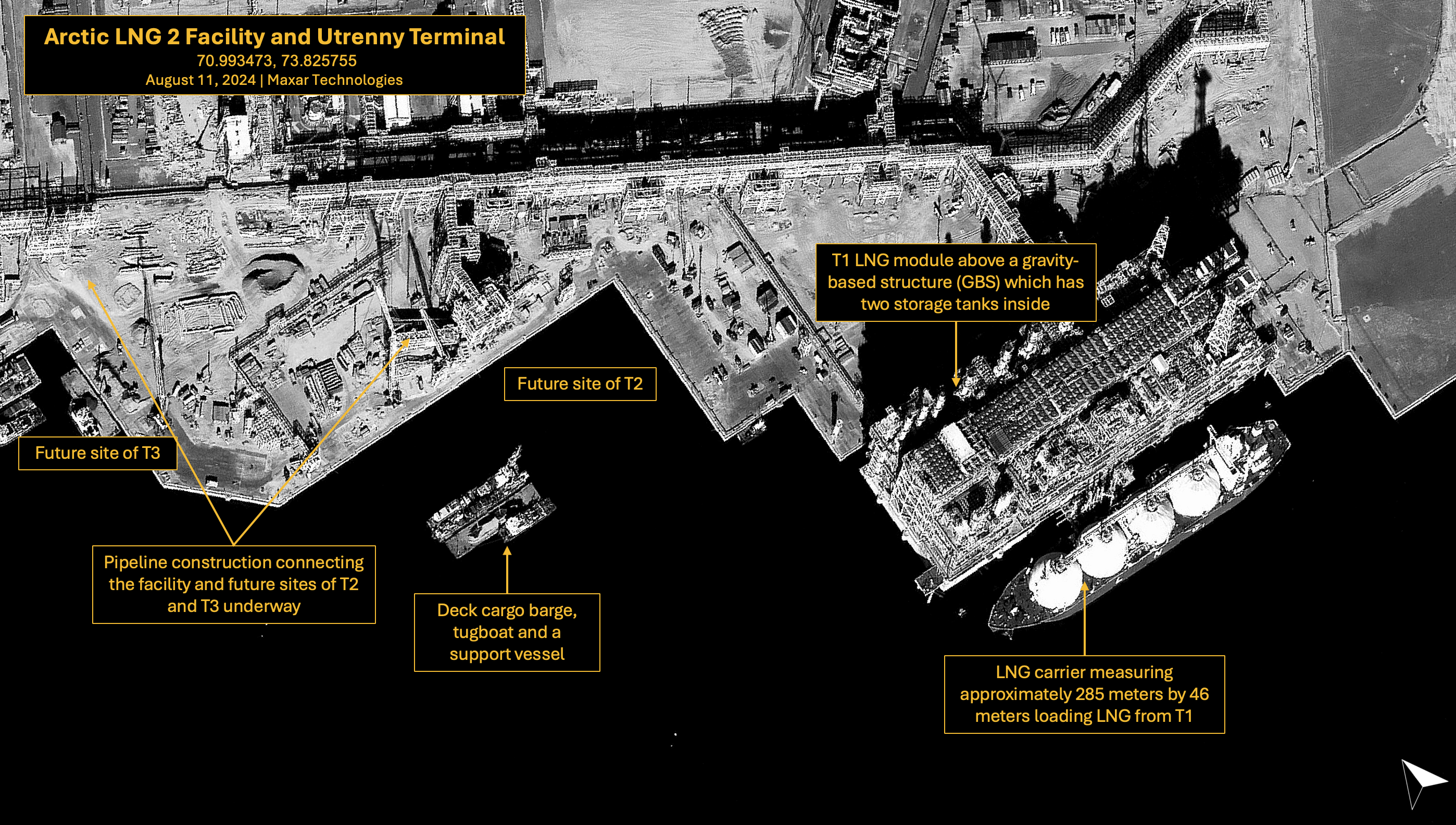
However, despite these challenges, Novatek announced its plan to start delivering the foundations of T2—the second GBS—in late July 2024.Reuters, “Russia's Novatek to Start Delivering Equipment for Arctic LNG 2’s Next Phase in July,” Reuters, June 27, 2024, https://www.reuters.com/business/energy/russias-novatek-start-delivering-equipment-arctic-lng-2s-next-phase-july-2024-06-27/.[38] Other sources also stated that the delivery would start between July 22 to July 25 of that year and additional reports suggested that the Arctic LNG 2 plant was ramping up its production as it entered summer and the handful of months when the Arctic warms up enough for easier vessel access. Export by vessel was reported to have started, and volumes reached “the highest so far this year.”Bloomberg, “Russia’s Arctic LNG 2 Plant Halts Amid Tightening US Sanctions,” Bloomberg, October 25, 2024, https://www.bloomberg.com/news/articles/2024-10-25/russia-s-arctic-lng-2-plant-halts-amid-tightening-us-sanctions.; Malte Humpert, “Exclusive: Russia Appears to Load First Arctic LNG 2 Cargo on ‘Shadow Fleet’ Vessel,” gCaptain, August 3, 2024, https://gcaptain.com/exclusive-russia-loads-first-arctic-lng-2-cargo-on-shadow-fleet-vessel/.[39] A Maxar image—the latest accessible high-resolution image of the facility during the study period—taken on August 11, 2024, supports such reporting. An LNG carrier, measuring approximately 285 meters by 46 meters, is observed berthed alongside T1, likely loading LNG processed by the T1 module. Additionally, a deck cargo barge, tugboat, and a support vessel were seen nearby transporting construction material.
Recent Developments & Operational Status
October 2024 was eventful for the Arctic LNG plant. Moscow’s Kommersant published the Russian Energy Ministry’s gas production data, which shows that the facility had produced 1.54 billion cubic meters of gas between January and September of 2024, a notable level considering that the facility is not yet complete and only relies on 1 train module.Upstream Online, “Arctic LNG 2’s Second Train Nears Commissioning After Power Plant Arrival,” Upstream Online, October 17, 2023, https://www.upstreamonline.com/energy-security/arctic-lng-2s-second-train-nears-commissioning-after-power-plant-arrival/2-1-1732100.[40] However, later in the month, on October 11, 2024, T1 was reportedly shut down, and the facility halted commercial operations without any plans to restart during the winter. The stated reasons were a “lack of appetite from buyers [as a result of Western sanctions] and a lack of Arc7 ice-class vessels needed to lift LNG during the winter months.”Gas Processing & LNG, “Russia's Novatek Shuts Down Commercial Operation at Arctic LNG 2 Train,” Gas Processing & LNG, October 28, 2024, https://gasprocessingnews.com/news/2024/10/russias-novatek-shuts-down-commercial-operation-at-arctic-lng-2-train/.[41] Additional sources confirmed this reporting later in the month, as commercial liquefaction at the facilities was paused due to high inventories and lack of available export methods.Bloomberg, “Russia’s Arctic LNG 2 Plant Halts Amid Tightening US Sanctions,” Bloomberg, October 25, 2024, https://www.bloomberg.com/news/articles/2024-10-25/russia-s-arctic-lng-2-plant-halts-amid-tightening-us-sanctions.[42]
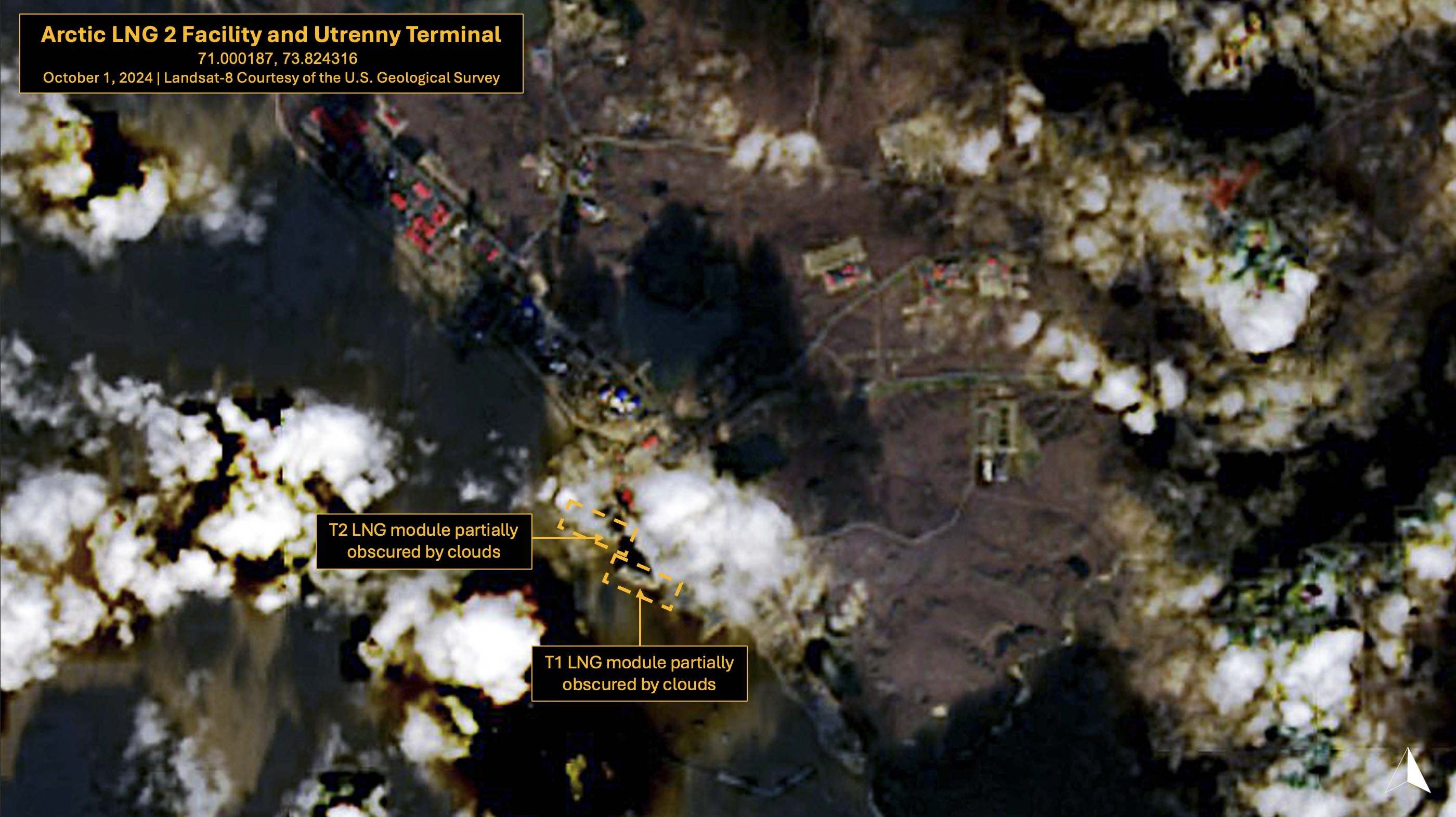
A rare partially cloud-free Landsat image taken on October 1, 2024, shows a sliver of the second module—T2—at its dedicated site next to T1, indicating that the train was still put into place sometime between mid-August and late September despite the halt in operation of T1, suggesting ongoing efforts for long-term production capabilities.
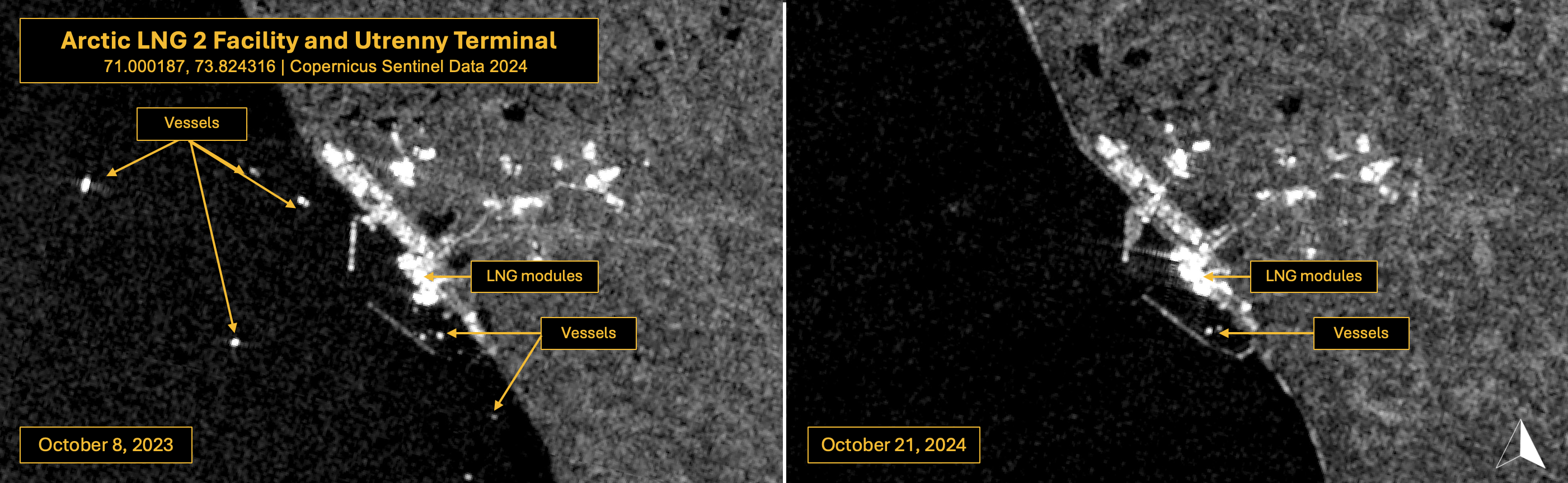
The Arctic LNG 2 facility is assessed to still be at a halt in operation, with no clear plans for restarting until the ice thaws during summer 2025, or when export challenges are mitigated. Although lack of cloud-free medium and high-resolution satellite imagery over the Arctic area make it challenging to view the facility and assess its most current state, a Sentinel-1 SAR image supports reporting of the operation’s halt. Compared to October 2023, the SAR image shows a comparatively lower vessel presence at the same time of the year. 42 subsequent Sentinel-1 SAR images taken between October 1, 2024, and December 1, 2024 show a persistent lack of vessel presence at the port.
Insights & Future Analysis
The facility’s progress—including the commissioning of Train 1 and the installation of Train 2—demonstrates Novatek’s resilience and commitment to maintaining Russia’s position as a major LNG exporter despite delays caused by Western sanctions and logistical hurdles. However, recent operational halts due to high inventories and limited export capacity highlight vulnerabilities in Arctic LNG 2’s operational framework, particularly under intensified geopolitical pressures. These challenges, coupled with the plant’s reliance on Arc7 ice-class tankers and the sensitivity of Arctic navigation, further complicate year-round export capabilities, especially during the winter, suggest that sustained monitoring of its logistical adaptations and infrastructure expansion will be crucial in the analysis of the facility.
Future analysis of the Arctic LNG 2 Facility should focus on the integration and functionality of subsequent GBS units, particularly T3, and the resolution of export constraints. Tracking developments in vessel traffic, storage capacity, and supporting infrastructure, such as Utrenny Airport, will provide insights into Arctic LNG 2’s recovery trajectory and operational capabilities.
Additional Facilities
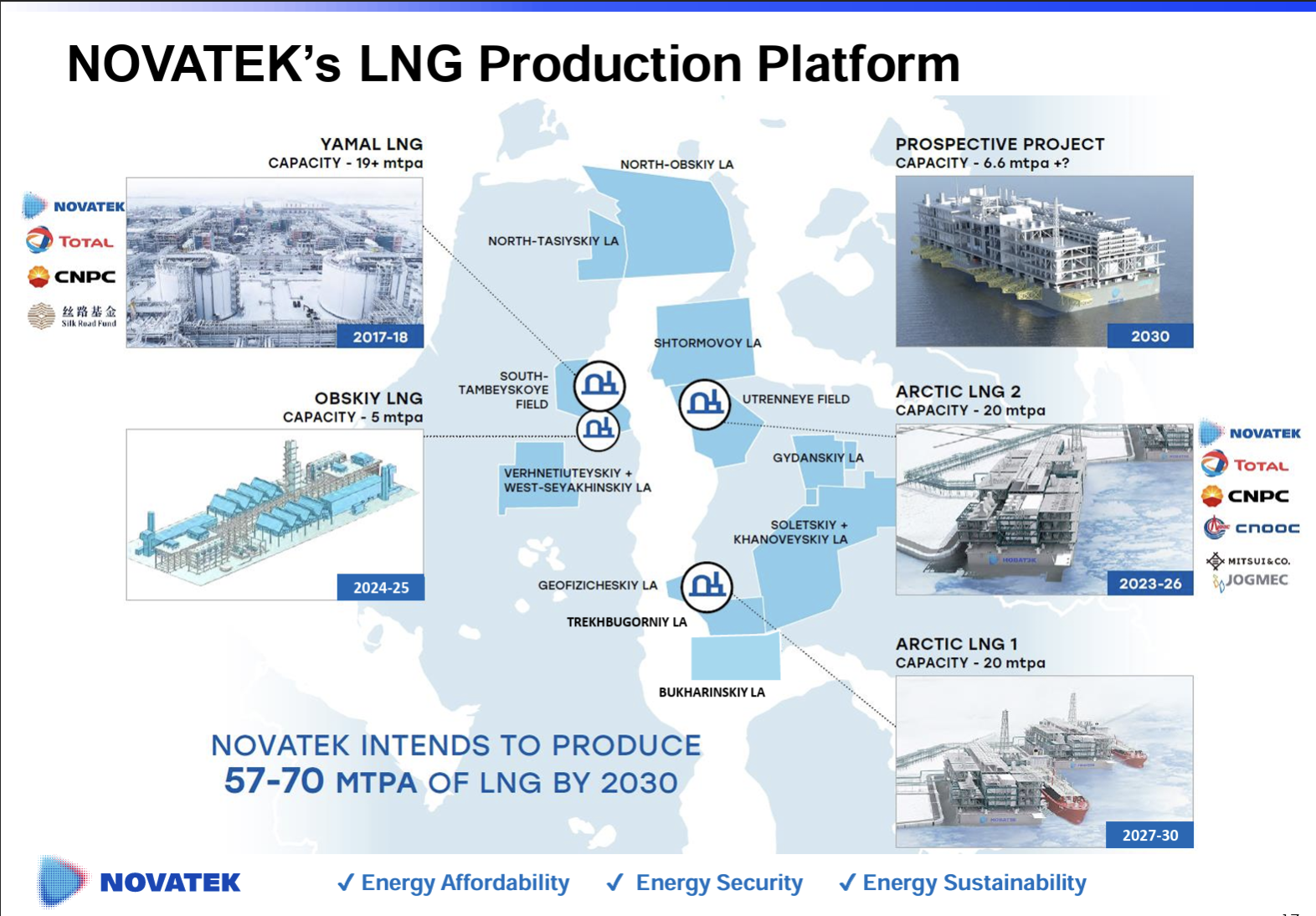
Russia’s Arctic energy ambitions do not stop with the two construction facilities. In 2020, Novatek published plans for three additional plants: Obskiy LNG, Arctic LNG 1, and another as yet unnamed prospective project.Novatek, Unlocking Arctic Potential: Expanding Our Global LNG Footprint to 2030, Investor Meetings Presentation, April 2020, https://www.novatek.ru.[43] However, these projects have seen major challenges or replanning.
Novatek originally proposed another LNG terminal just south of the Yamal LNG facility, called the Obsky LNG Terminal. However, this plan was reconfigured in June 2021 to the Obsky Gas Chemistry, dedicated to producing other types of fuel such as ammonia, hydrogen, and methanol.Reuters, “Novatek Says It Reconfigures Obsky LNG Project to Produce Hydrogen, Ammonia,” Reuters, June 23, 2021, https://www.reuters.com/business/energy/novatek-says-it-reconfigures-obsky-lng-project-produce-hydrogen-ammonia-2021-06-23/.[44] The decision is likely to have been a combination of technical and financial feasibility, shifting market demands, and long-term Arctic resource optimization plans.
The planned Arctic LNG 1 project, also in the Gydan Peninsula but further south of the Arctic LNG 2 facility, is currently in the investment decision-making stage, with construction expected to start in 2026 or 2027.Journal of Petroleum Technology, “Russian LNG Aims High, Leveraging Big Reserves and Logistical Advantages,” Journal of Petroleum Technology, September 1, 2023, https://jpt.spe.org/russian-lng-aims-high-leveraging-big-reserves-and-logistical-advantages.[45] Even earlier in the planning stage is the Arctic LNG 3 project, only in its early exploration drilling phase.High North News, “Ukraine Arctic War’s Impact on Russia’s Northern Energy Ambitions,” High North News, March 10, 2023, https://www.highnorthnews.com/en/ukraine-arctic-wars-impact-russias-northern-energy-ambitions.[46] Given the halt in operations and delays with the Arctic LNG 2 facility, it is highly likely that the timelines for the Arctic LNG 1 and Arctic LNG 3 projects have also been affected. These delays highlight the increasing challenges that sanctions and logistical constraints present Russian development of Arctic energy infrastructure. Russia’s ability to advance these projects will depend heavily on its capacity to navigate these barriers.
Concluding Analysis
The Yamal LNG and Arctic LNG 2 facilities exemplify Russia’s Arctic energy strategy, underscoring the region’s vast natural gas reserves and Russian ambitions to sustain its position as a global LNG exporter.
With its robust support infrastructure and operational consistency, the Yamal LNG facility continues to solidify its position as a cornerstone of Russia’s LNG production. Meanwhile, though operationally constrained, the Arctic LNG 2 facility, with its use of GBS, represents a significant technological leap. It is a testament to Russia’s efforts to innovate and overcome challenges posed by the harsh conditions of the Arctic as an investment to support future Arctic facilities.
The analysis has highlighted several notable insights. For the Yamal LNG facility, sustained export activities via Arc7 tankers and ongoing construction of additional storage tanks provide evidence of Russia’s efforts to expand production and logistics capacity. At the Arctic LNG 2 facility, its recent halt in operations underscores the regional vulnerabilities associated with limited transport infrastructure and reliance on seasonal navigation. Monitoring these facilities will remain crucial to understanding their operational trajectories and broader implications for Arctic resource management. The analysis will also benefit significantly from additional imagery access and other data sources. Although this project utilized thermal imagery and nighttime NASA Suomi imagery in an effort to supplement the lack of cloud-free multispectral imagery due to the harsh conditions of the Arctic, the analysis and the limited feasibility of these images at the publicly accessible level did not provide notable insights.
Look Ahead
Future Russian LNG projects, such as the proposed Arctic LNG 1 and Arctic LNG 3, remain in early planning or investment stages, with timelines likely affected by the challenges faced by Arctic LNG 2. However, given the operational capabilities and progress both Yamal and Arctic LNG 2 projects had in recent years, careful and continued monitoring is necessary for the proposed projects. This report provides a baseline for understanding Russia's Arctic energy strategy as well as a foundation for future geospatial analyses of similar infrastructure in other regions. While this paper primarily focuses on upstream infrastructure, broader sanction circumvention tactics must also be understood in the context of midstream and downstream activity. To do so, it is first necessary to acknowledge the complexities of the task. Given the international equity structure of the Yamal LNG facility including stakes by France's Total and China's CNPC and the Silk Road Fund, some LNG shipments may be delivered through entities affiliated with these foreign stakeholders. This equity structure complicates efforts to track sanctioned cargo and raises the possibility that exports may flow to destinations outside Russia's direct control. Further complicating the matter is Russia's increasing reliance on Floating Storage Units (FSUs) to facilitate transshipment from ice-class LNG carriers to conventional tankers.[47] These structures enable Russia to reduce its dependency on the scarce Arc7 tankers, allow continued LNG flows during the winter months, and further challenges sanctions enforcement. Understanding the dynamics of ownership, vessel contracting, and delivery routes beyond the LNG facilities will also be critical to evaluating the efficacy of sanctions and identifying potential pathways for circumvention.
Things to Watch
- Has construction continued and infrastructure been upgraded at and near Yamal LNG and Arctic LNG 2 facilities?
- Are storage and LNG production output capacity at currently operational facilities expanding?
- Are there further developments at sites identified for future facilities such as Obskiy and Arctic 1 LNG projects?
- Have there been changes in sanctions and the effects they have may on the expansion or operational status of the LNG facilities?
